How we line up your NSU preceptor, step by step
We work backward from your first clinical day. NSU asks APRN students who bring their own preceptor to tell the clinical coordinator two semesters before the course starts, so our search starts well before that mark and ends with a preceptor near your home, a site that fits the course and every detail the coordinator checks ready to hand over.
Start with your NSU plan
Your track, full-time or flex plan, home ZIP area and the semester your next clinical course starts.
Step one: your plan, your dates
Every NSU placement begins with a calendar. We take your track (FNP, AGACNP or PMHNP), whether you are on the full-time or flex plan, and the semester your next clinical course begins, then count back two semesters to the date your clinical coordinator should hear from you. That date is the real deadline, and it arrives much sooner than the course itself.
If you are early in the program, we plan the whole clinical sequence at once, from NSG 5549 through the capstone for FNP students, so each notice goes in on time. The full-time and flex plans guide shows how the notice dates fall for each plan.
Step two: the search near your home
Your placement advisor searches around your home ZIP code for preceptors whose practice matches the course: family, adult, pediatric and women's health primary care for FNP, hospital and intensive care services for AGACNP, psychiatric and behavioral health services for PMHNP, and a practice setting that can host a DNP project for doctoral students.
We look at the things that decide whether a match works in real life: the preceptor's specialty and license, the clinic's schedule, the days you can give each week around your job, and the drive from home. At a Florida site the preceptor must hold a Florida license, which the Florida preceptor rule explains, so we confirm that before anything goes further.
Step three: ready for the clinical coordinator
NSU's clinical coordinator confirms that a preceptor meets NSU's requirements for clinical supervision and that the site gives the right clinical experience. We prepare the preceptor's license and credential details, the site information and a clear note on how the setting fits the course, so what you pass to the coordinator is complete the first time.
In the same stretch we help you keep your DISA CastleBranch items current and flag anything the site adds, such as a level 2 background check or an extra immunization. NSU's handbook says a placement is canceled if a facility requirement is still open on the first day, so we treat those items as part of the placement, not an afterthought.
Approval stays with NSU: the clinical coordinator signs off on every preceptor and site. Our part is making sure the file they open is complete and matches NSU's rules on the first read.
Step four: weekly hours from the first week
NSU expects APRN clinical hours to start when the course starts and to run weekly, with no packing hours into the first or last weeks. Before the semester opens we help you confirm your clinic days with the preceptor, visit the site and meet them, which the handbook also asks of you before hours begin.
Once you are logging hours, we stay close. If a preceptor's schedule changes or a site pauses students, we start on a replacement right away, because every missed week has to be made up under NSU's rules. The placement fell through guide covers what to do the same day.
What you can expect from us
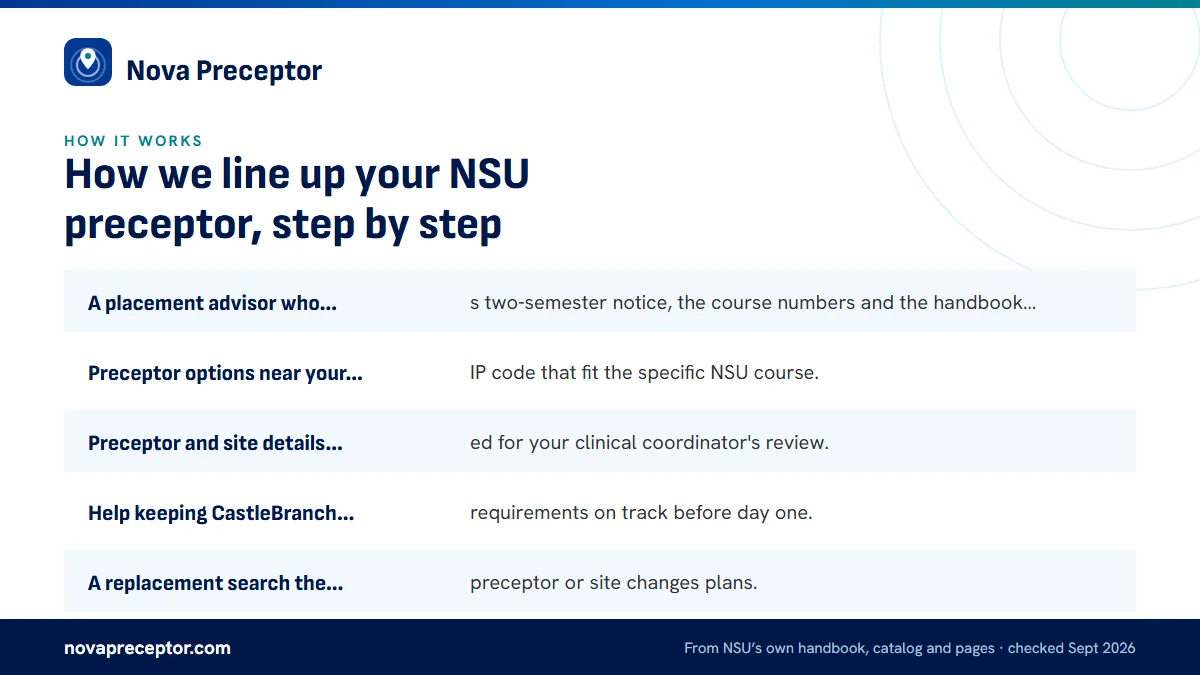
- A placement advisor who knows NSU's two-semester notice, the course numbers and the handbook rules.
- Preceptor options near your home ZIP code that fit the specific NSU course.
- Preceptor and site details organized for your clinical coordinator's review.
- Help keeping CastleBranch and site requirements on track before day one.
- A replacement search the moment a preceptor or site changes plans.
Students choose us because we plan around NSU's own timeline rather than a generic one, and because we stay with the placement through the semester, not just until a name is found. See the cost page for what shapes a quote.
When you are already late
If your clinical course is close and you have no preceptor yet, start today anyway. We move the search to the front of the queue, look wider around your home, and tell you plainly what the timing means under NSU's rules. The no preceptor yet guide lists what to do this week, and the 150-mile rule page explains NSU's own route if no preceptor is named.
Questions NSU students ask
How far ahead should I contact you?
Ideally a few months before your two-semester notice date, which itself falls two semesters before the clinical course. That gives time to find a preceptor who fits, confirm the Florida license and prepare the coordinator's details. Starting later still works; the search just runs on a tighter schedule.
Do you handle every clinical course or just the first one?
Every one. NSU's MSN tracks have four or five clinical courses and the BSN to DNP adds project practicum, and each needs its own preceptor or site named in time. We can plan the whole sequence at once so each notice is ready when it is due.
Can you find a preceptor who works around my job?
That is one of the main things we plan for. We ask which days you can give each week and look for preceptors whose clinic schedules match, because NSU expects clinical hours to run weekly through the semester rather than in a block.
What do I send the clinical coordinator?
The preceptor and site details NSU asks for, in the form your graduate clinical guide or coordinator describes. NSU does not publish its form names, so we organize the preceptor's license, credentials and site information and you pass them on through NSU's own process.
What happens if my preceptor cancels mid-semester?
Tell us the same day. We begin a replacement search near your home at once and help you tell your clinical coordinator, since NSU approves every preceptor and site. Missed clinical time must be made up under NSU's rules, so speed matters.
Related pages
Last checked 2026-09-25
We check these pages against NSU's own handbook, catalog and program pages. The graduate clinical guide, your course in Canvas, your clinical coordinator and your program director have the final word.
NSU lets you name your own preceptor. We make sure you have one, close to home and in time.
Tell us your NSU program, your home ZIP area and when your next clinical course starts. We find preceptors who fit the course and have everything ready for your clinical coordinator well before the two-semester notice.
- Preceptors matched to the course: primary care for FNP, acute care for AGACNP, psychiatric care for PMHNP, a practice site for DNP project hours
- Named early enough for NSU's two-semester notice, with license, credentials and site details ready for the coordinator
- Close to your home ZIP code, with clinic days we plan around your work schedule
Start your placement plan
Program, ZIP area and start term is all we need to begin.