Who can precept an NSU APRN student
NSU publishes one line on preceptor qualifications: your clinical coordinator checks each preceptor against NSU's supervision standard. The standard itself, from license type to years of experience, is written into the graduate clinical guide, a document NSU keeps internal. What you can pin down today is Florida's rule for Florida sites and the specialty each clinical course points to, and that is enough to build a strong shortlist.
Get a preceptor who fits your course
Tell us your NSU track, your next clinical course and your home ZIP area.
The one standard NSU publishes
The public rule is a single clause in the 2025-26 Nursing Student Handbook, in the section for graduate APRN students on printed page 123: the clinical coordinator confirms that the preceptor "meets NSU requirements for clinical supervision." A later sentence in the same section puts approval of the site and preceptor with the clinical coordinators. That is everything NSU prints about who may supervise a nurse practitioner student.
The same section explains why it stops there. It sends APRN students to the graduate clinical guide, which NSU names but keeps off its websites, and that is where the coordinator finds the criteria to apply. Our graduate clinical guide page covers how to get a copy.
For contrast, ACON does print a supervision rule for another program: a Ph.D. student's research mentor must be Ph.D.-prepared (printed page 140). No equivalent line exists for APRN preceptors in the handbook, either catalog or the program pages.
What the public record leaves out
In September 2026 we read every page of the handbook, both catalogs, the program pages and the likely NSU web addresses for a preceptor manual. None of these details appears anywhere public:
- The license type a preceptor must hold.
- A minimum number of years in practice, or in the specialty.
- How closely the preceptor's specialty has to match the course.
- Which clinicians may precept which course: nurse practitioner, physician, physician assistant, psychiatrist or someone else.
- Preceptor forms or packets, any preceptor agreement, and preceptor orientation.
- Whether a course can draw on more than one preceptor or site, and how hours would divide.
One related fact is public, though it concerns DNP admission rather than your clinicals: applicants document their earlier post-baccalaureate hours, including the total of preceptor-verified clinical hours, on the previous program's letterhead. NSU clearly counts precepted hours with care. It simply does not say, in public, who may do the precepting.
Florida's rule at a Florida site
When the site is in Florida, state law answers part of the question before NSU does. Board of Nursing rule 64B9-4.001(13) names four license types that can precept an NP student: APRNs who are certified and in practice, medical doctors, osteopathic physicians and dentists, each holding a Florida license. The same clause asks that you, the student, hold a chapter 464 RN license. Physician assistants do not appear in the definition.
Florida leaves experience minimums and student ratios open, so any higher bar comes from NSU. Our Florida preceptor rule page explains the rule clause by clause, compact RN licenses included.
Outside Florida, the practicum state's own rules take the place of Florida's, and NSU's graduate admission rules require your RN license to stay current in the jurisdiction of the practicum. The outside-Florida page covers that situation.
The specialty fit each clinical course implies
NSU's course titles name the population each clinical covers, and the preceptor should see that population every week. The coordinator decides what fits; this table is our reading of the titles and the preceptor profile that usually matches them.
| Course | NSU title | Preceptor whose practice fits |
|---|---|---|
NSG 5549, NSG 5559 | Primary Care Adult I and II Clinical (FNP) | A family or adult primary care NP or physician with a clinic caseload of adults |
NSG 5589 | Primary Care Pediatrics Clinical (FNP) | A pediatric or family NP, or a pediatrician, who sees children most days |
NSG 5569 | Primary Care Women Clinical (FNP) | A women's health NP, a family NP with a large women's health panel, or an OB/GYN physician |
NSG 5599 | Family Nurse Practitioner Capstone Clinical | A family practice preceptor seeing patients of every age |
NSG 5629, NSG 5639, NSG 5659 | Adult-Gerontology Acute Care I, II and III Clinical | An acute care NP or physician on a hospital service caring for adult and older adult inpatients |
NSG 5669 | Adult-Gerontology Acute Care Capstone Clinical | An acute care preceptor who can hand you a growing share of the service's patients |
NSG 5719, NSG 5729, NSG 5739 | Psychiatric Management I, II and III Clinical | A psychiatric-mental health NP or a psychiatrist; NSG 5729 runs beside NSG 5720, the child and adolescent course, so younger patients help |
NSG 5799 | Psychiatric Care Management Integration Capstone Clinical | A PMHNP or psychiatrist whose practice spans diagnosis, medication management and therapy |
Postgraduate certificate plans list some clinical hours under combined course numbers, such as NSG 5542, but the populations are the same. DNP project hours in NSG 7431 through NSG 7451 center on a project in a practice setting rather than on one patient population, and NSU does not publish who must supervise them; see the DNP project practicum page.
Questions to settle with your coordinator first
Because the criteria are unpublished, ask NSU before you ask a preceptor. A short SharkMail to your clinical coordinator, or twenty minutes with your copy of the graduate clinical guide, can save you a semester of chasing the wrong person.
- Which license types does NSU accept for this course: nurse practitioners only, or physicians as well?
- May a physician assistant precept any part of the course, given that Florida's rule leaves PAs out?
- Is there a minimum number of years in practice, or in the specialty?
- Must the preceptor hold national certification in the course population, such as family or psychiatric-mental health?
- For
NSG 5569andNSG 5589, may an OB/GYN or a pediatrician precept, or does it need to be an NP? - Can one course be split between two preceptors or two sites?
- What will the preceptor complete and sign for NSU, and when?
Keep the answers in writing. They become your checklist for every preceptor conversation that follows; the bring your own preceptor page covers how to approach one.
What we check before a name goes to NSU
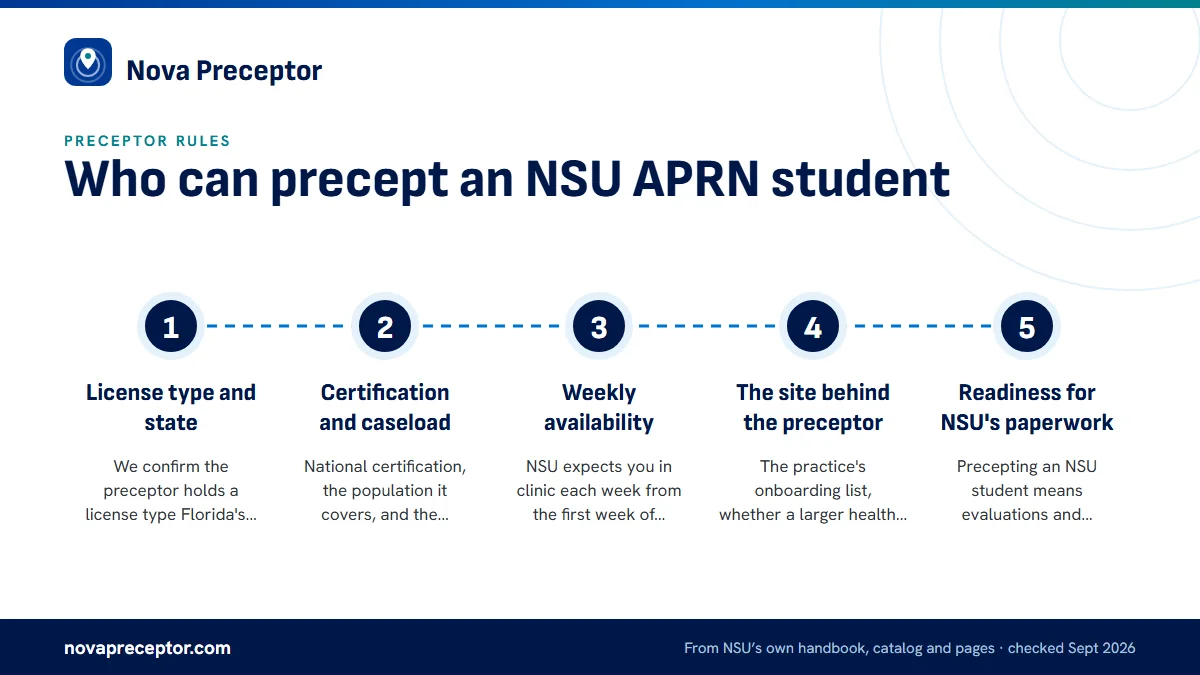
- License type and stateWe confirm the preceptor holds a license type Florida's rule accepts, active in Florida for a Florida site, and verify it on the state's public license lookup instead of relying on a photocopy.
- Certification and caseloadNational certification, the population it covers, and the patients the preceptor actually sees, matched against the course title.
- Weekly availabilityNSU expects you in clinic each week from the first week of didactic work, never packed into the term's opening or closing stretch. We confirm the preceptor can host you on a steady weekly schedule; see the weekly clinical hours rule.
- The site behind the preceptorThe practice's onboarding list, whether a larger health system requires a school agreement or a school-made request, and the drive from your home.
- Readiness for NSU's paperworkPrecepting an NSU student means evaluations and sign-offs as well as teaching. The preceptor hears that from us before agreeing.
- Your own license fitAt a Florida site your RN license has to fall under chapter 464. We check yours against the site before anything goes forward.
Why NSU students choose us for preceptors
Every match we make is built around the checks on this page. Your placement advisor shortlists preceptors near your home whose practice fits the exact course, from a pediatrician's office for NSG 5589 to an inpatient hospitalist service for NSG 5639, and screens each one for license, certification and weekly availability before you hear the name.
You receive a preceptor profile ready for your clinical coordinator well ahead of your notice date, together with the site's onboarding list. The coordinator makes the call; our part is a proposal that answers the coordinator's questions before they are asked. If a preceptor withdraws, we line up a replacement. Start with the form below or read how it works.
Questions NSU students ask
Can an MD or DO be my preceptor for an NSU course?
At a Florida site, Florida's rule counts Florida-licensed MDs and DOs as qualified preceptors for NP students. Whether NSU accepts a physician for a particular course is part of its unpublished supervision requirements, kept in the graduate clinical guide. Put the question to your clinical coordinator before contacting any physician, and keep the reply.
Can a physician assistant be my NSU preceptor?
Not as your qualified preceptor at a Florida site. Florida's rule lists certified APRNs, MDs, DOs and dentists and leaves physician assistants out. NSU's own criteria are not public, so if a PA works alongside your preceptor, ask your clinical coordinator whether any time spent with the PA can count toward your hours.
How many years of experience does my preceptor need?
Neither NSU's public documents nor Florida's rule set a figure. Any requirement would be in the graduate clinical guide, so ask your coordinator. In practice the preceptor's specialty and daily caseload matter as much as the years: the preceptor has to be able to supervise the course's population every week of the semester.
Does my preceptor need a Florida license?
If the clinical site is in Florida, yes. Rule 64B9-4.001(13) requires a Florida license under the chapter that matches the preceptor's profession. Outside Florida, the practicum state's rules apply, and NSU requires your RN license to stay current in that jurisdiction. NSU does not publish whether it approves sites outside Florida, so raise it with your coordinator early.
Can one preceptor cover my whole NSU clinical course?
NSU's public documents do not cap the preceptors or sites in a course, nor say whether hours can be divided. One preceptor per course keeps the weekly schedule and the evaluations simple, and it is the easiest arrangement to explain to a coordinator. Ask what your course allows before you plan around two.
Related pages
Last checked 2026-09-25
We check these pages against NSU's own handbook, catalog and program pages. The graduate clinical guide, your course in Canvas, your clinical coordinator and your program director have the final word.
- NSU Nursing Student Handbook 2025-2026, Graduate A.P.R.N. Students (printed p. 123)
- NSU Nursing Student Handbook 2025-2026, Ph.D. research mentor (printed p. 140)
- Ron and Kathy Assaf College of Nursing 2026-2027 Graduate Catalog
- NSU College of Nursing: graduate admissions
- Florida Administrative Code rule 64B9-4.001
NSU lets you name your own preceptor. We make sure you have one, close to home and in time.
Tell us your NSU program, your home ZIP area and when your next clinical course starts. We find preceptors who fit the course and have everything ready for your clinical coordinator well before the two-semester notice.
- Preceptors matched to the course: primary care for FNP, acute care for AGACNP, psychiatric care for PMHNP, a practice site for DNP project hours
- Named early enough for NSU's two-semester notice, with license, credentials and site details ready for the coordinator
- Close to your home ZIP code, with clinic days we plan around your work schedule
Start your placement plan
Program, ZIP area and start term is all we need to begin.