NSU clinicals outside Florida: what the rules say and what to confirm
NSU now runs its FNP and PMHNP master's tracks online, and its 2026-27 catalog asks those students for an unrestricted RN license current where the practicum takes place, not a Florida license. That opens the door to clinicals in other states, but NSU publishes little about how it works in practice. This page sets out what is published, what conflicts, and the questions to settle with NSU before you name an out-of-state preceptor.
Get your placement plan
Tell us your NSU program and your home ZIP area. A placement advisor replies with preceptor and site options near you that fit your NSU course.
Who this page is for
Two groups of NSU students run into these questions. The first lives outside Florida and studies the FNP or PMHNP track online, holding an RN license from their home state. The second lives in Florida but close to a border, around Jacksonville, Tallahassee or Pensacola, where the nearest good preceptor may practice in Georgia or Alabama.
Students in the AGACNP track and in the postgraduate certificates face a narrower path, because NSU's current sources still ask them for a Florida RN license. BSN students are placed by NSU near their campus and are not the audience here; see BSN clinicals instead.
What NSU publishes, and where it conflicts
NSU's graduate admissions page and its 2026-27 Graduate Catalog set the current license rule. AGACNP applicants need a current, unrestricted Florida RN license. FNP and PMHNP applicants need a current, unrestricted RN license with no state named, and every graduate student's license must stay current in the jurisdiction of the practicum for the whole program.
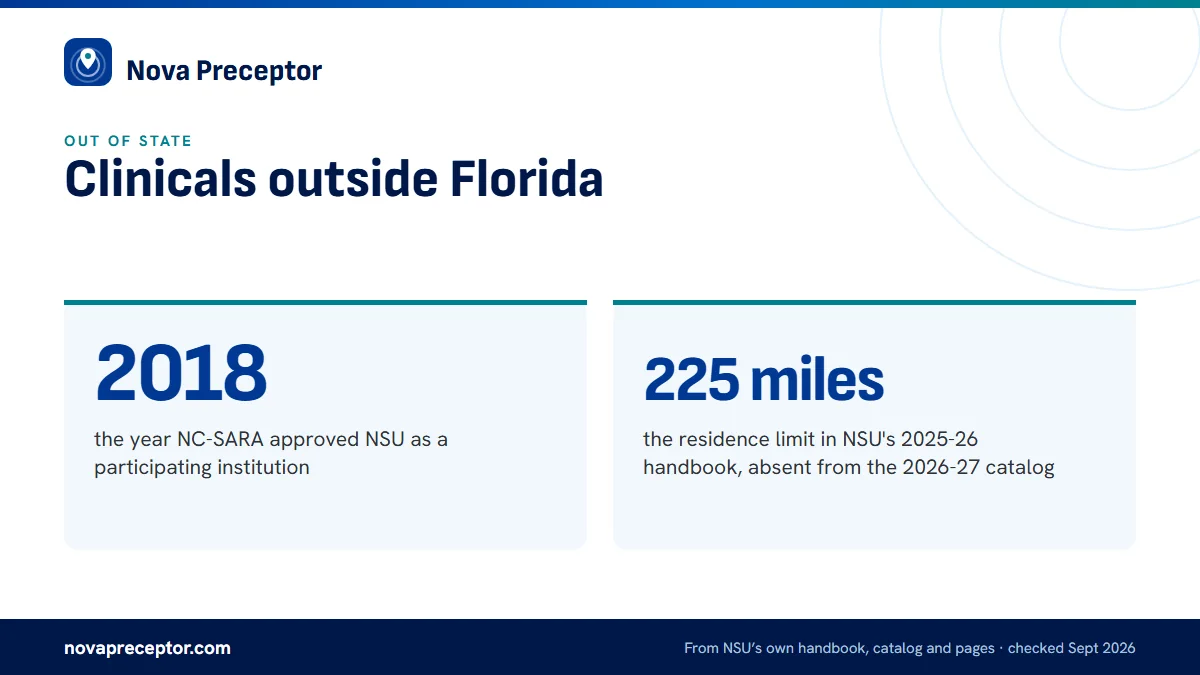
Older NSU sources point the other way. The Nursing Student Handbook 2025-2026 asks APRN entrants for a Florida RN license and says APRN students must live within 225 miles of their campus, a limit a July 2024 policy memo raised from 150. The certificates page still lists both the Florida license and the 225-mile residence rule. The 2026-27 catalog, the newest document, mentions no mileage rule at all.
NSU does not publish whether it places APRN students outside Florida, which states it holds clinical affiliation agreements in, or whether the 225-mile rule still binds students admitted under the new catalog. Those are questions for admissions and your program director, and the answer decides everything below. The 2026-27 changes page lays the old and new wording side by side.
| Source | RN license | Residence rule |
|---|---|---|
| 2026-27 Graduate Catalog and admissions page | Florida for AGACNP; any unrestricted RN for FNP and PMHNP, current where the practicum is | None stated |
| Nursing Student Handbook 2025-2026 | Florida for APRN entrants | Within 225 miles of campus |
| APRN certificates page | Florida | Within 225 miles of the program campus |
Your license in the state where you train
Whatever NSU confirms about residence, the license rule travels with you: your RN license has to be valid in the state where your clinical site sits. If you hold a multistate license under the Nurse Licensure Compact and the clinical state is a compact member, that license may already cover RN practice there. Ask your clinical coordinator whether NSU accepts it for the practicum rather than assuming.
The site's own state rules come on top. Florida, for example, requires a preceptor at a Florida site to hold a Florida license, and requires the NP student there to be an RN licensed under Florida's nursing chapter, as the Florida preceptor rule explains. Other states set their own terms for preceptors and for students from programs based elsewhere, so check the clinical state's board of nursing before you commit to a site.
NSU's SARA status and what it covers
NSU is a participant in the State Authorization Reciprocity Agreement. Florida's reciprocity council approved NSU to register in December 2017, and NC-SARA approved its participation on January 23, 2018. NSU's distance-education page notes that every state except California belongs to SARA, and that SARA has no effect on state professional licensure requirements.
SARA's policy manual treats supervised field experiences, which include clinical placements, in another SARA state as not creating a physical presence there. It also sets limits: without the host state's approval, no more than ten students from one program may be placed at one clinical site at the same time, and the host state's professional board rules still apply. NSU's own page tells students with state-authorization questions to contact their college adviser or NSU's Office of Licensure and State Relations.
NSU's licensure disclosure tables for the APRN programs list every state under meets educational requirements, with none under does not meet. That disclosure concerns the curriculum and licensure after graduation; it does not say where NSU can arrange or approve clinicals.
The 150-mile radius near state lines
NSU's rule for students who name no preceptor is a coordinator placement within 150 miles of the student's residential ZIP code. From the northern edge of Florida that radius crosses into neighboring states: a circle around Jacksonville reaches well into Georgia, and one around Tallahassee takes in parts of Georgia and Alabama. NSU does not say whether coordinator placements ever cross a state line.
If you live near a border and would rather train in Florida, or would prefer the closer practice across the line, naming your own preceptor is the way to decide it yourself. The 150-mile rule page explains how the coordinator route works.
Before you name an out-of-state preceptor
- Confirm with admissions or your program director that your residence fits the rules for your admission year.
- Ask your clinical coordinator whether NSU approves sites in your state, and how early it needs the details.
- Check that your RN license is valid in the clinical state, and whether NSU accepts a multistate compact license.
- Check the clinical state's board of nursing for rules on preceptors and on students from programs based elsewhere.
- Confirm your health insurance covers you where you train; NSU's handbook tells students with coverage from outside Florida to check their plan's reach.
- Keep your DISA CastleBranch items current, since an out-of-state site will ask for the same records plus its own.
The two-semester notice applies wherever the site is, so start these questions early. See the two-semester deadline for how to count it.
Why out-of-state NSU students choose us
Students outside Florida, and those on the border, come to us because the search has more moving parts: a preceptor who fits the NSU course, a license that works in the clinical state, and a site ready to host a student from a Florida program. We search where you live, check the preceptor's license and the state's rules before anything reaches NSU, and organize the details your clinical coordinator will want. NSU still decides whether the site and preceptor work for its program; our job is to hand over a match that answers the obvious questions up front.
Questions NSU students ask
Can I study NSU's online FNP from another state?
NSU's 2026-27 catalog calls the MSN APRN an online program and asks FNP and PMHNP applicants for an unrestricted RN license current where the practicum is, with no mileage rule. Its 2025-26 handbook still says APRN students live within 225 miles of campus. Confirm with admissions before you apply.
Does NSU need a Florida RN license for clinicals in another state?
Under the current admissions page, only AGACNP applicants need a Florida license; FNP and PMHNP need an unrestricted license current in the practicum's jurisdiction. The certificates page still asks for Florida. For a site in another state, your license has to be valid in that state.
Will NSU place me with a preceptor outside Florida?
NSU does not publish whether its clinical coordinators place APRN students outside Florida. The handbook's placement route is a site within 150 miles of your residential ZIP code. Ask your coordinator how that works where you live, or name your own preceptor in time.
Does SARA mean I can do clinicals in any state?
No. SARA lets NSU run distance programs and field experiences across member states without separate approval in each, but it does not change professional licensure rules, host states can limit placements, and California is not a member. NSU's own rules and the clinical state's board still apply.
Does NSU's licensure disclosure mean my state is fine?
The disclosure lists every state as meeting educational requirements for licensure after graduation. It says nothing about where NSU can approve clinical sites, so treat it as one piece of the picture and confirm clinical arrangements separately.
Related pages
Last checked 2026-09-25
We check these pages against NSU's own handbook, catalog and program pages. The graduate clinical guide, your course in Canvas, your clinical coordinator and your program director have the final word.
NSU lets you name your own preceptor. We make sure you have one, close to home and in time.
Tell us your NSU program, your home ZIP area and when your next clinical course starts. We find preceptors who fit the course and have everything ready for your clinical coordinator well before the two-semester notice.
- Preceptors matched to the course: primary care for FNP, acute care for AGACNP, psychiatric care for PMHNP, a practice site for DNP project hours
- Named early enough for NSU's two-semester notice, with license, credentials and site details ready for the coordinator
- Close to your home ZIP code, with clinic days we plan around your work schedule
Start your placement plan
Program, ZIP area and start term is all we need to begin.