Naming your own preceptor or taking an NSU placement: an honest comparison
NSU gives APRN students two ways into every clinical course. Propose your own preceptor and site early enough to give the clinical coordinator two semesters' notice, or let the coordinator choose for you, at a site up to 150 miles from home that the handbook calls not negotiable. Both end at an approved site. They differ in who decides where, when and in what kind of practice.
Take route one with a placement advisor
Tell us your track, ZIP code and next clinical course. We search near home, matched to the course.
Two routes, one approval
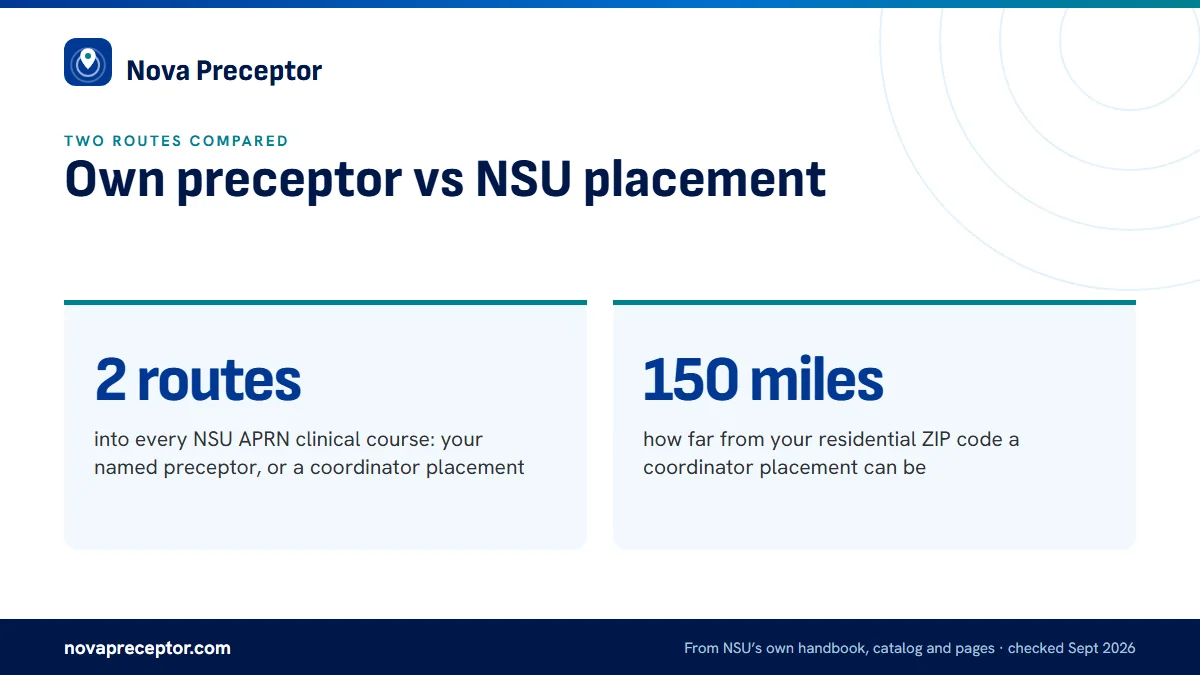
Both routes come from the same paragraph of NSU's Nursing Student Handbook, and both finish with a clinical coordinator approving the preceptor and site. The difference is who proposes them. On route one you do, and the coordinator tests your proposal. On route two the coordinator chooses, anywhere inside a 150-mile circle drawn around your home ZIP code.
Neither route skips NSU's standards, and neither is second best by definition. The comparison below sets them side by side so you can pick the one that fits your life, course by course. For the full sequence of steps, see the placement process.
The side-by-side
Everything in the right-hand column comes from the handbook's placement sentence or from what NSU leaves unpublished about it.
| Point | Route one: you name a preceptor | Route two: coordinator placement |
|---|---|---|
| Who finds the preceptor | You, alone or with help | The clinical coordinator |
| Distance from home | Wherever you choose, which can be minutes away | Anywhere within 150 miles of your residential ZIP code |
| Choice of setting | You pick the practice, within what the course requires | Set by the coordinator |
| Schedule fit | Agreed with your preceptor before you notify NSU | The site's clinic days and hours |
| Timing | Notice two semesters before each clinical course | Applies when nothing is requested in time; NSU publishes no placement timeline |
| Negotiability | You shape the arrangement before proposing it | Not negotiable once made, per the handbook |
| What you do | Search, secure the preceptor, notify, then paperwork and site visit | Wait for the assignment, then paperwork and site visit |
| Approval | Coordinator confirms preceptor and site | Coordinator chooses and approves |
Much stays the same either way. Hours begin in week one and run weekly, every absence is made up, CastleBranch and the site's own requirements must be cleared before day one, and at a Florida site the preceptor needs a Florida license (Florida's rule).
Who a coordinator placement suits
Route two works best for a student with room to adapt. If your job lets you move shifts, you are comfortable driving, you live where clinics and hospitals are plentiful, and you have no strong view on the practice within your specialty, a coordinator placement spares you the search. It is also the route that remains when a search has come up empty.
Go in knowing what NSU does not publish: how coordinators choose sites, how long an assignment takes, typical distances, and what happens if nothing turns up within 150 miles. The 150-mile rule page reads the rule closely, including the 225-mile residence rule it is often confused with.
Who naming your own preceptor suits
Route one suits anyone whose where and when are fixed: nurses on set shifts or rotating nights, parents working around school hours, students in rural counties or north Florida far from NSU's campuses, and online students outside Florida, where NSU has not said whether it places anyone (clinicals outside Florida).
It also suits students who care about setting: an FNP student who wants a practice with a busy pediatric panel, an AGACNP student aiming at a particular hospital service, a PMHNP student looking for child and adolescent experience before NSG 5729. The cost is effort and lead time, since each clinical course needs a preceptor named two semesters ahead (your notice date).
Why many working nurses take route one, with us
NSU's MSN APRN asks applicants for a year or more of recent hands-on clinical work, so most students arrive holding a nursing job. For them the weekly rule decides everything: clinical time every week from the first week, in courses of 95 to 285 hours, alongside work. A site an hour or more away, on days that clash with your shifts, is hard to sustain for a full semester, and the handbook leaves no room to renegotiate it.
That is the gap we close. Your placement advisor does the search that makes route one hard, near your home and matched to the course, with weekly days, total hours and semester dates settled before anyone is named. We assemble the preceptor and site details the coordinator reviews, track your CastleBranch items and the site's extras, and start a replacement search the day a preceptor drops out. The coordinator approves; we make route one the easy choice. How it works shows the steps.
Questions to settle before you choose
- Which days each week can you give to clinicals, for a whole semester, without breaking your work schedule?
- How far could you drive every week and still work and rest?
- Does a particular setting matter for the job you want after graduation?
- When is your next notice point, and how many clinical courses follow it?
- What has your clinical coordinator said about how the placement route works for your cohort?
If your answers point to route one, start early: use the placement request form, and a placement advisor lines the search up with your notice dates.
Questions NSU students ask
Is it better to find my own preceptor or let NSU place me?
It depends on how fixed your location and schedule are. A coordinator placement spares you the search but can fall anywhere within 150 miles of home and cannot be renegotiated. Naming your own takes effort and lead time but keeps the town, practice and days in your hands. Working nurses on set shifts often find route one easier to live with.
If NSU places me for one course, can I name my own preceptor for the next?
The handbook's notice rule works course by course, so you can propose your own preceptor for a later clinical by that course's notice date. The earlier placement stays as assigned for its own course. Ask your clinical coordinator how they handle a mix of routes across your program.
Will an NSU clinical placement be close to my home?
It may be, but the handbook makes no promise. It sets 150 miles from home as the ceiling, and NSU publishes no typical distance or selection method. A site near the edge of that circle can mean a long drive every clinical week.
Does using a placement service change how NSU approves my preceptor?
No. Your clinical coordinator reviews every preceptor and site against the same NSU requirements, whoever found them. A service changes how the search is run and how complete the file is when it reaches the coordinator, not who makes the decision.
Related pages
Last checked 2026-09-25
We check these pages against NSU's own handbook, catalog and program pages. The graduate clinical guide, your course in Canvas, your clinical coordinator and your program director have the final word.
NSU lets you name your own preceptor. We make sure you have one, close to home and in time.
Tell us your NSU program, your home ZIP area and when your next clinical course starts. We find preceptors who fit the course and have everything ready for your clinical coordinator well before the two-semester notice.
- Preceptors matched to the course: primary care for FNP, acute care for AGACNP, psychiatric care for PMHNP, a practice site for DNP project hours
- Named early enough for NSU's two-semester notice, with license, credentials and site details ready for the coordinator
- Close to your home ZIP code, with clinic days we plan around your work schedule
Start your placement plan
Program, ZIP area and start term is all we need to begin.