For preceptors: what hosting an NSU nurse practitioner student involves
Thank you for considering it. Precepting an NSU APRN student means steady weekly clinical time across one semester for one course, sized at 95, 190 or 285 hours, in the specialty the student's track needs. At a Florida site you need a Florida license as an APRN, MD, DO or dentist. We handle the matching and the paperwork so your part stays clinical.
Tell us about your practice
Choose "I'm a preceptor (not a student)", then add your specialty, location and the days you could host a student.
Who NSU's APRN students are
The students we place are registered nurses in NSU's Ron and Kathy Assaf College of Nursing, preparing for a Family, Adult-Gerontology Acute Care or Psychiatric-Mental Health NP role. They come through the MSN APRN, the postgraduate APRN certificates (for nurses with a master's in nursing already in hand), or the BSN to DNP. Admission to the MSN tracks asks for at least a year of current direct patient care, so your student arrives with bedside experience.
NSU now teaches the MSN online with short on-campus intensives, so students live in many parts of Florida, and FNP and PMHNP students may hold an RN license from another state. The clinical courses run in a fixed order, and each one needs a preceptor in the right setting for that course.
The courses you could precept
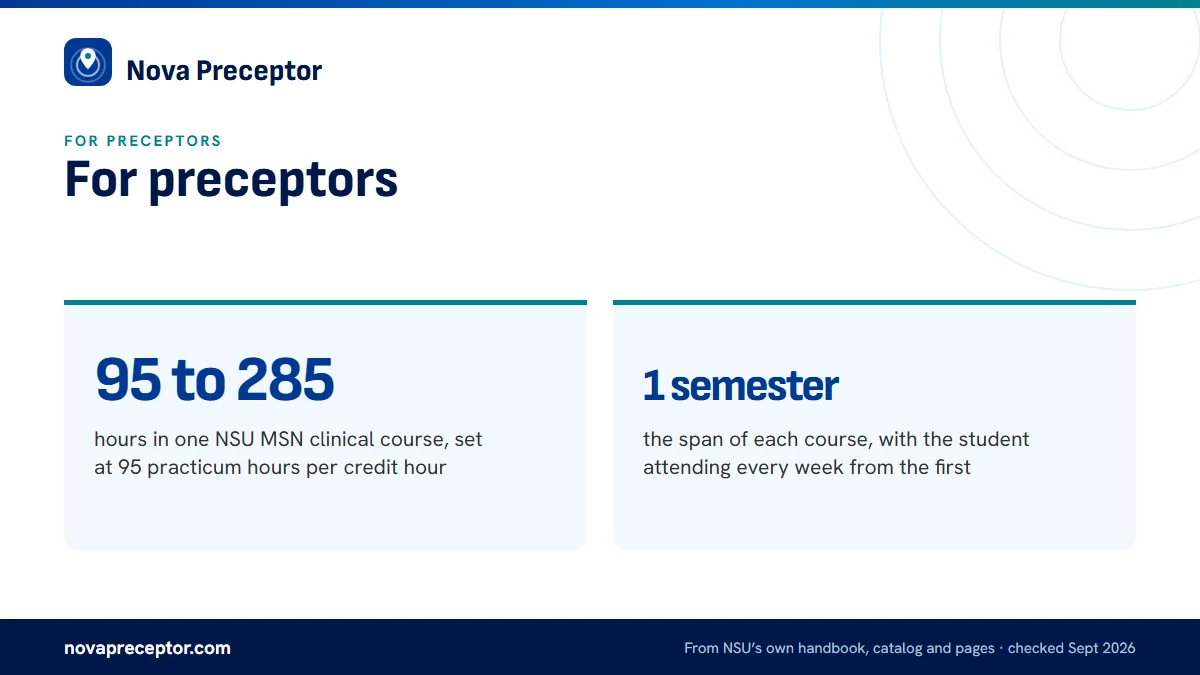
NSU sizes each MSN clinical at 95 practicum hours per credit hour, and the 2026-27 graduate catalog lists the resulting figures course by course:
| Track | Clinical course | Hours | Setting |
|---|---|---|---|
| FNP | NSG 5549 and NSG 5559 Primary Care Adult I and II Clinicals | 190 each | Adult primary care |
| FNP | NSG 5589 Primary Care Pediatrics Clinical | 95 | Pediatric primary care |
| FNP | NSG 5569 Primary Care Women Clinical | 95 | Women's health in primary care |
| FNP | NSG 5599 Family Nurse Practitioner Capstone Clinical | 285 | Family primary care |
| AGACNP | NSG 5629, NSG 5639 and NSG 5659, Acute Care I to III Clinicals | 190 each | Adult-gerontology acute care |
| AGACNP | NSG 5669 Acute Care Capstone Clinical | 285 | Adult-gerontology acute care |
| PMHNP | NSG 5719, NSG 5729 and NSG 5739, Psychiatric Management I to III Clinicals | 190 each | Psychiatric care; the second course's lecture covers child and adolescent mental health |
| PMHNP | NSG 5799 Psychiatric Care Management Integration Capstone Clinical | 285 | Psychiatric care management |
Certificate students and those on NSU's older plan may carry 85, 170 or 255 hours instead, and NSU's sources disagree on some certificate figures, so the student confirms the exact number for their course before you agree to it.
The weekly rhythm NSU expects
NSU's handbook sets one pattern for every APRN clinical. The student starts clinical hours when the course starts, attends every week, and may not pack hours into the first or last weeks of the semester. For you, that means a regular slot in your clinic week across the whole term rather than a short block.
As a rough guide (our arithmetic, not an NSU figure), a 190-hour course across a 16-week semester comes to about one 12-hour day a week, and the 285-hour capstone to about a day and a half. Shorter terms raise the weekly figure. The exact clinical weeks come from the student's course, and the weekly hours rule explains the reasoning.
If the student must miss a day, NSU asks them to tell you, the site and their program director at least two hours ahead, and every missed day is made up. Before hours start, the student also arranges to visit your site and meet you, as NSU requires.
Florida's qualified-preceptor rule
At a Florida clinical site, the Board of Nursing's rule 64B9-4.001(13) sets the test. Four license types can precept a nurse practitioner student: a certified APRN in active practice, a medical doctor, an osteopathic physician or a dentist, each holding a Florida license. The student's side of the rule is an RN license issued under chapter 464. Nothing in it fixes years of experience or how many students one preceptor may take. The Florida preceptor rule page has the detail.
Protocol and autonomous APRNs both pass that test. Most Florida APRNs work under a protocol with a supervising physician; since 2020, a primary-care APRN who meets the conditions of s. 464.0123, including 3,000 physician-supervised hours in the past five years, can register for autonomous practice instead. Because that registration exists only in primary care, FNP students are the likeliest to train with an autonomous APRN, as the protocol and autonomous APRN guide explains.
NSU then applies its own check: the clinical coordinator confirms each preceptor meets NSU's supervision requirements and the site suits the course. Those requirements live in the graduate clinical guide students receive, not on NSU's public site; the preceptor requirements page sets out what is known.
What the student brings: clearance before day one
NSU students keep their clearance records in DISA CastleBranch, which the college's Office of Student Affairs monitors. NSU requires every APRN student to have:
- A level 1 background check from acceptance, with a level 2 FDLE/VECHS fingerprint check added when a facility requires one.
- NSU's immunization list: hepatitis B series with a positive titer, annual influenza, MMR, annual TB testing by two-step PPD or blood test, Tdap and varicella.
- A physical examination on file and health insurance kept in force through the program.
- HIPAA education through NSU, and drug screening whenever required, including before entering a facility, under a zero-tolerance policy that extends to medical marijuana and marijuana-derived CBD.
Your site can add its own requirements, and NSU's handbook backs them: if a student has not met every facility requirement before the first scheduled day, the placement is canceled, and a student already placed is asked to leave. Students wear their NSU ID badge at every clinical and follow your site's dress code.
What we handle, and how to reach us
We keep the administrative side off your desk. The placement desk matches you only with students whose course fits your practice, confirms the dates and weekly days before you commit, and collects whatever NSU's clinical coordinator requests from you, such as license and credential details, in one clear ask. Before day one we check the student's clearance against your site's own list, and through the semester we help rearrange the schedule when a make-up day is needed. Your time goes to teaching and evaluating, the part only you can do.
To start, fill in the form below and pick "I'm a preceptor (not a student)" from the program list. Add your specialty, practice location, the days you could host and the course size that suits you: 95 hours, 190 hours or a full capstone. We reply with the NSU courses that fit your practice and when they next need a preceptor, and you decide on each student and term before anything is arranged. To see the process from the student's side, read how it works.
Questions NSU students ask
How many hours a week does precepting an NSU student take?
It depends on the course. NSU sizes its MSN clinicals at 95, 190 or 285 hours, spread weekly across one semester, which in a 16-week term is roughly 6, 12 or 18 hours a week by our arithmetic. The student's course sets the exact clinical weeks, and NSU does not allow hours to be crammed into the start or end of the term.
Can a physician precept an NSU nurse practitioner student?
Florida's rule allows it. At a Florida site, an MD or DO with a Florida license counts as a qualified preceptor for nurse practitioner students, alongside Florida-licensed APRNs and dentists. NSU's clinical coordinator then checks the physician against NSU's own supervision requirements and confirms that the site suits the course.
Do I need a Florida license to precept an NSU student?
At a Florida site, yes: the preceptor's license must be Florida-issued under the chapter that governs their profession. Outside Florida, the host state's rules and NSU's own requirements govern instead, and NSU expects the student's RN license to stay current wherever the practicum happens.
Can I share a student with a colleague or host part of a semester?
NSU does not publish whether a course's hours may be split between preceptors or sites, so the clinical coordinator decides course by course. What NSU does require is weekly attendance from the start of the course to the end, so any shared arrangement still needs a steady weekly schedule that the coordinator has approved.
How do I evaluate an NSU student?
NSU does not publish its preceptor evaluation forms; they reach you through the student's course and clinical coordinator. Florida's rule describes the preceptor's role as supervising, teaching and evaluating the student in the clinical setting, and NSU's course faculty will tell you what to complete and when.
Related pages
Last checked 2026-09-25
We check these pages against NSU's own handbook, catalog and program pages. The graduate clinical guide, your course in Canvas, your clinical coordinator and your program director have the final word.
NSU lets you name your own preceptor. We make sure you have one, close to home and in time.
Tell us your NSU program, your home ZIP area and when your next clinical course starts. We find preceptors who fit the course and have everything ready for your clinical coordinator well before the two-semester notice.
- Preceptors matched to the course: primary care for FNP, acute care for AGACNP, psychiatric care for PMHNP, a practice site for DNP project hours
- Named early enough for NSU's two-semester notice, with license, credentials and site details ready for the coordinator
- Close to your home ZIP code, with clinic days we plan around your work schedule
Start your placement plan
Program, ZIP area and start term is all we need to begin.