NSU's weekly clinical hours rule: start in week one, keep a steady pace
NSU's handbook sets three timing rules for APRN clinical hours. Your hours begin when the didactic course begins, you attend clinical every week, and you may not crowd hours into the opening or closing weeks of the semester. For a nurse who works full time, that means fixed clinic days, agreed with your preceptor and your employer before the term opens.
Plan clinic days that fit your job
Tell us your track, the clinical course, its start term and the weekdays you can give.
The three timing rules in NSU's handbook
The rules sit in the "Graduate A.P.R.N. Students" section of the Nursing Student Handbook 2025-2026, printed page 123. First, APRN students are expected to begin clinical hours at the same time as the didactic coursework. Second, clinical attendance is expected every week. Third, students may not compress hours at the beginning or the end of the semester.
NSU gives its reason in the same passage: weekly attendance lets the course content be fully integrated with practice. The week you study a topic in Canvas is meant to be a week you also see patients, so theory and clinic build on each other instead of sitting in separate blocks.
The wording is not new. The 2024-25 handbook carries the same APRN text, and an Internet Archive copy from March 2024 shows it in the 2023-24 edition. No 2026-27 handbook had been posted when we last checked, so the 2025-26 text is the current statement of the rule.
Week one starts before the semester does
Because hours begin with the course, everything that has to happen before your first clinical day has to happen before the semester opens. The same handbook passage asks you to submit all required paperwork before clinical hours start and to arrange a visit to the site to meet your preceptor, and it warns that skipping those steps may put your progression in the course and the APRN program at risk.
Your clinical coordinator also needs to have confirmed the preceptor and site before week one. NSU asks students with their own preceptor to report it two semesters before the course, and the stretch between that notice and week one is the time to finish paperwork, clear site requirements and settle a schedule. The clinical paperwork guide lists what tends to hold students up.
Weeks lost at the start cannot be won back in a final sprint. The no-compression rule closes the end of the semester as firmly as the beginning.
From course hours to a weekly load
NSU sizes each MSN clinical by credit, at 95 practicum hours per credit hour, so the 2026-27 graduate catalog lists 1-credit clinicals at 95 hours, 2-credit clinicals at 190 and the 3-credit capstone at 285. Certificate students and anyone on the older 2025-26 plan may see 85, 170 and 255 instead, so confirm your cohort's figure with your program director.
Divide the hours by the clinical weeks in your course and you have a weekly target. NSU does not post graduate term lengths, so take the dates from your course in Canvas. As a rough guide (our arithmetic, not NSU's), a 95-hour course fits in part of one clinic day a week, a 190-hour course needs about one full 12-hour shift in a 16-week term, and the capstone needs one and a half to two. The capstone clinicals page sets out average weekly hours by course size for 12, 14 and 16-week terms.
Two semesters weigh more than the hours alone suggest. FNP students take NSG 5589 (pediatrics) and NSG 5569 (women's health) together on both the full-time and flex plans, which is 190 hours across two preceptors in one term. And every capstone lands in your final semester, where the weekly figure peaks.
Planning clinic days around a nursing job
NSU's health-colleges section strongly discourages outside employment during regular terms. If you plan to keep working, build the schedule in this order, and redo it for every clinical course.
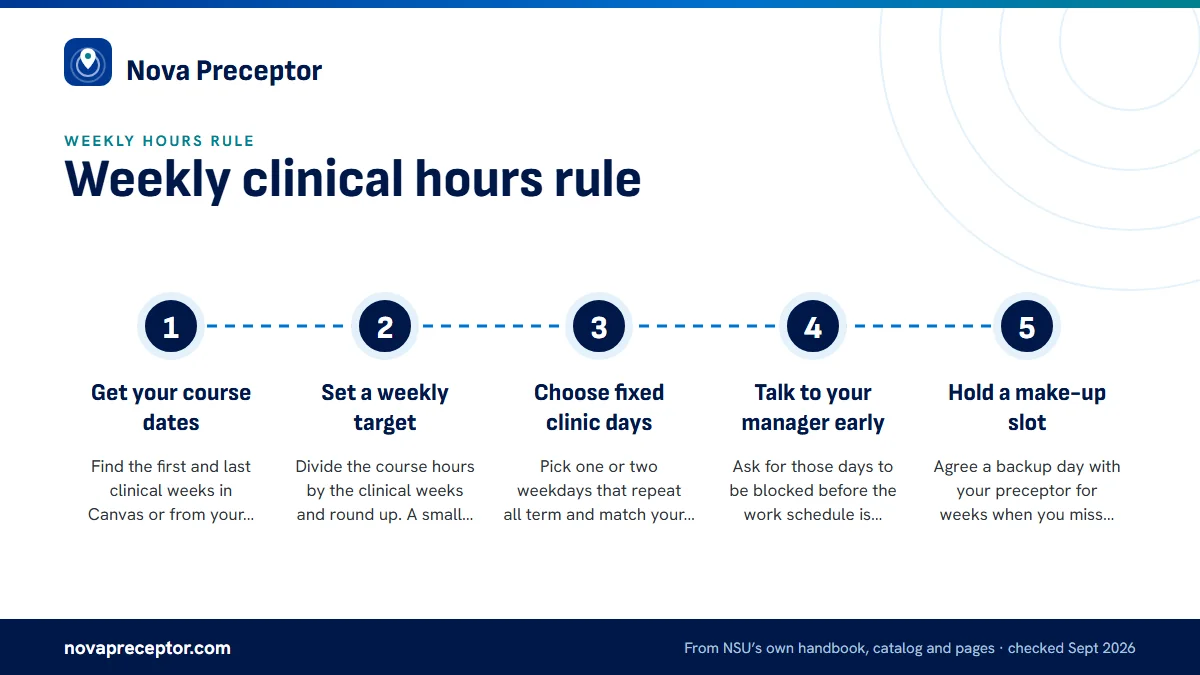
- Get your course datesFind the first and last clinical weeks in Canvas or from your course faculty, then mark your intensives. FNP students have 2-day intensives with
NSG 5542andNSG 5550, the lecture partners of their first two clinicals; AGACNP students have a 4-day intensive withNSG 5620, which runs besideNSG 5629. - Set a weekly targetDivide the course hours by the clinical weeks and round up. A small cushion each week is far easier to carry than a large deficit in week ten.
- Choose fixed clinic daysPick one or two weekdays that repeat all term and match your preceptor's clinic schedule. A standing day is easier for an employer to protect than a rotating one.
- Talk to your manager earlyAsk for those days to be blocked before the work schedule is written. If you work 12-hour shifts, ask whether your shifts can be grouped so the same weekday stays open each week.
- Hold a make-up slotAgree a backup day with your preceptor for weeks when you miss clinic. NSU requires every absence to be made up, and the clinical absences guide covers the notice rule.
- Recheck before each new courseHours, settings and preceptors change from course to course, so plan each semester fresh rather than carrying last term's schedule forward.
Full-time or flex: where the weekly rule bites
Both plans run the clinicals in the same order. What differs is the load around them. On the full-time FNP plan, NSG 5549 sits in semester III beside its 4-credit lecture course and NSG 5220; on the flex plan it moves to semester V with only its lecture partner. A lighter didactic load does not shrink the clinical hours, but it leaves more of your week for them.
Sequence matters too. The 2026-27 catalog expects MSN students to stay continuously enrolled, taking at least one graduate course each term, and the clinical courses run lock-step, so a clinical that ends short can hold up the next one. The full-time and flex plans guide compares the two schedules term by term.
What happens to progression when hours slip
Clinical hours feed straight into your grade and your next semester. The handbook says instructors grade on completion of all didactic and clinical objectives and on submission of clinical paperwork. To move into the next semester without restrictions, you must have satisfactorily completed every course and clinical requirement in the one before.
An incomplete is the usual safety valve, and it is narrow. You need to be passing, have at least half the coursework done and, in a clinical course, have met attendance expectations, so a student who stopped attending weekly may not qualify. Whatever remains must be finished within one semester of the course's end.
If the course is failed instead, the MSN passing mark is 80 points (B-) with no rounding, and a failure brings academic probation, a referral to the Committee on Student Progress (CSP) and possibly time out of sequence until the course runs again. If you are already short, behind on clinical hours sets out a recovery plan, and failing a clinical course covers what follows a failed grade.
Why working nurses plan their NSU schedule with us
A preceptor who fits the course but cannot host you every week does not fit NSU's rule, so weekly capacity is the first thing we ask about. Before anything reaches your clinical coordinator, your placement advisor confirms that the preceptor can take you on the same days each week, from the first clinical week to the last, at a practice near your home and at the pace your course needs.
We line up the paired FNP clinicals so both preceptors' days fit around your job, keep a backup day in view, and prepare the license, credential and site details the coordinator reviews, ready to name ahead of your two-semester notice. If a preceptor's schedule changes mid-term, we start on a replacement at once so your weekly hours keep moving. Tell us your course and the days you can give through the placement form.
Questions NSU students ask
Can I complete NSU clinical hours in 12-hour shifts?
NSU's public documents set no daily limit. The handbook's rules are about spread: start with the course, attend weekly and avoid crowding hours at either end. One 12-hour shift a week can fit that pattern for a 190-hour course in a 16-week term. Your preceptor's clinic hours and the graduate clinical guide decide the rest, so confirm the plan with your course faculty.
Can I start clinical hours before the semester begins?
The handbook ties the start of hours to the start of didactic coursework and describes no earlier hours. The time before the semester is better spent on what must come first: the coordinator's confirmation of your preceptor and site, your paperwork and the pre-clinical visit. If you have a specific reason to start early, ask your clinical coordinator.
What if I get ahead of my weekly target?
A little ahead is a cushion, not a problem, as long as you keep attending every week. The handbook's concern is compression, meaning hours bunched into the first or last weeks. Front-loading most of a course and then stopping would break the weekly-attendance expectation, so keep a steady presence at your site right through to the final week.
Does the weekly rule apply to DNP project hours?
The weekly and no-compression wording sits in the handbook's section for graduate APRN students, which covers the clinical courses BSN to DNP students take first. For the four 150-hour project courses, NSG 7431 through NSG 7451, NSU publishes no separate timing rule, so ask your DNP faculty how to spread project hours. The DNP project practicum page has the course detail.
Can my NSU clinical days fall on weekends?
No public NSU document limits clinical days to weekdays. What matters is that an approved preceptor is working at an approved site that day and that you attend every week. A preceptor with weekend clinic hours can fit that pattern; ask your clinical coordinator whether your course has any expectations about which days you attend.
Related pages
Last checked 2026-09-25
We check these pages against NSU's own handbook, catalog and program pages. The graduate clinical guide, your course in Canvas, your clinical coordinator and your program director have the final word.
- NSU Nursing Student Handbook 2025-2026: Graduate A.P.R.N. Students (printed p.123)
- NSU Nursing Student Handbook 2025-2026: grading and progression (printed p.101)
- NSU Nursing Student Handbook 2025-2026: incompletes (printed p.103)
- NSU Ron and Kathy Assaf College of Nursing 2026-2027 Graduate Catalog
- NSU Family Nurse Practitioner M.S.N.-A.P.R.N. program page
NSU lets you name your own preceptor. We make sure you have one, close to home and in time.
Tell us your NSU program, your home ZIP area and when your next clinical course starts. We find preceptors who fit the course and have everything ready for your clinical coordinator well before the two-semester notice.
- Preceptors matched to the course: primary care for FNP, acute care for AGACNP, psychiatric care for PMHNP, a practice site for DNP project hours
- Named early enough for NSU's two-semester notice, with license, credentials and site details ready for the coordinator
- Close to your home ZIP code, with clinic days we plan around your work schedule
Start your placement plan
Program, ZIP area and start term is all we need to begin.