Failed an NSU clinical course? What happens next
At NSU's College of Nursing a failed course, clinical or classroom, puts you on academic probation and sends your file to the Committee on Student Progress (CSP). You may have to sit out until the course runs again, you pay tuition a second time, and failing a second course can end your program. Here is the order things happen in, and how to keep your next clinical term on track.
Get your placement plan
Tell us your NSU program and your home ZIP area. A placement advisor replies with preceptor and site options near you that fit your NSU course.
What one failed course sets off
The handbook treats a failed clinical course exactly as it treats any other failed course. For MSN APRN and DNP students, failing means finishing under 80 points, with no rounding; the grading page has both scales. Once the grade posts, four things follow.
- Academic probation. “A student who fails any course in a program will be placed on academic probation.” Probation appears on your official transcript, and a student on probation is not cleared for graduation until it is lifted.
- A CSP referral. “Failing any course will result in referral to the Committee on Student Progress (CSP) and may lead to disciplinary action up to, and including, dismissal.”
- Lost time. A failure can stretch your program well past its planned length, or require you “to sit out a specified time frame from the program until the course is offered again.”
- Repeat tuition. “Students are charged additional tuition for repeated courses.” The handbook gives no amount, so ask the Office of the University Bursar what a repeat of your course will cost.
The ways a clinical course can be failed
A final score under 80 is the plain route, but the handbook names others that apply with particular force to clinicals. Moving ahead without restrictions depends on having “satisfactorily completed all courses and clinical requirements in the preceding academic semester,” and the same passage says “professionalism, maturity of thought, and/or academic performance” all count toward progression.
Safety is the sharpest edge. Care at the site has to be consistently safe, and the host agency's rules and the school's rules both apply; a student who falls short on either is removed from the clinical area and may be sent to the CSP. Compliance is another route: if a facility requirement is still missing on day one, NSU cancels the placement, and a student who has already started is asked to leave.
Then there is time. APRN students must submit all paperwork before hours start, begin hours when the didactic course begins, attend weekly, avoid bunching hours at either end of the semester, and make up every absence. The formula for the grade itself is set out in the syllabus posted to your Canvas course and in the graduate clinical guide, which NSU gives enrolled students rather than posting publicly. Read both in week one, and see the clinical absences page for the make-up rule.
Sitting out and repeating in a lock-step plan
NSU's MSN APRN curricula run in a fixed order, and the catalog expects you to stay enrolled in a graduate course every term. A failed clinical has to be repeated when NSU next offers it, which is why the handbook warns that you may have to sit out “a specified time frame” until then. NSU does not publish how often each clinical course runs, so ask your program director for the exact return term in writing.
The published plans show why one course can move several. In the full-time FNP plan, NSG 5549 (190 hours) comes in semester III and NSG 5559 follows in semester IV; the two 95-hour clinicals for children and for women come next, and the capstone closes the sequence. The AGACNP and PMHNP plans chain their clinicals the same way. The handbook also allows a clinical rotation to start only once every prerequisite course is complete, so a repeat can push each later clinical back, and with it the date by which each of those preceptors must be named.
Keep the clock in view as well. The handbook gives the MSN 150 percent of its normal length, or 11 semesters, and each extra semester spent on a repeat is drawn from that allowance.
The second failure
NSU's documents agree that a second failed course is where dismissal comes in, but they word it differently. The handbook says a student who fails two courses “may be dismissed with the second failure.” The 2026-2027 graduate catalog is firmer for both degrees: in the MSN, a second course below B- means the degree can no longer be completed and the student is dismissed, and in the DNP a student who fails two courses “will be dismissed with the second failure.”
Readmission after dismissal is another place where the handbook speaks two ways. It states that BSN, APRN, DNP and Ph.D. students, once dismissed, “will not be able to reenter the program,” and then describes a petition to the program director, with readmission at that director's discretion. If you are close to this point, ask your program director which reading applies to you before any decision is made.
Act on the first failure. The rules make a second one far more serious, so plan the repeat term with the same care you gave your first clinical.
Appeals, and the clinical you may not be allowed to start
You can contest a grade or a CSP outcome, and the CSP and CWAC appeals page sets out the steps and the five-business-day windows. One handbook sentence matters for clinical planning more than any other: “A student who appeals course failures may not be allowed to begin any clinical rotation during the appeal process.”
In practice, an appeal that overlaps the start of your next clinical course can hold that course back. Because hours start with the didactic course and cannot be compressed later, a late start is hard to recover. Tell your program director early that a preceptor is committed for the next course, ask whether you may begin, and let your preceptor know the start date could move.
Keeping a preceptor lined up for the repeat
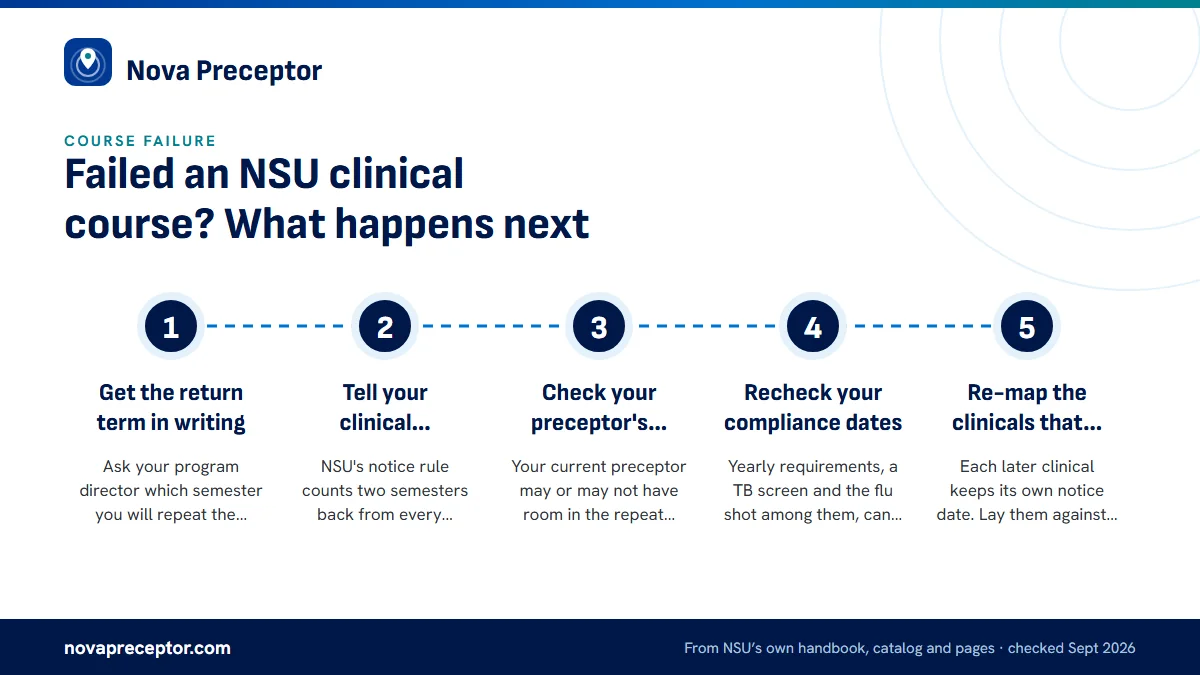
- Get the return term in writingAsk your program director which semester you will repeat the course in and which plan you will follow afterward. Use SharkMail, NSU's required channel for university business.
- Tell your clinical coordinator at onceNSU's notice rule counts two semesters back from every clinical course. A repeat may leave less time than that, so raise it right away and ask what the coordinator needs from you.
- Check your preceptor's availabilityYour current preceptor may or may not have room in the repeat term. Ask directly, and if the answer is uncertain, start on a second option now.
- Recheck your compliance datesYearly requirements, a TB screen and the flu shot among them, can lapse while you wait. Make sure DISA CastleBranch will show you current on day one of the repeat.
- Re-map the clinicals that followEach later clinical keeps its own notice date. Lay them against your new timeline so none arrives unplanned.
This is exactly the planning our placement desk handles for NSU students. We find a preceptor for the repeat term in the setting the course requires, prepare the license and credential details your coordinator checks, and keep a backup option ready while an appeal is open. The decision on each preceptor belongs to NSU's clinical coordinator; our part is a submission with nothing missing. Start with the request form, or see our guide for when a preceptor or site drops out.
Questions NSU students ask
Will a failed clinical course show on my NSU transcript?
Yes. Graduate failing grades count in your GPA, and the academic probation that follows any failed course appears on your official transcript. The handbook's transcript key also includes an E notation for a grade exempted from the GPA after a successful repeat; ask the registrar how that applies to your record once the repeat is done.
Can I start my next clinical while my appeal is pending?
Possibly not. The handbook leaves NSU room to hold back any clinical rotation while a course-failure appeal is under way. Because the rule says “may,” the answer can differ case by case, so ask your program director in writing before the term starts, and warn your preceptor that the start date could change.
Can I repeat a failed clinical with the same preceptor?
NSU's public pages are silent on that. What they make clear is that a clinical coordinator signs off on the preceptor and the site course by course, so handle the repeat as a new course: check whether your preceptor has room in the new term and give the coordinator notice as early as you can. A replacement preceptor needs the same sign-off.
Does failing one clinical course mean dismissal from NSU?
Not automatically. A first failure brings probation and a CSP referral, and the handbook's wording allows outcomes ranging from lesser discipline to dismissal, so the result depends on the committee's review and the decision that follows. The clearer dismissal line is a second failed course, which the graduate catalog says ends the MSN or the DNP.
How long will a failed clinical delay my graduation?
At least until NSU offers the course again, and NSU does not publish that schedule course by course. Because the MSN runs in a lock-step order, later clinicals can shift too. Ask your program director for a revised plan, then set it against your program's time limit; the leave of absence page lists each one.
Related pages
Last checked 2026-09-24
We check these pages against NSU's own handbook, catalog and program pages. The graduate clinical guide, your course in Canvas, your clinical coordinator and your program director have the final word.
- NSU Nursing Student Handbook 2025-2026: course failures (flipbook p. 112)
- NSU Nursing Student Handbook 2025-2026: probation and dismissal (flipbook p. 139)
- NSU Nursing Student Handbook 2025-2026: Graduate A.P.R.N. Students (flipbook p. 131)
- Ron and Kathy Assaf College of Nursing 2026-2027 Graduate Catalog
NSU lets you name your own preceptor. We make sure you have one, close to home and in time.
Tell us your NSU program, your home ZIP area and when your next clinical course starts. We find preceptors who fit the course and have everything ready for your clinical coordinator well before the two-semester notice.
- Preceptors matched to the course: primary care for FNP, acute care for AGACNP, psychiatric care for PMHNP, a practice site for DNP project hours
- Named early enough for NSU's two-semester notice, with license, credentials and site details ready for the coordinator
- Close to your home ZIP code, with clinic days we plan around your work schedule
Start your placement plan
Program, ZIP area and start term is all we need to begin.