NSU's B-minus rule: how graduate nursing grades work
In NSU's Ron and Kathy Assaf College of Nursing, graduate courses pass at 80 points, which is a B- on the master's scale and a B on the doctoral scale, and no grade is rounded up. MSN APRN students may repeat one course that falls below B-; a second such course ends the program. Here are both scales and what they mean for your clinical courses.
Get your placement plan
Tell us your NSU program and your home ZIP area. A placement advisor replies with preceptor and site options near you that fit your NSU course.
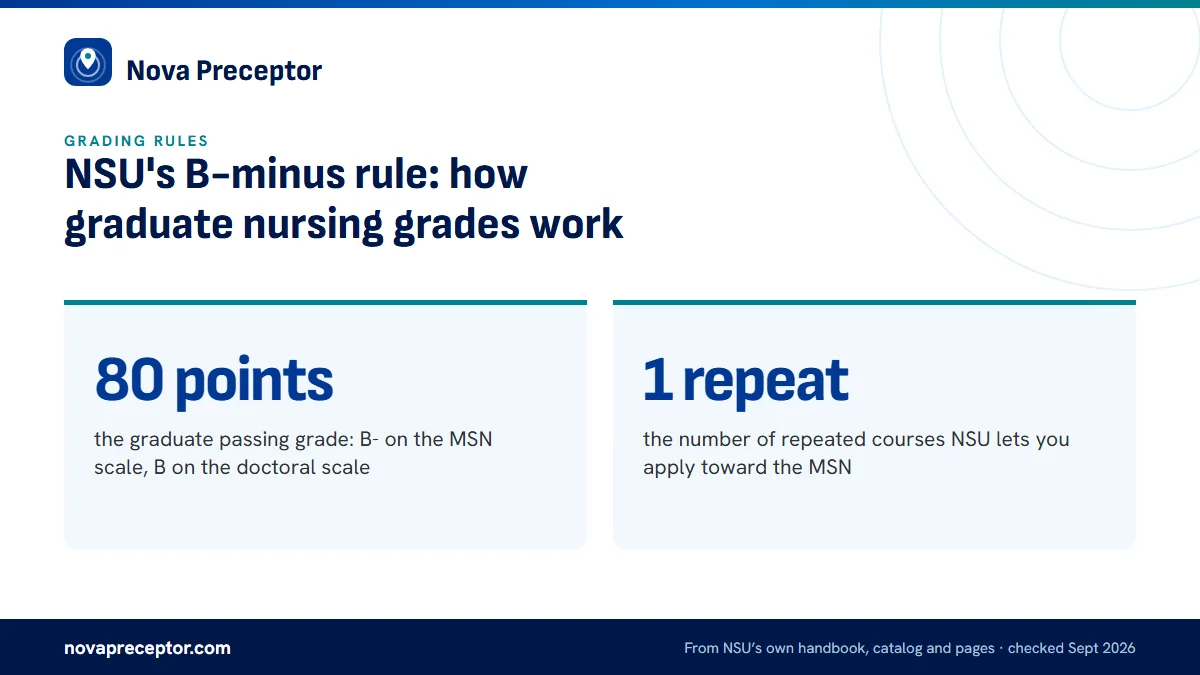
80 points is the graduate passing line
ACON scores every course from 0 to 100. The Nursing Student Handbook 2025-2026 sets two passing marks on that scale: 75 points for didactic courses in the BSN, and 80 points for the graduate programs. For the master's programs the handbook attaches the letter as well: “The passing grade for the Master's in Nursing Programs is 80 points (B-).”
The same page carries the sentence NSU students quote most: “There are no rounding of grades.” A final average of 79.7 stays 79.7. It does not become an 80, and it does not pass. Treat the last quiz, the last paper and the final exam as though every tenth of a point counts, because under this rule it does.
For graduate students a failing grade also stays in the grade point average; the handbook keeps its remediation notation, C(E), for undergraduate courses only. That matters at the finish line, where the MSN and the DNP both require a cumulative GPA of 3.0.
The MSN and doctoral scales side by side
The two graduate scales share one passing number and use different letters. The master's scale has the full run of pluses and minuses, with 80 to 83 as a B-. The doctoral scale, used for the DNP and the Ph.D., keeps only three letters, so every score from 80 to 89 is a B and anything under 80 is an F.
| Letter | MSN scale (points) | DNP and Ph.D. scale (points) |
|---|---|---|
| A | 94–100 | 90–100 |
| A- | 90–93 | not used |
| B+ | 87–89 | not used |
| B | 84–86 | 80–89 (lowest passing grade) |
| B- | 80–83 (lowest passing grade) | not used |
| C+ | 76–79 | not used |
| C | 75 | not used |
| C- | 70–74 | not used |
| F | below 70 | below 80 |
Read the table with two points in mind. An MSN score between 70 and 79 earns a C-range letter rather than an F, yet it sits under the B- floor and brings no credit toward the degree. A doctoral score of 79 drops straight to F. If you check these bands in NSU's online flipbook, note that its text layer loses the minus signs; the downloadable PDF of the handbook shows them.
BSN students work from a third scale in the same handbook, on which a C is 75 points and marks the passing line for didactic courses.
B- or better, and only one repeat, in the MSN
The graduate catalog turns the passing grade into a credit rule. The 2026-2027 catalog, repeating the 2025-2026 text, says: “All courses must be completed with a minimum grade of B- for credit to be received toward the M.S.N. degree.” A course may be repeated once after a grade below B-, and “only one repeated course can be applied toward the M.S.N. degree.”
The next sentence is the one to plan around: “A second course with a grade less than B- will preclude completion of the program and the student will be dismissed from the program.” The rule counts courses, not attempts. A low grade in NSG 5531 in your first year and another in NSG 5559 two semesters later make two courses below B-.
The MSN also runs as a lock-step sequence, and you are expected to stay enrolled in a graduate course every term. A repeat can therefore shift the courses that follow it in your plan, not just the one you retake. Repeated courses carry additional tuition, and the failed clinical course guide walks through the probation and Committee on Student Progress referral that come with the first low grade.
DNP courses need a B, and BSN to DNP students change scales
For the post-master's DNP and the BSN to DNP, the 2026-2027 catalog states: “Students are required to satisfactorily complete all required courses for the program with a grade of B or higher. A student who fails two courses in the program will be dismissed with the second failure.” DNP students must also stay continuously enrolled, and graduation requires a 3.0 GPA with no course below B.
BSN to DNP students sit on both scales. The handbook says their “5000-level courses are graded following the master's grading scale and 7000-level courses are graded following the doctoral grading scale.” In the FNP concentration, that puts NSG 5549 through NSG 5599 on the master's scale, where 80 is a B-, and the four project courses, NSG 7431 through NSG 7451, on the doctoral scale, where 80 is a B and the next step down is F.
The number you must reach stays at 80 across the switch; only the letter and the width of the band change. NSU's public documents do not spell out how the MSN one-repeat rule and the DNP two-failure rule combine for a dual-degree student. Ask your program director in writing, from SharkMail, before you register for any repeat, and keep the reply. The BSN to DNP FNP page shows where each course falls in the plan.
What the rule means for clinical courses
NSU lists each clinical as its own credit-bearing course (NSG 5549, NSG 5629, NSG 5719 and the other numbers ending in 9), and the catalog's B- minimum covers “all courses.” The handbook's general note on grading says instructors grade on completion of all didactic and clinical objectives and on submission of clinical paperwork. The detail of how a clinical course's grade is built is spelled out in its Canvas syllabus and in the graduate clinical guide the handbook points to. Neither is public, so read the syllabus in the first week.
The handbook's clinical rules show where a clinical grade is most exposed. Paperwork must be in before hours start, and the handbook warns that missing it can put your progress in the course, and in the program, at risk. Hours begin when the didactic course begins, run weekly, cannot be bunched at the beginning or end of the term, and every absence must be made up. A preceptor who starts late or steps away in week six turns those rules into a grade problem quickly. The weekly hours page explains the timing rule in full.
Protecting the one repeat you have
With a single repeat available in the MSN, a clinical term lost to logistics costs more than a semester. It spends your only margin. That is why NSU students choose to have their preceptor settled well before the course begins.
Our placement desk locates a preceptor close to home, in the kind of practice the course calls for, early enough for you to name them to your clinical coordinator two semesters ahead. We assemble what the coordinator reviews, the preceptor's license, credentials and site details, so nothing has to be chased. Once hours start we stay on call, and if your preceptor leaves partway through the term we work quickly on a replacement so the weekly schedule can keep going.
Approval of every preceptor and site stays with NSU's clinical coordinator, and the file we prepare is built to pass that review on the first read. Read how it works, or our steps for when a placement falls through.
Questions NSU students ask
Does NSU round a 79.5 up to an 80 in nursing courses?
No. The Nursing Student Handbook states, “There are no rounding of grades.” A graduate final average of 79.5 is under the 80-point passing line, so it does not pass. On the MSN scale it falls below B-, and on the doctoral scale it is an F. Watch your running average in Canvas through the term rather than counting on the last assignment.
Is a C a passing grade in NSU's MSN program?
No. On the master's scale a C is exactly 75 points and a C+ is 76 to 79, both under the B- floor of 80. The catalog awards MSN credit only for B- or better, so a C has to be repeated, and that repeat uses the one repeated course the MSN allows. A second course below B- ends the program.
What GPA do I need to graduate from NSU's MSN or DNP?
Both require a cumulative GPA of 3.0. The MSN adds that no course below B- may be applied toward the degree, and the DNP that no course may fall below B. Separately, the handbook says a student on academic or disciplinary probation will not be cleared for graduation until the sanction is lifted.
How do I dispute a grade at NSU's College of Nursing?
Start with a written dispute to your instructor, sent inside five business days and before any retake. If it stays unresolved, the program director or a designee is the next step, again on a five-day clock, and usually the last one. Formal appeals of a grade need evidence of discrimination, arbitrary or capricious action, or procedural irregularities. The appeals page walks through each stage.
Do BSN to DNP students need a B- or a B?
It depends on the course number. Any course numbered in the 5000s uses the master's letters, so a B- at 80 points passes; anything in the 7000 series uses the doctoral letters, where the lowest pass is a B covering 80 to 89. In points you are aiming for 80 either way, and a doctoral score below 80 goes on record as an F.
Related pages
Last checked 2026-09-24
We check these pages against NSU's own handbook, catalog and program pages. The graduate clinical guide, your course in Canvas, your clinical coordinator and your program director have the final word.
- NSU Nursing Student Handbook 2025-2026: grading scale (flipbook p. 110)
- NSU Nursing Student Handbook 2025-2026: passing grades (flipbook p. 109)
- Ron and Kathy Assaf College of Nursing 2026-2027 Graduate Catalog
- NSU Nursing Student Handbook 2025-2026: course failures and grade disputes (flipbook p. 112)
NSU lets you name your own preceptor. We make sure you have one, close to home and in time.
Tell us your NSU program, your home ZIP area and when your next clinical course starts. We find preceptors who fit the course and have everything ready for your clinical coordinator well before the two-semester notice.
- Preceptors matched to the course: primary care for FNP, acute care for AGACNP, psychiatric care for PMHNP, a practice site for DNP project hours
- Named early enough for NSU's two-semester notice, with license, credentials and site details ready for the coordinator
- Close to your home ZIP code, with clinic days we plan around your work schedule
Start your placement plan
Program, ZIP area and start term is all we need to begin.