NSU's Committee on Student Progress and College-Wide Appeals Committee
When something goes wrong academically at NSU's College of Nursing, two committees handle it. The Committee on Student Progress (CSP) investigates, holds a hearing and recommends, and your program director and the dean of Academic Programs decide. You then have five business days to appeal to the College-Wide Appeals Committee (CWAC), whose decision is final.
Get your placement plan
Tell us your NSU program and your home ZIP area. A placement advisor replies with preceptor and site options near you that fit your NSU course.
What brings a case to the Committee on Student Progress
The CSP is ACON's committee for academic and professional problems. The handbook sends students to it from several directions:
- A failed course. Any failed course, didactic or clinical, brings a referral, along with academic probation; see failing a clinical course.
- Unsafe clinical practice. When a student's care at a site is not reliably safe, or the host agency's rules are not followed, the student is removed from the clinical area and a referral can follow.
- Missed check-ins during leave. Students on leave must contact the program director every two months or risk a referral; the leave of absence page covers the rule.
- Academic dishonesty. The program director refers suspected dishonesty to a body the handbook calls the AHC, and the case moves to the CSP if dishonesty is found.
- Conduct. A behavioral track runs from warning to behavioral probation, which appears on the transcript, to behavioral dismissal, and a single serious act can lead straight to dismissal.
The handbook never spells out what AHC stands for. If your case starts there, ask your program director which committee it is and what it will review.
How a CSP hearing works
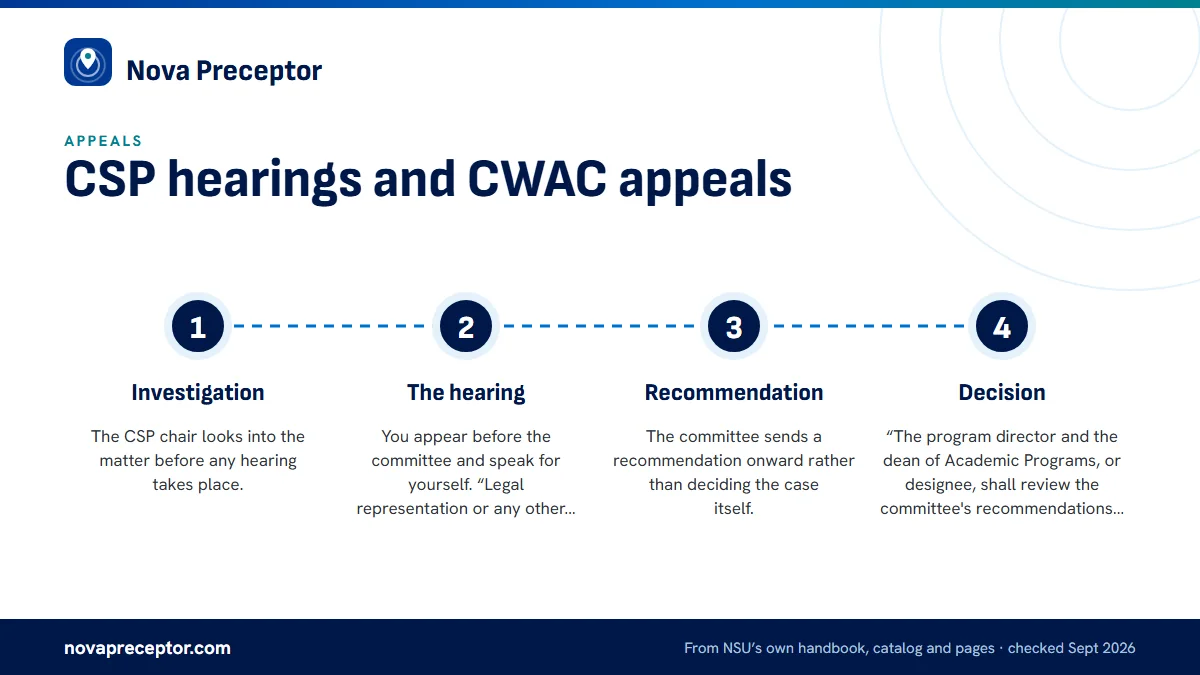
- InvestigationThe CSP chair looks into the matter before any hearing takes place.
- The hearingYou appear before the committee and speak for yourself. “Legal representation or any other form of representation is prohibited,” and “character witnesses are not permitted.”
- RecommendationThe committee sends a recommendation onward rather than deciding the case itself.
- Decision“The program director and the dean of Academic Programs, or designee, shall review the committee's recommendations, make a final decision” and notify you of it.
Since you cannot bring a representative or character witnesses, your written record does the talking. Gather what shows what happened: the syllabus, your grades and feedback, emails with faculty, your clinical coordinator and your preceptor, your hour records and any correspondence with the site. Put it in date order and bring copies for the committee.
Put every piece of evidence in front of the CSP. If you appeal, the College-Wide Appeals Committee looks only at evidence that was presented to the CSP.
Appealing to the College-Wide Appeals Committee
The handbook states: “Students have the right to appeal the decision within five business days of notification to the ACON's College-Wide Appeals Committee (CWAC).” Count business days from the day you are notified, and file early rather than on the fifth day.
The CWAC hears appeals of dismissal decisions and works from the record. It considers “only evidence which was presented to the CSP,” which is why the hearing stage carries so much weight: a document the CSP never saw has no place in the appeal.
The CWAC is also the last stop inside NSU. “All decisions of the Appeals Committee will be final and binding. No further option for appeal will be considered.” Prepare as though this is your one chance to be heard on appeal, because it is.
Grade disputes take a shorter path
A disagreement over a grade does not start at the CSP. The handbook gives it its own route: “Grievances and grade disputes must be in writing and directed to the course instructor within five business days prior to any retake.” If the instructor does not resolve it, you may forward the dispute to the program director, or designee, within five business days.
“The program director is the final appeal for all grade disputes, except in cases of potential dismissal.” The grounds are narrow too. Grades are “not subject to formal appeal unless there is evidence of discrimination, arbitrary or capricious action, and/or procedural irregularities.” A request for extra points without that kind of evidence falls outside the formal process, and because NSU does not round grades, a 79.6 stays below the graduate line of 80. The grading page shows both graduate scales.
The channel of communication, and complaints beyond grades
Before any committee, NSU expects problems to move up a set ladder. The handbook's channel of communication runs: (a) the course faculty member, for lecture or clinical courses; (b) your adviser, for issues that are not course-specific or if you are not comfortable with the faculty member; (c) the program director, with the assistant program director contacted first in nurse anesthesiology; and (d) the dean of Academic Programs. The who does what page describes each role.
Nonacademic grievances follow a similar ladder: the program director, then a written summary to the dean of Academic Programs, a meeting, and a written reply from the dean on the action taken. Only once NSU's internal steps are complete do the outside bodies the handbook lists come in: SACSCOC, the Florida Department of Education's Office of Articulation and, for non-instructional complaints about distance education, FL-SARA PRDEC.
Your clinical plan while a case is open
A pending appeal can reach your clinical schedule. Under the handbook, a student who is appealing a failed course can be held out of every clinical rotation until the appeal is settled; the failed clinical course page looks at that rule closely. Ask your program director in writing whether you may begin your next clinical course while your case is open, and keep your preceptor told of any change to the start date.
If a case ends in dismissal, the handbook points two ways on return. One passage rules out reentry for dismissed APRN and DNP students; another lets a dismissed student petition, leaving readmission to the program director. Ask which one governs your situation before you plan anything further.
When the outcome is a repeat or a later start, your preceptor plan has to move with it. NSU students use our placement desk to keep that plan alive: we confirm whether your preceptor can shift to the new term, line up a replacement near home if not, and prepare the credentials your clinical coordinator reviews, so the course can begin as soon as NSU clears you. Your clinical coordinator still signs off on the choice. Talk to the placement desk.
Questions NSU students ask
Can I bring a lawyer or advocate to a CSP hearing at NSU?
No. The handbook states that “legal representation or any other form of representation is prohibited” at a CSP hearing, and character witnesses are not permitted either. You present your own case, which is why a well-organized written record, with emails, grades, feedback and hour records, matters so much.
Can I give new evidence to the College-Wide Appeals Committee?
No. The CWAC considers only evidence that was presented to the CSP. Anything you want the appeal to weigh has to reach the CSP first, so bring every relevant document to the hearing, even the ones that seem minor at the time. Organize them by date so the committee can follow events in order.
Who makes the final decision after a CSP hearing?
The committee only recommends. Your program director and the dean of Academic Programs, or a designee, review the recommendation and decide. You may then appeal to the CWAC within five business days of being notified, and the CWAC's decision is final and binding with no further appeal inside NSU.
Does a CSP referral mean I will be dismissed?
Not necessarily. For a failed course, the handbook's wording covers everything from lighter discipline to dismissal, which leaves a range of outcomes. Dismissal is most directly tied to a second failed course. Prepare for the hearing as though the outcome is open, because under the handbook's wording it is.
How long do I have to dispute a grade in NSU nursing?
Five business days at each step. Your written dispute reaches the instructor first, and it must arrive before any retake. An unresolved dispute can move up to the program director or a designee on the same five-day clock, and that decision stands unless dismissal is on the table.
Related pages
Last checked 2026-09-24
We check these pages against NSU's own handbook, catalog and program pages. The graduate clinical guide, your course in Canvas, your clinical coordinator and your program director have the final word.
NSU lets you name your own preceptor. We make sure you have one, close to home and in time.
Tell us your NSU program, your home ZIP area and when your next clinical course starts. We find preceptors who fit the course and have everything ready for your clinical coordinator well before the two-semester notice.
- Preceptors matched to the course: primary care for FNP, acute care for AGACNP, psychiatric care for PMHNP, a practice site for DNP project hours
- Named early enough for NSU's two-semester notice, with license, credentials and site details ready for the coordinator
- Close to your home ZIP code, with clinic days we plan around your work schedule
Start your placement plan
Program, ZIP area and start term is all we need to begin.