Who does what at NSU when you're in a clinical course
At NSU's Ron and Kathy Assaf College of Nursing, a clinical coordinator approves your preceptor and site, course faculty run each clinical course, a faculty adviser keeps your plan of study on track, and your program director signs off on changes to it. Problems move up a fixed ladder the handbook calls the channel of communication. Here is every role by NSU's own title, what each one decides, and where each kind of question belongs.
Get your preceptor to the coordinator early
Tell us your NSU track, your home ZIP area and your next clinical course.
The clinical coordinator decides on preceptors and sites
NSU's HR title for this role is "Coordinator - Clinical Services"; the Nursing Student Handbook simply says "clinical coordinator." Several people hold the title on ACON's people directory, most of them also listed as Assistant Professor - Nursing.
The handbook's section for graduate APRN students (printed page 123) gives the coordinator four jobs:
- Receiving your notice, two semesters before each clinical course, that you have an identified preceptor and clinical site.
- Confirming that the preceptor "meets NSU requirements for clinical supervision" and that the site "provides the appropriate clinical experience."
- Placing you within 150 miles of your residential ZIP code when you have not named a preceptor, a placement NSU calls not negotiable.
- Hearing from you, along with the site, when you cannot attend a planned clinical day.
One sentence settles who approves: "Clinical site and preceptor are approved by clinical coordinators." The clinical coordinator page covers working with them, and the two-semester deadline page shows how to find your notice date.
Mentioning a preceptor to your course faculty or adviser is not the notice NSU's rule asks for. That notice goes to the clinical coordinator, because clinical coordinators approve every preceptor and site.
Course faculty and your faculty adviser
Course faculty are the first stop for anything inside a course, lecture or clinical: assignments, evaluations and grades. Courses run in Canvas, reached through SharkLink. To dispute a grade, the handbook says to write to the course instructor "within five business days prior to any retake." The faculty member, or the program director, also decides whether you qualify for an incomplete, which requires passing status and at least half the coursework done.
Every new student is assigned a faculty adviser before classes start "for academic and program progression." The adviser meets you each semester about the lockstep courses, reviews your Degree Works report with you each term and before graduation, and completes your registration at orientation once you accept the Student Enrollment Agreement (SEA). You also consult the adviser before withdrawing from a course.
Your program director signs off on changes
Each track has its own program director: FNP (Palm Beach and Tampa Bay), AGACNP (Palm Beach), PMHNP (Miramar and Tampa Bay), the DNP, and the Entry and Accelerated BSN programs. MSN applicants meet theirs at the admission interview. After that, the director's approval is what turns a request into a change:
- Dropping a nursing course, allowed only during drop/add and only with program director approval.
- Withdrawing from a course while passing (after consulting your adviser), and withdrawing from a clinical rotation, which needs the director's prior approval.
- Absences: the director is one of three people you notify two hours before a missed clinical. The absences page explains the make-up rule.
- Grade disputes the instructor does not resolve, forwarded within five business days; the director's word is final except where dismissal is possible.
- Check-ins every two months during a leave of absence.
- Referring suspected academic dishonesty to the committee the handbook calls the "AHC" (the acronym is never spelled out).
The dean and the associate deans
The dean of ACON heads the college. In the handbook, the dean can impose an administrative break in enrollment and closes out a nonacademic grievance by advising the student in writing, and the dean's office is where health-college students report any arrest or pending criminal charge within 10 days.
The Associate Dean of Academic Programs is the role the handbook calls the "dean of Academic Programs." That dean is the last rung of the channel of communication, reviews Committee on Student Progress recommendations with the program director before a final decision, and receives the written summary in a nonacademic grievance. The 2025-26 handbook also gives this dean campus-transfer decisions, though a 2023 policy change named the department chair; ask your program director which applies.
The Associate Dean of Academic Affairs, the Assistant Dean of Research (and Assessment), the Course Design Director and the Director of Assessment and Accreditation complete the leadership; the last is the contact printed on NSU's professional licensure disclosures.
The channel of communication, in order
The handbook (printed pages 116 and 117) sets the order in which you raise a problem. Start at the first rung that fits:
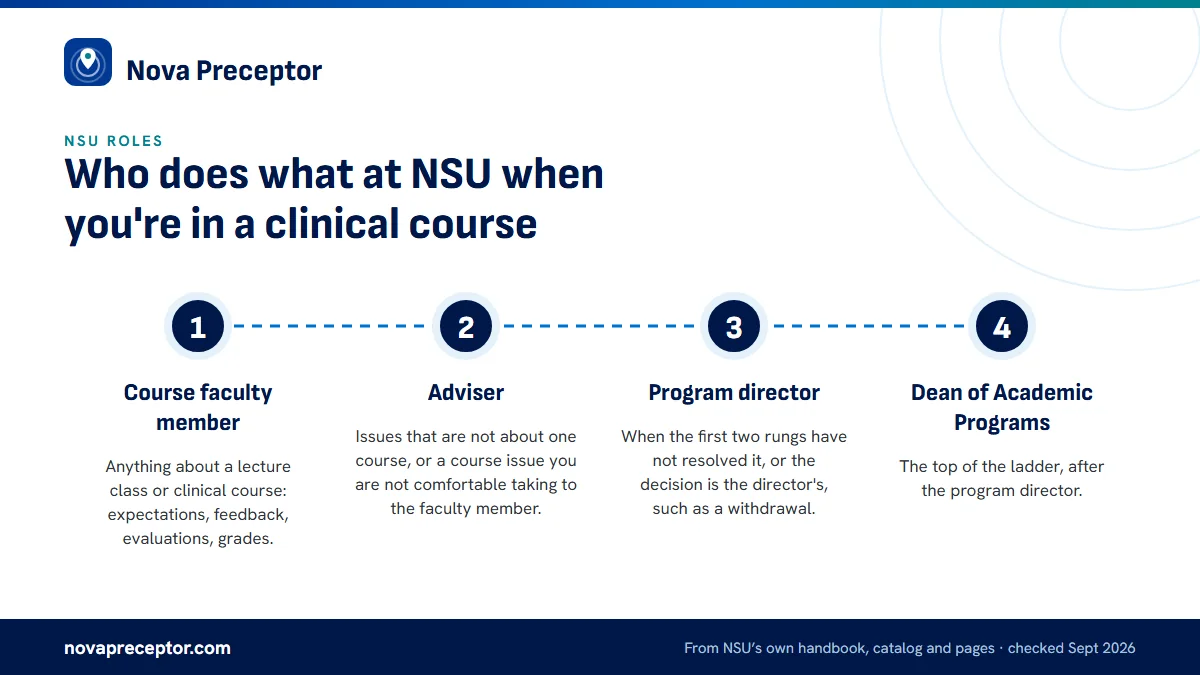
- Course faculty memberAnything about a lecture class or clinical course: expectations, feedback, evaluations, grades.
- AdviserIssues that are not about one course, or a course issue you are not comfortable taking to the faculty member.
- Program directorWhen the first two rungs have not resolved it, or the decision is the director's, such as a withdrawal.
- Dean of Academic ProgramsThe top of the ladder, after the program director.
Going straight to a dean skips the people the handbook expects to hear a problem first. Use SharkMail throughout: NSU requires university email for university business, and it keeps a dated record.
Offices and committees beyond your course
- ACON Office of Student Affairs (also called the Nursing Office of Student Affairs): monitors DISA CastleBranch and handles the health, drug-screen and background requirements. See the CastleBranch page.
- Committee on Student Progress (CSP): failing any course brings a referral here. The chair investigates and holds a hearing where legal representation and character witnesses are not allowed.
- College-Wide Appeals Committee (CWAC): you have five business days from notification to appeal; CWAC weighs only evidence the CSP saw, and its decision is final. During an appeal of a course failure you may be kept from starting a clinical rotation. See the CSP and CWAC page.
- Office of Licensure and State Relations: NSU's contact, alongside your college adviser, for state-authorization questions, including supervised field experience outside Florida.
- SharkIT Services / NSU Help Desk: your SharkLink sign-in, Canvas and SharkMail.
- One-Stop Shop (Horvitz Administration Building): ID badges, which regional-campus students can obtain online.
- Office of the University Bursar: home of the Student Health Insurance Plan.
Who to ask about what
| Your question | Start with | Worth knowing |
|---|---|---|
| I have a preceptor and site to propose | Clinical coordinator | Two semesters before the clinical course |
| I have no preceptor yet | Clinical coordinator | A placement inside a 150-mile radius of your home ZIP code |
| I will miss a clinical day | Preceptor, site and program director; also the clinical coordinator | Two hours' notice; every absence is made up |
| A clinical evaluation or grade | Course faculty | Then the program director within five business days |
| My plan of study or Degree Works | Faculty adviser | Reviewed with you each semester |
| Dropping or withdrawing | Adviser, then program director | Two withdrawals allowed per program |
| A CastleBranch item, immunization, drug screen or background check | ACON Office of Student Affairs | CastleBranch emails weekly reminders about missing items |
| A course failure or dismissal | CSP, then CWAC | Five business days to appeal |
| A clinical site in another state | Office of Licensure and State Relations or your college adviser | Raise the site with your clinical coordinator too |
| SharkLink or Canvas access | SharkIT Services | The NSU Help Desk |
Why NSU students choose us for the coordinator step
Of all the roles on this page, the clinical coordinator is the one your placement runs through, so that is where our work is aimed. We find a preceptor near your home whose practice suits the course (an FNP primary-care clinic for NSG 5549, a hospital service for NSG 5629, a mental health practice for NSG 5719), line it up well before your two-semester notice date, and gather what the coordinator checks: the preceptor's license and credentials, the site details and the specialty fit.
We track the site's requirements alongside your CastleBranch items and stay on call if a preceptor drops. Approval stays with the coordinator; what we control is the file they receive, complete, on time and built around NSU's rules. Begin with the form below or on the contact page.
Questions NSU students ask
Who approves my preceptor at NSU?
The clinical coordinators do. The 2025-26 handbook says clinical site and preceptor "are approved by clinical coordinators," once the coordinator confirms the preceptor meets NSU's supervision requirements and the site fits the course. At a Florida site, the state's rule also requires a Florida-licensed preceptor; see Florida's preceptor rule.
Is my faculty adviser the same person as my clinical coordinator?
They are different roles. The faculty adviser is assigned before classes start to guide your academic progression, meets you each semester and reviews Degree Works with you. The clinical coordinator, whose HR title is "Coordinator - Clinical Services," handles preceptor and site approval and places students who have not named a preceptor. Send preceptor questions to the coordinator.
What does the handbook mean by the "dean of Academic Programs"?
It is the handbook's short name for the Associate Dean of Academic Programs, one of ACON's associate deans. This dean is the fourth and last rung of the channel of communication, after course faculty, adviser and program director, and reviews Committee on Student Progress recommendations with the program director before a final decision is made.
Does NSU nursing have success coaches?
Not in any ACON document. Each new student gets a faculty adviser for academic and program progression, who meets with you every semester about the lockstep courses. NSU's Center for Academic and Professional Success (CAPS) serves undergraduates generally. For placement questions, go to the clinical coordinator.
Who do I contact about a clinical placement outside Florida?
NSU's distance-education page tells students with state-authorization questions to contact their college adviser or the Office of Licensure and State Relations. For the placement itself, the clinical coordinator decides whether a preceptor and site meet NSU's requirements. NSU's list of states with clinical agreements is not public, so ask early. The outside-Florida page has more.
Related pages
Last checked 2026-09-25
We check these pages against NSU's own handbook, catalog and program pages. The graduate clinical guide, your course in Canvas, your clinical coordinator and your program director have the final word.
- NSU Nursing Student Handbook 2025-2026, channels of communication (printed pp. 116-117)
- NSU Nursing Student Handbook 2025-2026, Graduate A.P.R.N. Students (printed p. 123)
- Ron and Kathy Assaf College of Nursing, people directory
- ACON Office of Student Affairs
- NSU distance education and state authorization
NSU lets you name your own preceptor. We make sure you have one, close to home and in time.
Tell us your NSU program, your home ZIP area and when your next clinical course starts. We find preceptors who fit the course and have everything ready for your clinical coordinator well before the two-semester notice.
- Preceptors matched to the course: primary care for FNP, acute care for AGACNP, psychiatric care for PMHNP, a practice site for DNP project hours
- Named early enough for NSU's two-semester notice, with license, credentials and site details ready for the coordinator
- Close to your home ZIP code, with clinic days we plan around your work schedule
Start your placement plan
Program, ZIP area and start term is all we need to begin.