NSU's BSN to DNP, FNP concentration: the sequence, the 1,455 hours and your preceptors
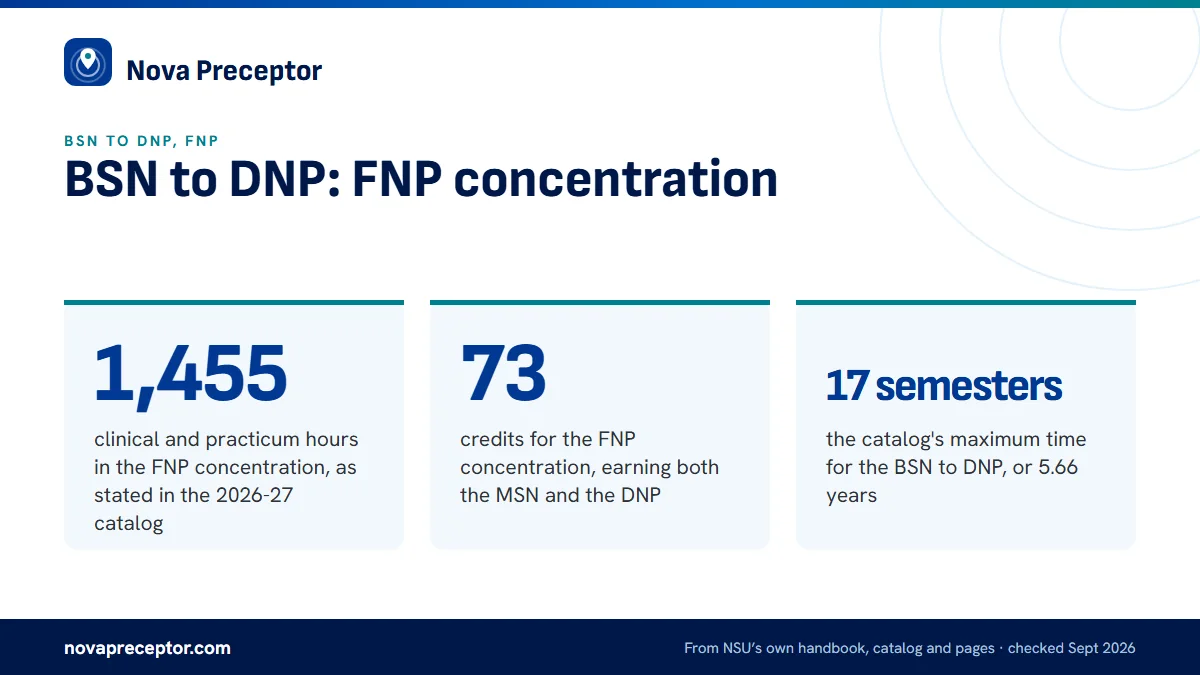
NSU's BSN to DNP with the FNP concentration is a 73-credit path that awards both the MSN and the DNP. The 2026-27 catalog counts 1,455 clinical and practicum hours: 855 in five family practice clinicals, then 600 across four DNP project courses. The clinicals run from the fourth to the seventh semester of NSU's sequence, so your first preceptor search starts almost as soon as you enroll.
Map your BSN to DNP preceptors
Give us your start term and home ZIP area. We plan every FNP clinical and your project site around NSU's timeline.
What the FNP concentration looks like
The BSN to DNP is NSU's integrated route for a nurse with a bachelor's degree who wants to become a family nurse practitioner and finish with a practice doctorate. Master's-level APRN courses and 7000-level doctoral courses are interleaved from the first semester, the family practice clinicals come in the middle, and the program closes with four DNP project courses.
Coursework is online. The FNP concentration adds three on-campus intensives, and every DNP project course includes one to two Virtual Intensive days. NSU admits to the program in fall and winter, with an August 1 deadline for fall and December 1 for winter on the program page. Admission follows the MSN's GPA and practice-experience rules and adds a writing sample in APA 7th edition style and an interview; the 2026-27 catalog also asks for a current, unencumbered US RN license and official documentation of all supervised postbaccalaureate practice hours.
The semester-by-semester sequence
This is the FNP sequence as NSU's BSN to DNP page lays it out, with clinical and practicum hours from the 2026-27 graduate catalog. Courses with a slash are a didactic course and its paired clinical course.
| Semester | Courses | Credits | Hours |
|---|---|---|---|
| I | NSG 7300 DNP Roles, Leadership, and Collaboration; NSG 5531 Advanced Pathophysiology | 3, 3 | none |
| II | NSG 5502 Advanced Health Assessment (intensive); NSG 5512 Diagnostic Reasoning; NSG 7350 Leadership in Complex Healthcare Systems | 3, 1, 3 | none |
| III | NSG 5220 Health Promotion and Disease Prevention; NSG 5510 Advanced Pharmacology | 3, 3 | none |
| IV | NSG 5542 / NSG 5549 Primary Care Adult I and Clinical (intensive) | 4, 2 | 190 |
| V | NSG 7131 Epidemiology Advancing Global Health; NSG 5550 / NSG 5559 Primary Care Adult II and Clinical (intensive) | 3, 4, 2 | 190 |
| VI | NSG 7135 Healthcare Information Systems and Outcomes Management; NSG 5580 / NSG 5589 Primary Care Pediatrics and Clinical; NSG 5560 / NSG 5569 Primary Care Women and Clinical | 3, 2, 1, 2, 1 | 95 + 95 |
| VII | NSG 7020 Healthcare Policy and Advocacy; NSG 7400 Nursing Science for Clinical Practice; NSG 5590 / NSG 5599 FNP Capstone and Capstone Clinical | 3, 3, 3, 3 | 285 |
| VIII | NSG 7431 Project I: Mentored Scholarship (3 didactic, 2 practicum) | 5 | 150 |
| IX | NSG 7444 Project II: Project Plan (2, 2) | 4 | 150 |
| X | NSG 7040 Biostatistics I; NSG 7445 Project III: Implementation (1, 2) | 3, 3 | 150 |
| XI | NSG 7451 Project IV: Evaluation (1, 2) | 3 | 150 |
| Total | 73 | 1,455 |
Semester VI is the busiest for placements: two clinicals at once, pediatrics and women's health, each needing its own fit. Our page on the FNP clinical courses describes what each of the five clinicals asks for.
How the 1,455 hours break down
The 2026-27 catalog states 1,455 clinical and practicum hours for each BSN to DNP concentration. For FNP, the clinical side is 190 + 190 + 95 + 95 + 285 = 855 hours, the same as NSU's master's FNP track, at 95 hours per credit. The project side is 150 hours in each of NSG 7431, NSG 7444, NSG 7445 and NSG 7451, which is 600; NSU's program page describes the rate as 2 practicum credits for 150 practicum hours.
Two other figures circulate. The BSN to DNP web page states more than 500 clinical hours each in the MSN and DNP portions, more than 1,000 in all, which is consistent with 1,455 but less precise. The 2025-26 catalog described an older 75-credit plan with 1,365 hours that included NSG 5571 Behavioral Health for Advanced Practice Nurses. If your acceptance letter or plan of study was issued under the older catalog, ask your program director which one you follow.
The project hours call for a practice site that can host your DNP project, and our DNP project practicum guide explains how those 600 hours work.
Intensives, format and the 225-mile question
For FNP, the BSN to DNP page marks three courses as intensives: NSG 5502 (2 days at Palm Beach), plus NSG 5542 and NSG 5550, which the master's FNP page schedules for 2 days each at Palm Beach or Tampa Bay. The project courses add one to two Virtual Intensive days apiece. Intensive dates are not published, so plan travel as soon as NSU gives you the dates; the on-campus intensives page collects what NSU does publish.
NSU's documents disagree about where you must live. The 2025-26 handbook and NSU's July 2024 "Miles from Campus" policy say APRN-route BSN to DNP students take the clinical courses in hybrid format and must live within 225 miles of their campus. The 2026-27 catalog says the clinical courses are online and states no mileage rule. The license rule moved too: the admissions page accepts any unrestricted RN license for FNP, while the 2025-26 handbook required a Florida license for every APRN entrant. See RN license rules for NSU clinicals and confirm your own case with the program director.
When to line up clinical preceptors and the project site
The handbook's placement rule applies to each APRN clinical course: tell the clinical coordinator about an identified preceptor and site two semesters before the course starts, or the coordinator places you within 150 miles of your residential ZIP code, and that placement is not negotiable. Counting back two program semesters from each clinical gives this pattern. The two-semester deadline page covers the exact term math.
| Clinical course | Semester | Hours | Notice falls at the start of |
|---|---|---|---|
NSG 5549 Primary Care Adult I Clinical | IV | 190 | Semester II |
NSG 5559 Primary Care Adult II Clinical | V | 190 | Semester III |
NSG 5589 Pediatrics Clinical and NSG 5569 Women Clinical | VI | 95 each | Semester IV |
NSG 5599 FNP Capstone Clinical | VII | 285 | Semester V |
So the search for your first family practice preceptor belongs in Semester I, while you are still in NSG 7300 and pathophysiology.
The project site runs on a different clock. The two-semester rule is written for APRN clinical courses, and NSU publishes no separate notice date for the practice setting that hosts your DNP project, nor who supervises those hours. Ask your DNP faculty during the capstone semester what they expect for NSG 7431, because Project I starts the very next term.
Four notice points fall inside your first five semesters. Put all of them in your calendar on the day you are admitted.
Grades and time limits across two degrees
The BSN to DNP runs two grading scales. The handbook grades 5000-level courses on the master's scale, where 80 points (B-) passes with no rounding, and 7000-level courses on the doctoral scale, where B is the minimum. The 2026-27 catalog's DNP rules ask for B or higher in all required courses, dismiss a student at the second course failure and require continuous enrollment; if you earn a B- in a 5000-level course, ask the program director which rule governs it.
A failed clinical course also triggers probation and a referral to the Committee on Student Progress, and it can push every later placement back a term; NSU's B-minus rule explains the details.
The catalog allows up to 5.66 years or 17 semesters to finish. The sequence above uses 11, so there is room for a delay, but every repeated or postponed clinical moves your notice points too.
Why BSN to DNP students choose us
A BSN to DNP student needs five FNP clinical placements in four semesters and then a practice setting for 600 project hours, all while carrying doctoral coursework. We plan the whole run at once. Your placement advisor maps each clinical to NSU's sequence, finds preceptors near your home for adult primary care, pediatrics, women's health and the capstone, and has each one named ahead of its notice point.
For every preceptor we assemble what the clinical coordinator checks: license, credentials, site details and the specialty fit. We keep your CastleBranch items and site requirements moving, we stay on call if a preceptor drops, and when the clinicals are done we help you find a practice site for the project hours. NSU's clinical coordinator gives the final approval of each preceptor and site, and what we send them is complete and fits NSU's rules. See how it works or use the form below.
Questions NSU students ask
Do I earn an MSN on NSU's BSN to DNP path?
Yes. NSU describes the BSN to DNP as an integrated path that blends MSN and DNP study and awards dual degrees. The master's-level FNP courses and clinicals match the MSN FNP track's course numbers and hours, and the doctoral courses and four project courses complete the DNP. Ask your program director when the MSN is conferred within your sequence.
How many clinical hours are in the BSN to DNP FNP concentration?
The 2026-27 catalog states 1,455: 855 in the five FNP clinicals (NSG 5549, NSG 5559, NSG 5589, NSG 5569, NSG 5599) and 600 in the four DNP project courses. The program page's shorter summary says more than 1,000. The older 2025-26 plan listed 1,365 hours over 75 credits.
Do BSN to DNP students have to live within 225 miles of an NSU campus?
NSU's sources disagree. The 2025-26 handbook and the 2024 Miles from Campus policy require it for students in the APRN clinical courses. The 2026-27 catalog describes the clinical courses as online and has no mileage rule. Until NSU publishes a new handbook, ask the program director which rule applies to your admit term.
Can my FNP capstone site also host my DNP project?
NSU's public documents do not address it. The capstone needs a primary-care preceptor for 285 clinical hours, while the project courses need a practice setting where your project can be planned, implemented and evaluated over four semesters. If one organization can do both, raise it early with your DNP faculty and your clinical coordinator.
How long can the BSN to DNP take?
NSU's sequence runs 11 semesters, and the 2026-27 catalog sets a maximum of 5.66 years or 17 semesters. Leave time within that limit counts too, and a failed or withdrawn clinical course can delay your next placement by a term or more.
Related pages
Last checked 2026-09-24
We check these pages against NSU's own handbook, catalog and program pages. The graduate clinical guide, your course in Canvas, your clinical coordinator and your program director have the final word.
- NSU B.S.N. to D.N.P. program page
- Ron and Kathy Assaf College of Nursing 2026-2027 Graduate Catalog
- NSU Nursing Student Handbook 2025-2026, graduate program formats (printed p.139)
- NSU Policy Change: Miles from Campus (July 3, 2024)
- NSU Nursing Student Handbook 2025-2026, graduate A.P.R.N. clinical rules (printed p.123)
NSU lets you name your own preceptor. We make sure you have one, close to home and in time.
Tell us your NSU program, your home ZIP area and when your next clinical course starts. We find preceptors who fit the course and have everything ready for your clinical coordinator well before the two-semester notice.
- Preceptors matched to the course: primary care for FNP, acute care for AGACNP, psychiatric care for PMHNP, a practice site for DNP project hours
- Named early enough for NSU's two-semester notice, with license, credentials and site details ready for the coordinator
- Close to your home ZIP code, with clinic days we plan around your work schedule
Start your placement plan
Program, ZIP area and start term is all we need to begin.