NSU's BSN to DNP, PMHNP concentration: 76 credits, four psychiatric clinicals, then the project
The PMHNP concentration is the longest of NSU's three BSN to DNP options at 76 credits, the extra 3 coming from NSG 5532 Neurobiology Psychopharmacology. Four psychiatric clinicals, NSG 5719 through NSG 5799, run through Semesters IV to VII for 855 hours; the project courses then bring the catalog total to 1,455. One of those clinicals centers on children and adolescents, which shapes the preceptor search from the start.
Plan your psychiatric clinicals
Share your start term and home ZIP area. We find PMHNP preceptors near you for each semester of the block.
Why the PMHNP concentration runs to 76 credits
NSU's BSN to DNP page lists the program at 73 to 76 credits. The difference is one course. PMHNP students take NSG 5532 Neurobiology Psychopharmacology in Semester III, a 3-credit course with no clinical hours, on top of the three Ps and the other APRN foundation courses. Everything else follows the shared design: MSN-level specialty courses, 7000-level doctoral courses, and four DNP project courses at the end, with both an MSN and a DNP awarded.
Hours do not change with the extra course. The catalog's 1,455 splits into 855 for the psychiatric clinicals (190, 190, 190 and 285) and 600 for the project sequence that runs from Project I to Project IV. NSU's web page rounds this to more than 1,000 hours, and the 2025-26 catalog showed an older 75-credit design with 1,365 hours.
The psychiatric clinical block
Each specialty semester pairs a 4-credit Psychiatric Management course with a 2-credit clinical, and the capstone pairs 3 and 3. Clinical courses end in 9, and NSU's catalog confirms those are the ones that carry the hours.
| Semester | Courses | Focus from the course title | Clinical hours |
|---|---|---|---|
| III | NSG 5532 | Neurobiology Psychopharmacology (didactic only) | none |
| IV | NSG 5710 / NSG 5719 | Psychopathology and the DSM V | 190 |
| V | NSG 5720 / NSG 5729 | Developmental theories for child and adolescent mental health | 190 |
| VI | NSG 5730 / NSG 5739 | Modalities of psychotherapy | 190 |
| VII | NSG 5790 / NSG 5799 | Psychiatric care management integration capstone | 285 |
| Total | 855 |
The titles are a useful guide to fit. Semester V calls for a preceptor whose patients include children and teenagers, Semester VI for one whose practice gives you real psychotherapy exposure, and the capstone for a setting that can hold you for 285 hours of integrated care. What NSU accepts for each is set out in its graduate clinical guide, which is not public, and your clinical coordinator confirms the fit. PMHNP clinical courses at NSU goes deeper on settings.
License, residence and practicing outside Florida
PMHNP applicants to the BSN to DNP need a current, unrestricted RN license, and NSU's current admissions page names no state, unlike AGACNP. Whatever state issued it, the license has to remain valid where your practicum takes place. The 2025-26 handbook still asked every APRN entrant for a Florida license, so read your acceptance terms closely.
Two distance rules also appear in NSU's documents, measured from different points. One is residential: the handbook and the 2024 policy memo set a 225-mile limit between an APRN-track student's home and campus, widened from 150 miles in earlier catalogs. The other governs placement: a student with no preceptor named is placed within 150 miles of the home ZIP code. The 2026-27 catalog drops the residence radius entirely and describes the clinical courses as online.
If you live outside Florida, NSU publishes no rule on out-of-state placements. Clinicals outside Florida collects what is known. Florida sites add a state layer, since the Board of Nursing's preceptor rule wants the preceptor and the student both licensed in Florida; see Florida's preceptor rule.
The intensive, and which campus it is at
The PMHNP concentration has one on-campus intensive, in NSG 5502 Advanced Health Assessment. The intensive table on NSU's BSN to DNP page lists it as 2 days at Palm Beach. The master's PMHNP page repeats that Palm Beach entry in its table but names Tampa Bay in its introduction, and the handbook's program list names Palm Beach, Miramar or Tampa Bay for BSN to DNP students. Confirm the campus when your NSG 5502 section is scheduled.
The project years add Virtual Intensive days, one to two per project course, held online. None of the intensive dates are published ahead of time. The on-campus intensives page keeps NSU's published schedule for every track in one place.
A preceptor calendar for Semesters I to VII
The handbook's rule gives each clinical course a notice point two semesters earlier: that is when you tell the clinical coordinator which preceptor and site you have. Without one, the coordinator places you within 150 miles of home, and the placement is not negotiable. The two-semester deadline page explains how to count it by term.
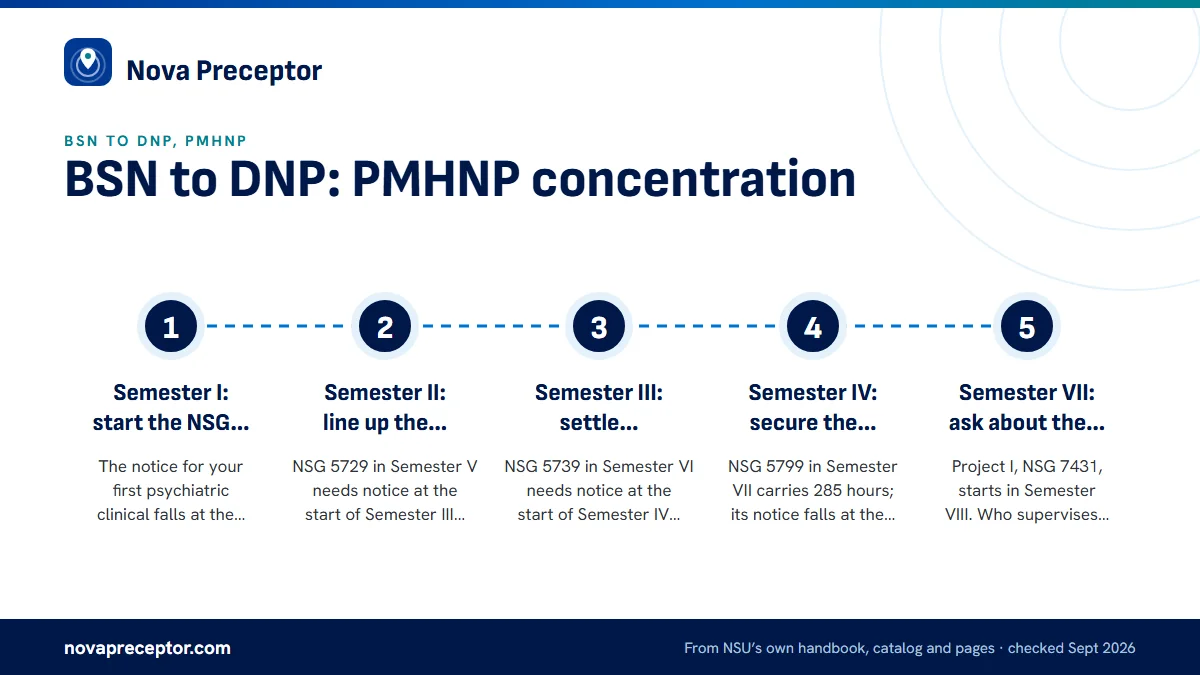
- Semester I: start the
NSG 5719searchThe notice for your first psychiatric clinical falls at the start of Semester II, so the first preceptor conversation belongs in your opening term. - Semester II: line up the child and adolescent fit
NSG 5729in Semester V needs notice at the start of Semester III. Search for a practice that treats young people, and bear in mind that Florida's s. 464.012 limits psychiatric controlled-substance prescribing for minors to APRNs who are psychiatric nurses. - Semester III: settle psychotherapy exposure
NSG 5739in Semester VI needs notice at the start of Semester IV. Name it while you are inNSG 5532. - Semester IV: secure the capstone
NSG 5799in Semester VII carries 285 hours; its notice falls at the start of Semester V, while your first clinical is under way. - Semester VII: ask about the project siteProject I,
NSG 7431, starts in Semester VIII. Who supervises project hours, and how the site is picked, is not in NSU's public documents, so bring it up with DNP faculty duringNSG 5790. Our DNP project practicum guide covers the 600 hours.
Grades and the time limit
Your 5000-level work, all four psychiatric clinicals and NSG 5532 included, follows the master's grading scale: 80 points is a B-, the lowest pass, and grades stay unrounded. Courses numbered in the 7000s follow the doctoral scale, with B as the floor. Because the 2026-27 catalog's DNP section wants a B in every required course and dismisses on a second failure, ask your program director how it treats a B- earned at the 5000 level.
You have up to 17 semesters (5.66 years) under the catalog. A failed or withdrawn psychiatric clinical can push later clinicals back, because re-enrollment in clinical courses depends on space, and failing any course also means academic probation and a CSP referral. NSU's B-minus rule sets out the grading detail.
Why PMHNP BSN to DNP students choose us
Psychiatric preceptors, and child and adolescent preceptors above all, reward an early, organized search. We run yours from Semester I. Your placement advisor finds a PMHNP-fit preceptor near your home for each of the four psychiatric clinicals, matched to the course's focus and named ahead of its notice point.
Each preceptor comes with the paperwork your clinical coordinator will review, from licensure and credentials to a summary of the practice and why it fits the course, and we clear the site's own requirements alongside your CastleBranch record. If a preceptor's availability changes, we source the next one, and after the clinicals we turn to a practice site for your project hours. The coordinator decides on every preceptor and site; our work is to give them a complete, rule-ready file to decide on. How we work has the details, and the form below gets you started.
Questions NSU students ask
Why is the PMHNP concentration 76 credits instead of 73?
It adds NSG 5532 Neurobiology Psychopharmacology, a 3-credit course in Semester III. The rest of the credit load matches the FNP and AGACNP concentrations, and the clinical and practicum hours are the same 1,455 in the 2026-27 catalog: 855 in the psychiatric clinicals and 600 in the DNP project courses.
Can I do BSN to DNP PMHNP clinicals outside Florida?
NSU's current admissions page asks PMHNP applicants for an unrestricted RN license without naming a state, and it must stay current where the practicum happens, which suggests a site in another state is possible. NSU publishes no out-of-state placement rule, though, and older documents still set a 225-mile residence limit from campus. Ask the program director before planning a site outside Florida.
Where is the PMHNP intensive for BSN to DNP students?
NSU's BSN to DNP page shows a single 2-day intensive at Palm Beach, attached to NSG 5502. The master's PMHNP page shows the same Palm Beach table but mentions Tampa Bay in its text. Confirm the campus with your program director once your course is scheduled, and expect Virtual Intensive days in each later project course.
Does the child and adolescent clinical need a special preceptor?
NSG 5729 pairs with Psychiatric Management II, whose title centers on child and adolescent mental health, so a preceptor with patients under 18 fits it. NSU's exact setting rules are in the graduate clinical guide, and the clinical coordinator confirms each fit. In Florida, only APRNs who are psychiatric nurses may prescribe psychiatric controlled substances to minors.
How long does the PMHNP BSN to DNP take?
NSU's sequence covers 11 semesters, with the psychiatric clinicals in Semesters IV to VII and the project courses in Semesters VIII to XI. The 2026-27 catalog's maximum is 5.66 years or 17 semesters, and leave time counts toward that limit.
Related pages
Last checked 2026-09-24
We check these pages against NSU's own handbook, catalog and program pages. The graduate clinical guide, your course in Canvas, your clinical coordinator and your program director have the final word.
NSU lets you name your own preceptor. We make sure you have one, close to home and in time.
Tell us your NSU program, your home ZIP area and when your next clinical course starts. We find preceptors who fit the course and have everything ready for your clinical coordinator well before the two-semester notice.
- Preceptors matched to the course: primary care for FNP, acute care for AGACNP, psychiatric care for PMHNP, a practice site for DNP project hours
- Named early enough for NSU's two-semester notice, with license, credentials and site details ready for the coordinator
- Close to your home ZIP code, with clinic days we plan around your work schedule
Start your placement plan
Program, ZIP area and start term is all we need to begin.