NSU PMHNP clinical courses and psychiatric settings
NSU's Psychiatric-Mental Health NP track has four clinical courses: NSG 5719, NSG 5729 and NSG 5739 at 190 hours each and the 285-hour NSG 5799 capstone. The didactic partners shape each one, with child and adolescent mental health in NSG 5720 and psychotherapy modalities in NSG 5730, so the preceptor who suits one course may not suit the next.
Get your placement plan
Tell us your NSU program and your home ZIP area. A placement advisor replies with preceptor and site options near you that fit your NSU course.
The four PMHNP clinicals and their partners
Each PMHNP clinical runs in the same semester as a Psychiatric Management didactic course, and that course sets the content your clinical hours should reflect. NSU's catalog gives each clinical its own credits and hours.
| Clinical course | Hours | Didactic partner in the same semester | Semester: full-time / flex / BSN to DNP |
|---|---|---|---|
NSG 5719 Psychiatric Management I clinical | 190 (2 credits) | NSG 5710 Psychiatric Management I: Psychopathology and the DSM V; full-time students also take NSG 5532 Neurobiology Psychopharmacology | III / VI / IV |
NSG 5729 Psychiatric Management II clinical | 190 (2 credits) | NSG 5720 Psychiatric Management II: Developmental Theories for Child and Adolescent Mental Health | IV / VII / V |
NSG 5739 Psychiatric Management III clinical | 190 (2 credits) | NSG 5730 Psychiatric Management III: Modalities of Psychotherapy | V / VIII / VI |
NSG 5799 Psychiatric Care Management Integration Capstone Clinical | 285 (3 credits) | NSG 5790 Psychiatric Care Management Integration Capstone | VI / IX / VII |
The PMHNP flex plan runs nine semesters, one more than FNP or AGACNP, so flex students reach NSG 5719 in semester VI. NSU's website marks NSG 5720 as the clinical in that flex plan; the 2026-27 catalog confirms NSG 5729 is the 190-hour clinical. The track's single intensive, NSG 5502, is listed at Palm Beach in the page's table but described as a Tampa Bay intensive in its text; the on-campus intensives page tracks that conflict.
What each course asks of the clinical site
NSU publishes no per-course site list; your clinical coordinator decides whether a site gives the right clinical experience for the course. The didactic titles point to what fits:
NSG 5719, psychopathology and diagnosis: a setting with a steady stream of psychiatric evaluations, where you practice DSM-based assessment and begin medication management whileNSG 5532covers psychopharmacology. Outpatient psychiatry practices and community mental health centers suit it well.NSG 5729, child and adolescent: the didactic course covers developmental theories for child and adolescent mental health, so a site that treats patients under 18 matches it: child and adolescent psychiatry practices, youth behavioral health programs, and community services for children and families.NSG 5739, psychotherapy modalities: a setting where psychotherapy is part of psychiatric care, such as a practice where the prescriber also provides therapy, or a program running individual and group therapy.NSG 5799, integration capstone: a site where you carry a full psychiatric caseload and bring diagnosis, prescribing and therapy together. It is a natural place to try the setting you want to work in after graduation.
Inpatient psychiatric units, crisis stabilization programs and certified community behavioral health clinics can each fit more than one of these courses. Whether NSU expects a mix of inpatient and outpatient hours is written in the graduate clinical guide, not on a public page, so ask before you plan four outpatient semesters.
Florida prescribing rules and the child and adolescent course
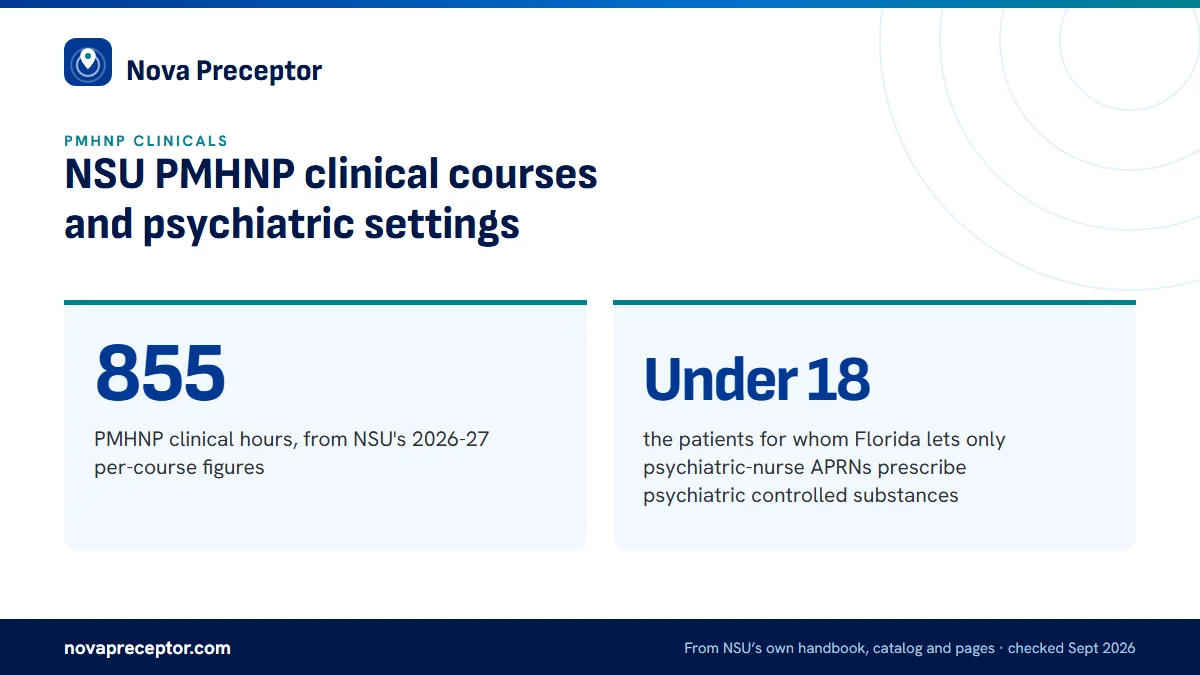
Florida law draws a line that matters for NSG 5729. Under section 464.012 of the Florida Statutes, psychiatric mental-health controlled substances for children under 18 may be prescribed only by APRNs who are also psychiatric nurses. The same section caps Schedule II controlled substances at a 7-day supply, with an exception for psychiatric medications prescribed by psychiatric nurses.
So at a Florida site, the controlled-substance side of child and adolescent psychiatry comes from psychiatric APRNs or physicians. A pediatric primary care office may manage common behavioral concerns, but when you need to learn controlled psychiatric prescribing for minors, the APRN preceptor has to be a psychiatric nurse. That is one more reason to line up a dedicated child and adolescent preceptor for NSG 5729 rather than stretching an adult or pediatric one.
Who can precept an NSU PMHNP student
At a Florida site, rule 64B9-4.001(13) treats a Florida-licensed APRN, MD or DO as a qualified preceptor and requires you to be an RN licensed under chapter 464. For PMHNP clinicals that usually means one of these:
- A psychiatric-mental health NP: the closest match to your future role, prescribing included
- A psychiatrist (MD or DO): including child and adolescent psychiatrists for
NSG 5729 - Another APRN or physician in psychiatric practice: if your clinical coordinator agrees the experience fits the course
Psychologists and licensed clinical social workers are not on Florida's list, so even in NSG 5739, where therapy is the focus, the preceptor of record at a Florida site is an APRN, MD or DO. NSU's own supervision requirements sit on top of Florida's and are not public; the coordinator confirms each preceptor meets them. The preceptor requirements page and the Florida preceptor rule go into detail.
Timing, license and where you live
Each preceptor and site is due to your clinical coordinator two semesters before its course. Full-time students therefore name the NSG 5719 preceptor in semester I and each later one a semester apart; flex students begin in semester IV, and BSN to DNP PMHNP students in semester II. The two-semester deadline page shows how to count it.
PMHNP is one of the two tracks that NSU's 2026-27 catalog opened to any unrestricted RN license, provided it stays current in the jurisdiction of the practicum. Older NSU documents still require a Florida license and residence within 225 miles of campus. Either way, your RN license has to be current in the state where your practicum site sits for every clinical day. If you live outside Florida, read clinicals outside Florida and confirm your situation with your program director.
Why PMHNP students choose us
Psychiatric preceptors are specialized, and your four courses ask different things of them. We plan all four together: a diagnostic and medication-management site for NSG 5719, a preceptor who treats children and adolescents for NSG 5729, a therapy-rich setting for NSG 5739 and a capstone site you would be glad to work at. Each is near your home ZIP code, Florida-licensed when the site is in Florida, and documented for your clinical coordinator before the two-semester notice. If a psychiatric preceptor's schedule changes mid-term, we find a replacement who fits the same course content, so your weekly hours continue without a gap.
Use the form below with your plan and first clinical semester, or start with the PMHNP program guide.
Questions NSU students ask
Does NSG 5729 have to be at a child and adolescent site?
NSU does not publish per-course site rules, but the paired didactic course is NSG 5720, Developmental Theories for Child and Adolescent Mental Health, so a site that treats patients under 18 matches the course. Your clinical coordinator decides whether the experience is appropriate; ask before you commit to a practice that sees adults only.
Can a psychologist or therapist precept my NSU psychotherapy clinical?
Not as the preceptor of record at a Florida site. Florida's rule limits qualified preceptors to Florida-licensed APRNs, MDs, DOs and dentists. A therapist can be part of the setting for NSG 5739, but the preceptor your clinical coordinator approves will be an APRN or physician who meets NSU's supervision requirements.
Can a psychiatrist be my PMHNP preceptor?
Florida's rule allows it: a Florida-licensed MD or DO qualifies as a preceptor for NP students at Florida sites, and psychiatrists suit every PMHNP course. Your clinical coordinator still confirms that the psychiatrist meets NSU's own supervision requirements, which sit in the graduate clinical guide rather than on NSU's public site.
Where is the NSU PMHNP intensive held?
NSU's PMHNP page says the track has one on-campus intensive at the Tampa Bay campus, but its intensive table lists NSG 5502 Advanced Health Assessment, 2 days, at Palm Beach. The certificates page places PMHNP at Miramar and Tampa Bay. Confirm the campus with your program director before booking travel.
How many clinical hours is NSU's PMHNP program?
855 by the 2026-27 catalog: 190 hours in each of NSG 5719, NSG 5729 and NSG 5739, and 285 in the NSG 5799 capstone. The PMHNP certificate appears as 765 hours on NSU's web pages and 855 in the catalog. The clinical hours hub compares every NSU program.
Related pages
Last checked 2026-09-25
We check these pages against NSU's own handbook, catalog and program pages. The graduate clinical guide, your course in Canvas, your clinical coordinator and your program director have the final word.
- NSU Psychiatric-Mental Health Nurse Practitioner M.S.N.-A.P.R.N. page
- NSU Ron and Kathy Assaf College of Nursing 2026-2027 Graduate Catalog
- NSU Nursing Student Handbook 2025-2026: Graduate A.P.R.N. Students
- Florida Administrative Code 64B9-4.001 (qualified preceptor)
- Florida Statutes s. 464.012 (APRN prescribing)
NSU lets you name your own preceptor. We make sure you have one, close to home and in time.
Tell us your NSU program, your home ZIP area and when your next clinical course starts. We find preceptors who fit the course and have everything ready for your clinical coordinator well before the two-semester notice.
- Preceptors matched to the course: primary care for FNP, acute care for AGACNP, psychiatric care for PMHNP, a practice site for DNP project hours
- Named early enough for NSU's two-semester notice, with license, credentials and site details ready for the coordinator
- Close to your home ZIP code, with clinic days we plan around your work schedule
Start your placement plan
Program, ZIP area and start term is all we need to begin.