NSU's PMHNP postgraduate certificate: 765 or 855 hours and the psychiatric sites behind them
NSU's PMHNP postgraduate certificate is 27 credits: NSG 5532 Neurobiology Psychopharmacology, three Psychiatric Management courses (NSG 5710, NSG 5720, NSG 5730) and the NSG 5790 capstone. NSU's web pages put its clinical hours at 765, while the 2026-27 graduate catalog puts them at 855. Either way, four courses need a psychiatric preceptor, one of them with child and adolescent content.
Line up your psychiatric preceptors
Tell us your start term and home ZIP area. We find PMHNP-fit preceptors near you for each clinical course.
What the PMHNP certificate includes
By credits, the PMHNP certificate is the largest of NSU's three postgraduate certificates. It opens with a 3-credit psychopharmacology course that carries no clinical hours in any NSU table, then four 6-credit psychiatric courses that combine class content with clinical time. NSU publishes two sets of hours for those four courses, shown side by side here.
| Course | Title | Credits | Hours: PMHNP page and certificates page | Hours: 2026-27 catalog |
|---|---|---|---|---|
NSG 5532 | Neurobiology Psychopharmacology | 3 | none | none |
NSG 5710 | Psychiatric Management I: Psychopathology and the DSM V | 6 | 170 | 190 |
NSG 5720 | Psychiatric Management II: Developmental Theories for Child and Adolescent Mental Health | 6 | 170 | 190 |
NSG 5730 | Psychiatric Management III: Modalities of Psychotherapy | 6 | 170 | 190 |
NSG 5790 | Psychiatric Care Management Integration Capstone | 6 | 255 | 285 |
| Total | 27 | 765 (our sum) | 855 (our sum) |
Titles in the table are the full course names from NSU's PMHNP program page, where the same course numbers appear.
765 or 855: two hour tables for one certificate
The web figures follow NSU's older structure, in which a 6-credit course carries 170 clinical hours and a 6-credit capstone 255. The 2026-27 catalog uses the newer master's-track figures, where a 2-credit clinical carries 190 hours and a 3-credit capstone clinical 285, so each psychiatric course rises to 190 hours and the capstone to 285. The gap is 90 hours, about half of one full course's clinical time.
The catalog's summer plan goes a step further. It splits each course into a didactic course and a clinical course, so NSG 5710 pairs with NSG 5719, NSG 5720 with NSG 5729, NSG 5730 with NSG 5739 and NSG 5790 with NSG 5799, again totaling 855 by our count, with NSG 5532 at the front.
NSU has not said which table binds a given cohort, and your formal gap analysis can waive coursework or hours on top. Get the figure for your own plan from the program director before a preceptor commits to a weekly schedule. Our certificate gap analysis guide sets the PMHNP numbers beside the other two tracks, and the 95-hours-per-credit page explains the rate change.
Psychiatric settings for each course
The clinical coordinator confirms that each site provides the appropriate clinical experience, and the rules for what counts sit in NSU's graduate clinical guide, which is not public. The course titles still tell you what each preceptor will be asked to support: NSG 5710 centers on psychopathology and DSM diagnosis, NSG 5720 on the mental health of children and adolescents, NSG 5730 on psychotherapy modalities, and the NSG 5790 capstone on integrated psychiatric care management.
NSG 5720 asks for the most specific fit. A preceptor whose caseload includes children and adolescents matches its title, and Florida adds a wrinkle: s. 464.012 lets an APRN prescribe psychiatric controlled substances to a minor only if that APRN is also a psychiatric nurse. That matters when you weigh an APRN preceptor for the child and adolescent course. PMHNP clinical courses at NSU covers settings course by course.
Florida's qualified-preceptor rule, 64B9-4.001(13), accepts physicians as well as APRNs (and dentists) at a Florida site, provided the license is a Florida one, so a psychiatrist can meet the state standard just as a psychiatric NP can; Florida's preceptor rule has the wording. NSU's own qualification rules are in the graduate clinical guide.
Miramar, Tampa Bay and the move online
NSU's certificates page places on-site PMHNP certificate coursework at the Miramar and Tampa Bay campuses. The format is hybrid for now. The move to online coursework is dated to the 2027-2028 academic year on the program pages and to summer 2027 in the current catalog. No public source lists the certificate's intensive days, their campus or whether any remain after the change.
NSU's PMHNP campus details are worth double-checking. The master's PMHNP page is an example: its description mentions a single Tampa Bay intensive, but its own intensive schedule places the 2-day NSG 5502 session at Palm Beach. Read your acceptance materials closely and ask where any certificate campus days fall. The on-campus intensives page tracks what NSU publishes for each track.
Admit terms also vary. The PMHNP program page lists two admit pairings, winter and fall, and summer and fall, so ask admissions which one your prerequisites put you in. The 2025-26 catalog gave fall and winter. The 2026-27 catalog says twice a year, with a separate summer plan.
License and residence: where the certificate and the MSN part ways
For the PMHNP master's track, the 2026-27 catalog and the admissions page now accept any current, unrestricted RN license. The certificates page still reads differently, asking for active Florida RN licensure and a home no farther than 225 miles from the program campus. Distance rules are absent from the 2026-27 catalog for every program.
While the two sources differ, an applicant living outside Florida should put the question to admissions or the PMHNP program director and keep the reply. RN license rules for NSU clinicals lists every version side by side.
Otherwise the certificates page asks for what the other tracks do: a 3.0 GPA from the master's, NLNAC or CCNE accreditation for that MSN, a CV and a year of independent clinical practice. The three Ps, NSG 5531, NSG 5510 and NSG 5502, come first; applicants missing one start as non-degree-seeking students. The 2026-27 catalog caps the certificate at two years or six semesters.
Planning psychiatric preceptors against NSU's notice date
Each certificate course with clinical hours falls under the same handbook rule. Two semesters before it starts is your window to give the clinical coordinator a preceptor and site; after that, the coordinator places you inside a 150-mile radius of your home ZIP code, and the handbook does not allow that choice to be renegotiated. Counting the two-semester deadline works through the term math.
Order the search so the course that opens the sequence is settled first.
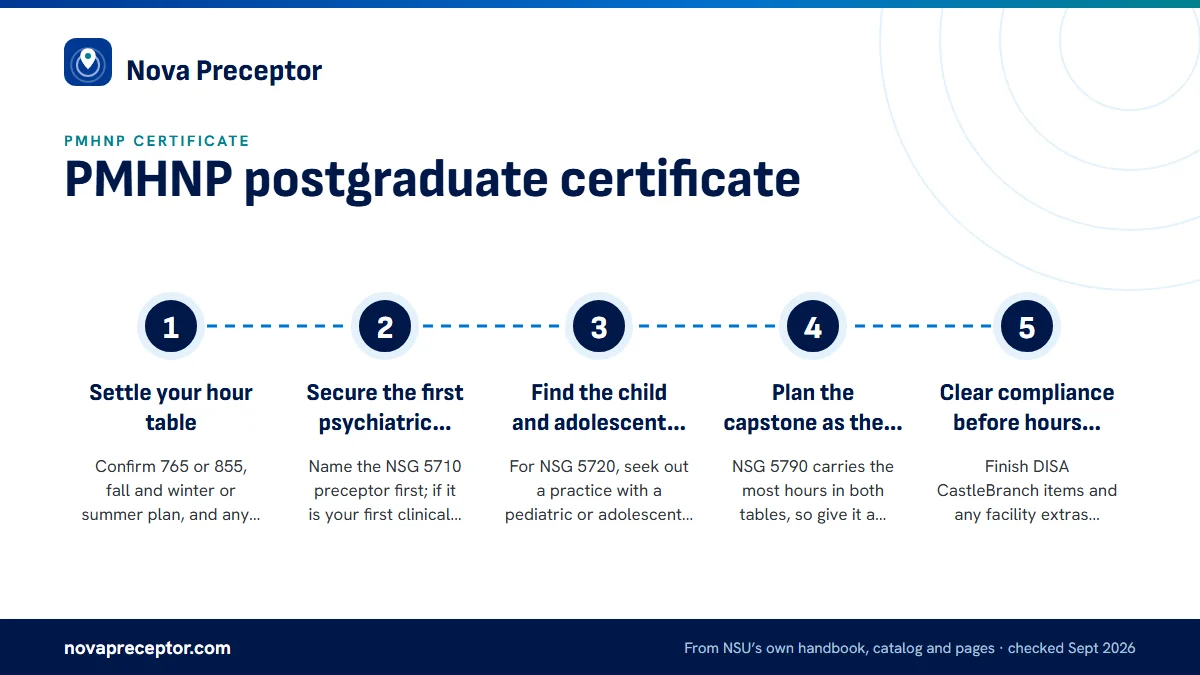
- Settle your hour tableConfirm 765 or 855, fall and winter or summer plan, and any gap-analysis waivers before you ask anyone for a weekly commitment.
- Secure the first psychiatric courseName the
NSG 5710preceptor first; if it is your first clinical term, its notice date may come before you start. - Find the child and adolescent fit earlyFor
NSG 5720, seek out a practice with a pediatric or adolescent caseload, keeping the Florida prescribing rule in mind if the preceptor is an APRN. - Plan the capstone as the largest block
NSG 5790carries the most hours in both tables, so give it a preceptor who can host you week after week for the full term. - Clear compliance before hours beginFinish DISA CastleBranch items and any facility extras early, since a facility item still outstanding when hours are due to begin costs you the placement.
Why PMHNP certificate students choose us
We specialize in NSU's clinical process, and psychiatric placements are where that focus pays off. Your placement advisor reads your plan of study, identifies the hour table that applies, and finds preceptors near your home for each psychiatric course, including a child and adolescent fit for NSG 5720, all named before each two-semester notice date.
For the coordinator's review we collect the preceptor's licensure and credentials, a profile of the practice and a short case for how its caseload matches the course. We handle the site's own requirements with you, and when a preceptor's schedule shifts mid-course, we bring you a replacement. The final yes on each preceptor and site belongs to NSU; everything we send is organized to make that review straightforward. You can read the full process or share your details through the form below.
Questions NSU students ask
How many clinical hours is the NSU PMHNP certificate?
NSU publishes two answers. The PMHNP program page and the certificates page give 170 hours for each Psychiatric Management course and 255 for the capstone, 765 in total by our sum. The 2026-27 graduate catalog gives 190 and 285, or 855. Your program director can tell you which applies to your cohort and whether your gap analysis waives any hours.
Does NSG 5532 need a preceptor?
No NSU table assigns clinical hours to NSG 5532 Neurobiology Psychopharmacology, so it is a classroom course. It is also the reason the PMHNP certificate runs to 27 credits instead of 24. Your preceptor planning starts with NSG 5710, the first Psychiatric Management course.
Can a psychiatrist be my preceptor for the PMHNP certificate?
Florida's rule 64B9-4.001(13) counts licensed physicians, MDs and DOs alike, as qualified preceptors for nurse practitioner students, alongside APRNs and dentists, as long as the license is from Florida. A psychiatrist with a Florida license therefore meets the state standard. NSU keeps its own preceptor standards in the graduate clinical guide, and the coordinator checks each preceptor against them before hours begin.
Which campus does the NSU PMHNP certificate use?
The certificates page lists Miramar and Tampa Bay for PMHNP certificate students while the program is hybrid. NSU plans to move certificates fully online in summer 2027 or the 2027-2028 academic year, depending on the source, and it has not published the certificate's intensive schedule. Ask the program director where any campus days will fall.
Why does the certificate need a Florida license when the PMHNP MSN does not?
Because NSU's sources differ on this point. PMHNP master's applicants no longer need a Florida license under the 2026-27 catalog, yet the certificates page still lists Florida RN licensure and a 225-mile residence limit for certificate students. Treat the certificates page as the rule until admissions tells you otherwise in writing.
Related pages
Last checked 2026-09-24
We check these pages against NSU's own handbook, catalog and program pages. The graduate clinical guide, your course in Canvas, your clinical coordinator and your program director have the final word.
NSU lets you name your own preceptor. We make sure you have one, close to home and in time.
Tell us your NSU program, your home ZIP area and when your next clinical course starts. We find preceptors who fit the course and have everything ready for your clinical coordinator well before the two-semester notice.
- Preceptors matched to the course: primary care for FNP, acute care for AGACNP, psychiatric care for PMHNP, a practice site for DNP project hours
- Named early enough for NSU's two-semester notice, with license, credentials and site details ready for the coordinator
- Close to your home ZIP code, with clinic days we plan around your work schedule
Start your placement plan
Program, ZIP area and start term is all we need to begin.