NSU APRN certificate hours, the three Ps and the gap analysis
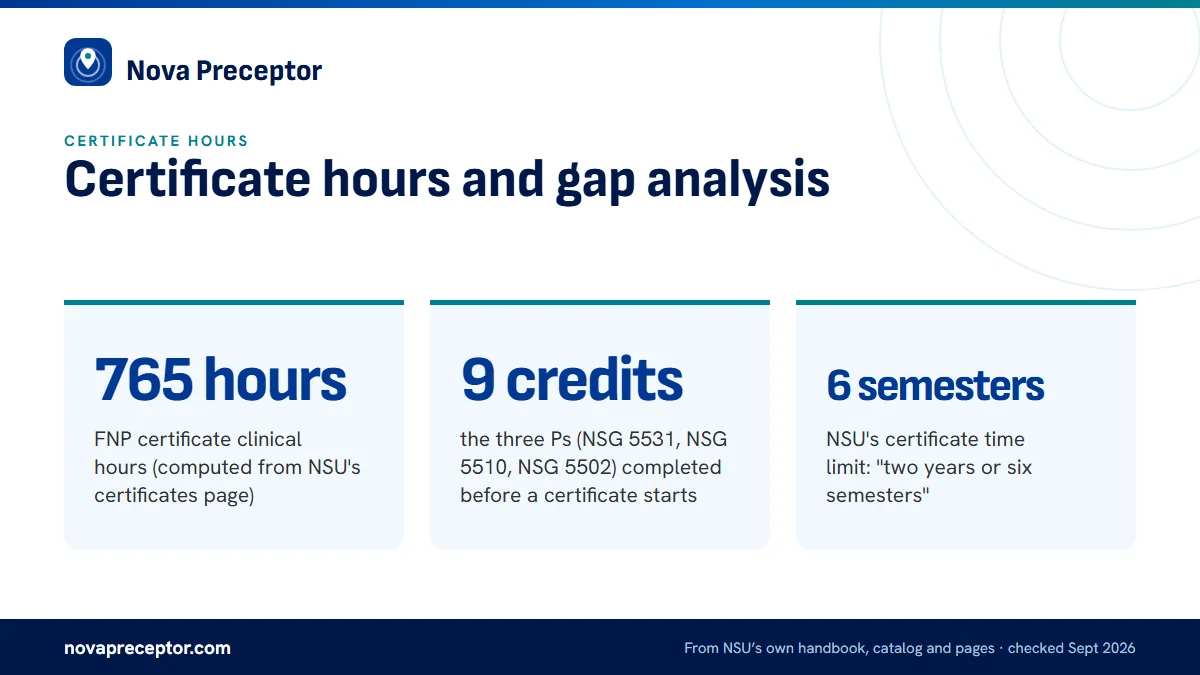
An NSU postgraduate APRN certificate means 765 clinical hours on the FNP track, while AGACNP students see 735 or 765 and PMHNP students 765 or 855, depending on the NSU source. The three Ps (NSG 5502, NSG 5510, NSG 5531) have to be done first, and a "formal gap analysis" named in the handbook settles whether you can skip any coursework or hours.
Plan your certificate preceptors
Tell us your track, your admit term and whether you still need the three Ps.
Certificate hours by track, and where NSU disagrees
Certificate courses use the older 6-credit format, with clinical hours built into each course instead of a separate clinical number. NSU's certificates page, the three track pages and the 2026-27 graduate catalog give the per-course figures below; the totals are our arithmetic from those figures.
| Track | Courses with clinical hours | Hours per course | Total (computed) |
|---|---|---|---|
| FNP (24 credits) | NSG 5542, NSG 5550 (6 credits each); NSG 5560, NSG 5580 (3 each); NSG 5590 capstone (6) | 170, 170, 85, 85, 255 | 765 |
| AGACNP (24 credits) | NSG 5620, NSG 5630, NSG 5650 (6 each); NSG 5660 capstone (6) | 170 each; capstone 225 (certificates page) or 255 (AGACNP page, both catalogs) | 735 or 765 |
| PMHNP (27 credits) | NSG 5710, NSG 5720, NSG 5730 (6 each); NSG 5790 capstone (6); NSG 5532 (3, no hours) | 170 each and 255 (PMHNP and certificates pages) or 190 each and 285 (2026-27 catalog) | 765 or 855 |
Summer-start certificate curricula in the 2026-27 catalog follow the MSN pattern instead, with separate didactic and clinical courses at 190, 95 and 285 hours, so the summer AGACNP and PMHNP plans total 855. The summer FNP list names NSG 5542 but leaves out its paired NSG 5549 clinical, a gap NSU has not explained. Ask your program director which plan and figures govern your cohort; the 95-hours-per-credit page explains both hour scales.
The three Ps come before everything else
Each certificate track is built on three graduate courses you must already have: Advanced Health Assessment (NSG 5502), Advanced Pathophysiology (NSG 5531) and Advanced Pharmacology (NSG 5510), at 3 credits apiece. NSU's certificates page requires them before the certificate begins. Applicants who lack them apply first as non-degree-seeking students and complete them before moving into the certificate.
That route shifts your start. NSU's FNP and AGACNP pages describe "winter admission only" for applicants who hold the three Ps and "fall admission only" for those who need them; the PMHNP page lists "winter & fall" and "summer & fall". The 2026-27 catalog describes certificate admission as happening "twice a year", while the 2025-26 catalog had FNP and AGACNP in winter only. Confirm your term with admissions.
In the MSN, NSG 5502 includes a 2-day Palm Beach intensive. NSU does not publish whether non-degree-seeking students attend the same one; the intensives page tracks what is published.
The formal gap analysis: what NSU says and what it leaves open
The 2025-26 handbook (printed p.107) says certificate applicants go through a "formal gap analysis", and that it decides waivers of coursework or clinical hours. That is the whole public description. NSU does not publish the method, the documents it reviews or how a waiver is recorded, so your program director and admissions are the people to ask.
The outcome matters for placement. A waived course takes its clinical hours out of your plan, and waived hours shrink the block a preceptor has to host. Until the analysis is finished and confirmed, plan for the full hours on your track. NSU publishes no document list, so treat the one below as preparation of your own, not an NSU checklist.
What to have ready when you ask about a gap analysis
- Transcripts from your MSN and any other graduate nursing program.
- Course descriptions or syllabi for courses you hope will count, especially pathophysiology, pharmacology and health assessment.
- A record of your supervised clinical hours by setting, verified by the program that supervised them.
- Your current license details and any national certification, if you already practice in another APRN role.
Time limit, license and residence rules
A certificate must be finished within "two years or six semesters" under the 2026-27 catalog. With four or five clinical-bearing courses inside that window, a semester lost to a missing preceptor is hard to absorb.
The certificates page still lists a Florida RN license (current, active, and kept current wherever your practicum takes place), living within 225 miles of your program's campus, a 3.0 master's GPA and a year of active independent clinical practice; AGACNP applicants add ACLS. The handbook's GPA rule differs: 2.75 for applicants with at least two years of experience, 3.0 for those with less. See license rules for clinicals.
The campuses are Miramar (PMHNP), Palm Beach (AGACNP and FNP) and Tampa Bay (FNP and PMHNP). Today the coursework is hybrid. The switch to online is dated to the 2027-28 academic year on NSU's program pages but to summer 2027 in the 2026-27 catalog.
When a certificate student should name preceptors
Certificate students are APRN students, so the handbook's rule applies to every clinical course: name your preceptor and site to the clinical coordinator two semesters ahead, or accept a coordinator placement up to 150 miles from your home ZIP code. See the two-semester deadline and the 150-mile placement rule.
Certificates are short, and NSU does not publish a semester-by-semester certificate sequence, so the notice date for your first clinical course can fall before or right at admission. As soon as your plan of study arrives, work it out: find the first course with clinical hours, count back two semesters, and start the search from there. If you are taking the three Ps as a non-degree-seeking student, that window can open while you are still in them.
Do not bank on a waiver shrinking your hours. Until NSU confirms the gap analysis result, line up preceptors for the full hours on your track.
Why certificate students choose us
Certificate students have the least slack of anyone at NSU: a six-semester limit, clinical-heavy 6-credit courses and a first notice date that can arrive before the first day. Your placement advisor starts from your track and plan, searches near where you live for preceptors who fit each course (primary care for FNP, acute care for AGACNP, psychiatric care for PMHNP), and assembles the credentials and site details the clinical coordinator reviews.
If the gap analysis changes your hours, we adjust the search to match, and if a preceptor drops mid-course we start on a replacement at once. The coordinator decides; we see to it that your certificate submissions arrive complete and in NSU's terms. Track details are on the FNP certificate, AGACNP certificate and PMHNP certificate pages, and the form below starts your search.
Questions NSU students ask
What is the clinical hour total for NSU's FNP certificate?
By NSU's certificates page it comes to 765: NSG 5542 and NSG 5550 at 170 apiece, NSG 5560 and NSG 5580 at 85 apiece, and the NSG 5590 capstone at 255, over 24 credits. Summer-start plans in the 2026-27 catalog are structured differently, so check which plan is yours.
Why does NSU list two different PMHNP certificate totals?
On the PMHNP and certificates pages, the three psychiatric management courses (NSG 5710 through NSG 5730) carry 170 hours apiece and the NSG 5790 capstone 255, a total of 765. The 2026-27 graduate catalog lists 190 apiece and 285, a total of 855. NSU has not reconciled the two, so ask your program director which figure governs your cohort.
Can I start an NSU certificate without the three Ps?
Not as a certificate student. All three Ps must be finished before certificate coursework starts. Applicants without them first apply as non-degree-seeking students, and NSU's FNP and AGACNP pages tie that route to fall admission, against winter for applicants who already hold the three Ps.
Can a gap analysis waive clinical hours at NSU?
The handbook says the formal gap analysis decides waivers of coursework or clinical hours, so a waiver is possible. NSU publishes no criteria and nothing on how often hours are waived. Plan your preceptor search around the full hours for your track until the program confirms a waiver, then adjust.
What is the time limit on an NSU APRN certificate?
The 2026-27 graduate catalog sets the limit at "two years or six semesters". Clinical courses fill most of that window and each needs its own two-semester notice, so a missed preceptor deadline can push a course, and with it your finish date, toward the limit.
Related pages
Last checked 2026-09-25
We check these pages against NSU's own handbook, catalog and program pages. The graduate clinical guide, your course in Canvas, your clinical coordinator and your program director have the final word.
NSU lets you name your own preceptor. We make sure you have one, close to home and in time.
Tell us your NSU program, your home ZIP area and when your next clinical course starts. We find preceptors who fit the course and have everything ready for your clinical coordinator well before the two-semester notice.
- Preceptors matched to the course: primary care for FNP, acute care for AGACNP, psychiatric care for PMHNP, a practice site for DNP project hours
- Named early enough for NSU's two-semester notice, with license, credentials and site details ready for the coordinator
- Close to your home ZIP code, with clinic days we plan around your work schedule
Start your placement plan
Program, ZIP area and start term is all we need to begin.