NSU clinical hours, program by program
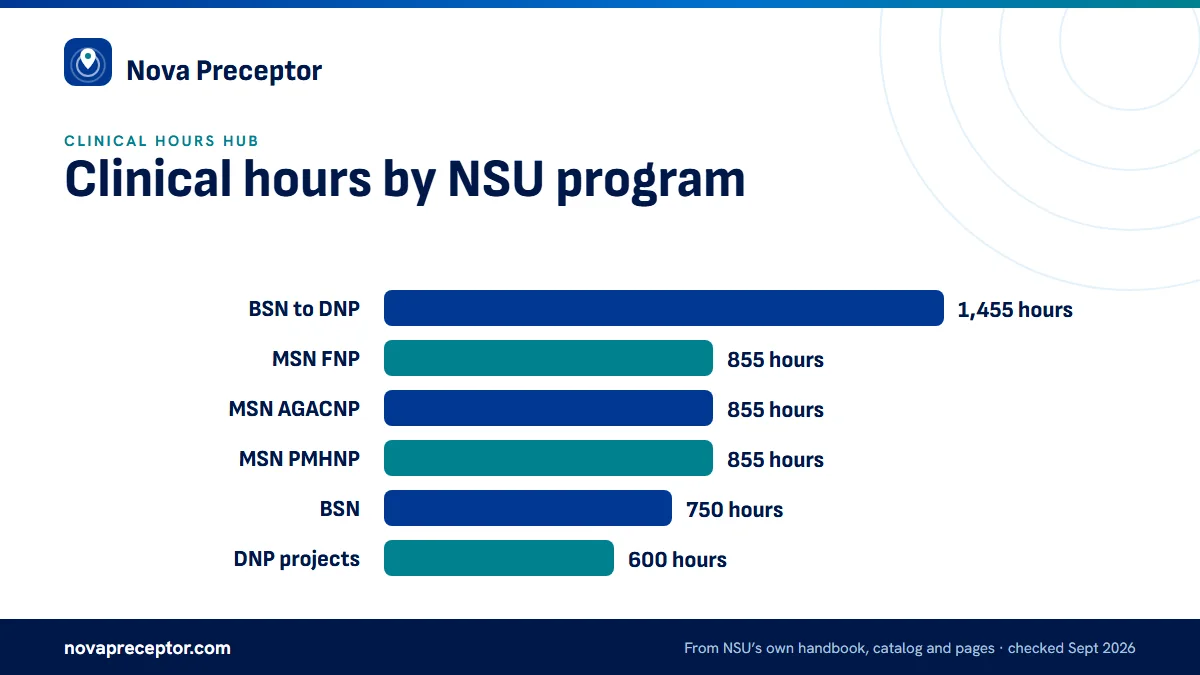
Every NSU MSN APRN track now adds up to 855 clinical hours, BSN to DNP states 1,455, and the post-master's DNP asks for 600 project hours on top of 500 verified ones. Some of those figures NSU prints and some are sums of its per-course numbers, and older documents still show 765. Choose your program in the planner below for the course list, then use this page to read the numbers correctly.
Get your placement plan
Tell us your NSU program and your home ZIP area. A placement advisor replies with preceptor and site options near you that fit your NSU course.
Pick your NSU program
Your clinical courses and hours, who can precept you, where, and when to start looking. From NSU's own catalog, handbook and program pages.
- Who precepts
- A primary-care preceptor NSU's clinical coordinator approves: adult, pediatric and women's health
- Where
- Family practice, internal medicine, pediatric and women's health offices near your home ZIP code
- Start looking
- Two semesters before NSG 5549, and again ahead of each later clinical course
- Who precepts
- An acute-care preceptor (APRN, MD or DO) the clinical coordinator approves
- Where
- Hospital units, intensive care, hospitalist and emergency services near home
- Start looking
- Two semesters before NSG 5629, with your Florida RN license and ACLS current
- Who precepts
- A psychiatric preceptor (PMHNP or psychiatrist) the clinical coordinator approves
- Where
- Outpatient psychiatry, behavioral health centers, inpatient units, child and adolescent services
- Start looking
- Two semesters before NSG 5719; NSG 5729 adds child and adolescent content
- Who precepts
- The same specialty preceptors as the MSN track you are adding
- Where
- Primary care (FNP), acute care (AGACNP) or psychiatric settings (PMHNP) near home
- Start looking
- Before your first clinical course; NSU's gap analysis can waive some coursework or hours
- Who precepts
- Specialty preceptors for the clinical block, then a practice site and mentor for the project
- Where
- Your concentration's settings (FNP shown), then a practice setting that fits your DNP project
- Start looking
- Two semesters before your first clinical course; project site before NSG 7431
- Who precepts
- A practice site and project mentor that fit your DNP project
- Where
- A health system, clinic or practice where the project can run
- Start looking
- Before NSG 7431; your 500 post-BSN clinical hours verified before the project courses
- Who precepts
- NSU's clinical coordinator places BSN students in clinical groups
- Where
- Within 75 miles of your campus: Fort Lauderdale/Davie, Miami or Fort Myers
- Start looking
- Placed by NSU each semester; you keep CastleBranch current
Three kinds of hour figures, and two curricula
NSU publishes clinical hours in three forms, and most confusion clears once you know which one you are reading. A stated total is printed by NSU itself, such as the 1,455 clinical and practicum hours the ACON 2026-2027 Graduate Catalog gives for BSN to DNP. A computed total is a sum of NSU's per-course figures: the catalog prints 190, 95 or 285 beside each MSN clinical course but never prints 855 as a program total.
The third form is a rate. NSU's FNP, AGACNP and PMHNP pages carry the footnote “Requires 95 practicum hours per credit hour”, while the BSN curriculum counts clock hours at 50 per clinical credit. How the MSN rate produces each course's hours, and why it replaced the older figures, is the subject of the 95 hours per credit page.
Two curricula also circulate at once. The current one, on the program pages and in the 2026-27 catalog, is online with 45 or 48 credits. The previous one, in the 2025-26 health colleges catalog and parts of the 2025-26 Nursing Student Handbook, was a 51-credit hybrid plan with 765 clinical hours. Where NSU documents disagree, the table below shows both versions.
Clinical hours by NSU program
| Program | Hours | How the figure is reached | Other figures in circulation |
|---|---|---|---|
| MSN APRN, Family NP | 855 | Computed from the 2026-27 catalog: 190 + 190 + 95 + 95 + 285 | 765 in the 2025-26 hybrid plan |
| MSN APRN, Adult-Gerontology Acute Care NP | 855 | Computed: three clinicals at 190, capstone at 285 | 765 in the 2025-26 hybrid plan |
| MSN APRN, Psychiatric-Mental Health NP | 855 | Computed: three clinicals at 190, capstone at 285 | 765 in the 2025-26 hybrid plan |
| Postgraduate certificate, FNP | 765 | Computed from the certificates page: 170 + 170 + 85 + 85 + 255 | The 2026-27 catalog's summer plan uses the MSN-style clinicals |
| Postgraduate certificate, AGACNP | 765 or 735 | Computed; the NSG 5660 capstone is 255 hours in the catalogs, 225 on the certificates page | 855 in the 2026-27 summer certificate plan |
| Postgraduate certificate, PMHNP | 765 or 855 | Computed; 765 from the web pages, 855 from the 2026-27 catalog | Unresolved between NSU sources |
| BSN to DNP (FNP, AGACNP or PMHNP) | 1,455 | Stated in the 2026-27 catalog; matches 855 clinical plus 600 project hours | 1,365 in the 2025-26 plan; the web page says “more than 1,000” |
| Post-master's DNP | 600 project hours | Computed: NSG 7431, NSG 7444, NSG 7445 and NSG 7451 at 150 each | Plus 500 post-BSN clinical hours verified by your master's school |
| Entry or Accelerated BSN | 750 clock hours | Computed from NSU's key: 1 clinical credit = 50 clock hours | NSU places BSN clinicals within 75 miles of campus |
The course-by-course hours sit in the planner above and on each track's course page: FNP clinical courses, the two 95-hour pediatrics and women's health clinicals, AGACNP clinical courses, PMHNP clinical courses and the three 285-hour capstone clinicals.
Certificates and doctoral hours: the exceptions
Certificate figures are the least settled numbers NSU prints. The certificates page still lists combined didactic-and-clinical courses at 170, 85 and 255 hours, while the 2026-27 catalog adds summer certificate plans with separate clinicals at 190, 95 and 285. A formal gap analysis can also waive coursework or clinical hours, so your own total may differ from every published one. The certificate gap analysis page explains how that review works.
Doctoral hours follow a different logic. Each of the four DNP project courses carries 150 practicum hours at a practice site that suits your project, covered on the DNP project practicum page. Post-master's students also need 500 clinical hours after the BSN, verified by the school that granted the master's, and NSU's sources disagree on whether that check comes before NSG 7431 or before NSG 7451. Anyone short enrolls in NSG 7460, 150 hours per 3-credit enrollment, as the 500 clinical hours page sets out.
How NSU expects the hours to be earned
Three timing rules in NSU's handbook shape your schedule more than any total does. APRN students begin clinical hours when didactic coursework begins. Clinical attendance is expected “on a weekly basis”. And hours may not be compressed at the beginning or the end of the semester, so a 190-hour course cannot be packed into a few long weeks.
That turns every total into a weekly figure. NSU does not post graduate term lengths, but as simple arithmetic, a 16-week term puts a 190-hour course at a little under 12 hours each week and a 285-hour capstone near 18; the dates on your course in Canvas give your real divisor. Planning around a full-time job is covered on the weekly hours rule page, and missed days are made up in full, as the absences page explains.
Hours start only after your paperwork is in and your clinical coordinator has approved the preceptor and site. Get that approval settled before week one, not during it.
How hours are logged, and what NSU keeps internal
NSU does not name, in any public document, the system APRN students use to record clinical hours. The handbook points APRN students to “the graduate clinical guide”, which is not posted online. The one compliance platform NSU names publicly, DISA CastleBranch, tracks clearance items such as immunizations and background checks rather than hours.
So the mechanics (where entries go, what your preceptor signs, when logs are due) come from that guide and from your clinical course in Canvas. Keep a simple week-by-week tally of your own as well, so a short week shows up while there is still time to schedule the make-up. In week one, ask your course faculty how and when entries are reviewed; the handbook names course faculty as the first contact for anything about a clinical course. The graduate clinical guide page lists what to check in it first.
Where the official numbers live
When a figure matters, go to the document that owns it. Each NSU source is authoritative for something different:
- Program pages on nursing.nova.edu: the 95-per-credit footnote, the full-time and flex plans of study, and the certificate hour tables.
- The ACON 2026-2027 Graduate Catalog: per-course hours for every MSN clinical, the 1,455-hour BSN to DNP total and the summer certificate plans. It is the newest rulebook NSU has posted.
- The 2025-26 health colleges catalog: the older 51-credit plan and its 765 hours, useful if you began under it.
- The Nursing Student Handbook 2025-2026: the weekly, no-compression and make-up rules. No 2026-2027 handbook had been posted when we last checked.
- Degree Works and your faculty adviser: your own program requirements, reviewed each semester.
- Your clinical coordinator and program director: the final word on which figure applies to your cohort.
Before you quote an hour total to a prospective preceptor, confirm it with your program director or clinical coordinator.
Why NSU students plan their hours with us
Hour totals only become real when a preceptor has room for them week after week. We build each placement around the exact figure for your course, so the preceptor we find has agreed to 190 hours across the whole term, or 285 for a capstone, rather than a loose number of shifts. That preceptor is near your home ZIP code, and the details your clinical coordinator checks are ready well before NSU's two-semester notice.
When two clinicals share a semester, as FNP pediatrics and women's health do, we schedule both preceptors so their weekly days fit together around your job. If a preceptor steps away mid-term, we line up a replacement quickly so your weekly hours keep moving. Tell us your program and next clinical course in the form below, or read how it works first.
Questions NSU students ask
How many clinical hours is the NSU FNP program?
NSU's 2026-27 catalog lists 190 hours for NSG 5549 and NSG 5559, 95 each for NSG 5589 and NSG 5569, and 285 for the NSG 5599 capstone. Those add up to 855, the same total as the AGACNP and PMHNP tracks. NSU prints the per-course figures rather than the total. Students on the older 2025-26 hybrid plan had 765.
Why does one NSU document say 765 hours and another 855?
They describe two different curricula. The 2025-26 catalog folded clinical hours into combined courses that totaled 765; the current online MSN splits them into separate clinical courses at 95 hours per credit, totaling 855. Some certificate pages still show the older figures. Ask your program director which plan your cohort follows.
Do DNP project hours count toward NSU's hour totals?
Yes. They are practicum hours earned at a practice site, and they make up 600 of the 1,455 hours in BSN to DNP. For post-master's students, the 600 project hours sit on top of 500 post-BSN clinical hours verified by the school where you earned the master's. With fewer than 500, NSU enrolls you in NSG 7460 until you reach it.
Can I finish my NSU clinical hours early in the semester?
No. The handbook says APRN students are not permitted to compress clinical hours at the beginning or end of the semester, and it expects weekly attendance from the week didactic coursework starts. Agree a steady weekly schedule with your preceptor from the outset, and remember every absence has to be made up.
Where do I record my NSU clinical hours?
NSU does not name its hour-logging system in public documents. The handbook sends APRN students to the graduate clinical guide, and your clinical course in Canvas explains how entries are made and signed off. DISA CastleBranch, the one platform NSU names publicly, handles compliance records such as immunizations, not hours.
Related pages
Last checked 2026-09-25
We check these pages against NSU's own handbook, catalog and program pages. The graduate clinical guide, your course in Canvas, your clinical coordinator and your program director have the final word.
- NSU Family Nurse Practitioner M.S.N.-A.P.R.N. page (95 practicum hours per credit hour)
- NSU Ron and Kathy Assaf College of Nursing 2026-2027 Graduate Catalog
- NSU Nursing Student Handbook 2025-2026: Graduate A.P.R.N. Students
- NSU A.P.R.N. Postgraduate Certificates page
- NSU Student Academic Catalog 2025-26 (health colleges)
NSU lets you name your own preceptor. We make sure you have one, close to home and in time.
Tell us your NSU program, your home ZIP area and when your next clinical course starts. We find preceptors who fit the course and have everything ready for your clinical coordinator well before the two-semester notice.
- Preceptors matched to the course: primary care for FNP, acute care for AGACNP, psychiatric care for PMHNP, a practice site for DNP project hours
- Named early enough for NSU's two-semester notice, with license, credentials and site details ready for the coordinator
- Close to your home ZIP code, with clinic days we plan around your work schedule
Start your placement plan
Program, ZIP area and start term is all we need to begin.