The graduate clinical guide: NSU's unpublished rulebook for APRN clinicals
One sentence in NSU's Nursing Student Handbook sends every APRN student to another document: APRN students "are expected to follow the graduate clinical guide." NSU does not post that guide on nova.edu, so the day-to-day procedures for your clinical courses sit in a document you have to obtain through your program. Here is what we checked, what to look up in the guide first and how to get a copy.
Match your preceptor to NSU's criteria
Tell us your NSU track, your next clinical course and your home ZIP area.
What the handbook says about the guide
The reference appears in the section headed "Graduate A.P.R.N. Students" on printed page 123 of the 2025-26 handbook (flipbook page 131). It sits just before an attendance instruction: APRN students follow the graduate clinical guide and tell the site and the clinical coordinator when they cannot attend a planned clinical day.
The rest of that section holds the rules NSU does make public: notice to the coordinator two semesters ahead, the coordinator's check of preceptor and site, a coordinator placement when no preceptor is named, paperwork before hours start, a site visit, weekly hours from the first week of didactic coursework and a make-up for every absence. The guide is where the procedures behind those rules would be expected to live. Our clinical placement process page walks through the public rules in order.
The handbook gives the guide no edition date, no author and no link. It is simply "the graduate clinical guide."
Why you won't find it on nova.edu
We searched for a public copy on September 24, 2026 and found none. The search covered:
- All 154 pages of the 2025-26 Nursing Student Handbook flipbook.
- The 2025-26 Student Academic Catalog, the 2026-27 ACON Graduate Catalog and the MSN, certificate and DNP program pages.
- Likely addresses on NSU's sites, such as /preceptors/, /clinical/ and /publications/nursing/graduate-clinical-guide/, each of which returns a 404 error.
- Internet Archive listings of nursing.nova.edu and nova.edu/nursing addresses.
No preceptor handbook or preceptor manual turned up either. The guide is an internal document, which means your copy comes from NSU rather than a search engine. A file passed around online from another year, or from another school's program, is no substitute for the edition your course actually uses.
What the guide is the likely home for
The handbook points APRN students to the guide from a section that stays silent on the details below. Each one is missing from every public NSU source, so the guide, your course syllabus and your coordinator are where the answers should be found.
- Preceptor qualifications: the license a preceptor needs, experience, specialty match and which clinicians may precept which course.
- Paperwork: what the forms are called, who signs them and where each one goes.
- Hour logging: the system APRN students use to record hours and patient encounters, which NSU names nowhere in public.
- Evaluations: how your preceptor rates you, how you rate the site, and whether faculty visit or check in.
- Absences and make-up: how a missed day is documented and how the make-up is arranged.
- Site limits: whether one course may use two preceptors or two sites, and how split hours are counted.
What to look up first
Read the guide in the order your semester will need it, not front to back.
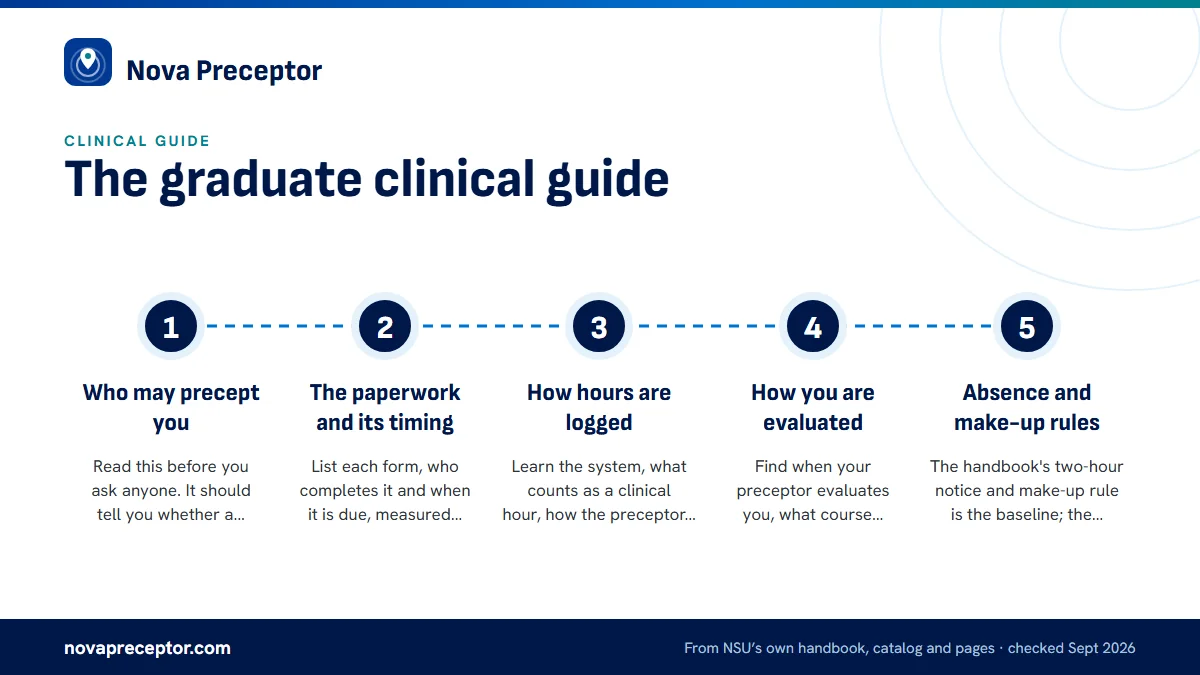
- Who may precept youRead this before you ask anyone. It should tell you whether a physician, a psychiatrist or only a nurse practitioner may precept each course, and any minimum experience. The preceptor requirements page covers what is public.
- The paperwork and its timingList each form, who completes it and when it is due, measured against your two-semester notice and the first week of the course.
- How hours are loggedLearn the system, what counts as a clinical hour, how the preceptor verifies it and how often you must enter it. Gaps in an hour log are hard to repair later.
- How you are evaluatedFind when your preceptor evaluates you, what course faculty review, and how clinical performance feeds the course grade.
- Absence and make-up rulesThe handbook's two-hour notice and make-up rule is the baseline; the guide may set how both are documented. See clinical absences.
Where to get your copy
NSU does not say how the guide is handed out, so work through these in order until one of them produces it.
- Your clinical course in Canvas. Check the syllabus and course resources of your first clinical course as soon as it opens.
- Your clinical coordinator. Ask for the current edition by SharkMail, ideally when you first write about a preceptor.
- Your program director. If you are early in the program, or still deciding whether to apply, the program director can tell you what the guide asks of preceptors.
- Orientation material. Fall 2026 orientation for APRN master's and BSN to DNP students ran on August 11; keep anything you were given there.
Check the date on the copy you receive. The handbook online is still the 2025-26 edition, while the 2026-27 graduate catalog has already changed the MSN's delivery format and license rules, so a guide can lag behind the catalog. When the guide, the handbook and the catalog disagree, ask your coordinator which one governs your course and keep the reply.
The nurse anesthesiology guide is a different document
The handbook mentions a second guide. Nurse anesthesiology students follow their own "clinical guide," and their absence rule differs from yours: they notify the site, the clinical coordinator and a program administrator.
That guide belongs to the DNP with a nurse anesthesiology specialization, which the 2025-26 catalog described as awaiting initial accreditation from the Council on Accreditation of Nurse Anesthesia Educational Programs. The council deferred its initial decision in October 2025, and the program does not appear in the 2026-27 graduate catalog. FNP, AGACNP and PMHNP students should make sure the document they are sent is the graduate clinical guide for APRN students, not the anesthesiology one.
If you are unsure which document you hold, check its title page and the programs it names, and ask your coordinator to confirm it is the edition for your track and start term.
Why NSU students choose us alongside the guide
Our preparation is built around the checks the guide governs. Share the preceptor section of your copy with your placement advisor, and we match against NSU's actual criteria for your course: the license, the specialty and the experience it names, not a general standard borrowed from elsewhere. Where your copy is silent on a point, we help you frame the question for your coordinator before any preceptor is asked.
We then line up a preceptor near your home who meets those criteria, with credentials and site details ready for your clinical coordinator before your two-semester notice date, and we track the site's onboarding list next to your DISA CastleBranch items. If a preceptor has to step away, we find a replacement. See how it works.
Questions NSU students ask
Is the graduate clinical guide the same as the Nursing Student Handbook?
No. The handbook is NSU's public rulebook for nursing students, with a section for graduate APRN students. That section tells APRN students to follow the graduate clinical guide, a separate document NSU does not post online. Both apply: the handbook sets the headline rules, and the guide holds the clinical procedures behind them.
Can I read the graduate clinical guide before I enroll?
Not from NSU's public websites; we could not find it posted anywhere. If you are weighing an offer, ask the program director at your interview what the guide requires of preceptors and whether you can see that section. Admitted students can ask their clinical coordinator for the current edition.
Where do NSU APRN students log clinical hours?
NSU does not name the system publicly. No hour-logging or case-log platform appears on any public NSU nursing page, in the handbook or in either catalog. Look in your clinical course in Canvas and in the graduate clinical guide, and ask your coordinator if neither names it. The clinical hours page covers how many hours each course requires.
Is there a preceptor handbook for my preceptor?
None is published. NSU names no preceptor handbook, manual or orientation in its public documents, and preceptor forms and any agreement are among the unpublished details. Ask your clinical coordinator what your preceptor receives and signs, so you can brief the preceptor well before the course starts.
What if the guide conflicts with the handbook or the catalog?
Ask your clinical coordinator or program director which rule applies to your course, and keep the answer in SharkMail. NSU's public sources already disagree on several points, such as clinical hours per course and license rules, and a guide may follow an older or newer edition than the one you are reading.
Related pages
Last checked 2026-09-25
We check these pages against NSU's own handbook, catalog and program pages. The graduate clinical guide, your course in Canvas, your clinical coordinator and your program director have the final word.
NSU lets you name your own preceptor. We make sure you have one, close to home and in time.
Tell us your NSU program, your home ZIP area and when your next clinical course starts. We find preceptors who fit the course and have everything ready for your clinical coordinator well before the two-semester notice.
- Preceptors matched to the course: primary care for FNP, acute care for AGACNP, psychiatric care for PMHNP, a practice site for DNP project hours
- Named early enough for NSU's two-semester notice, with license, credentials and site details ready for the coordinator
- Close to your home ZIP code, with clinic days we plan around your work schedule
Start your placement plan
Program, ZIP area and start term is all we need to begin.