NSU's clinical coordinator: the person who approves your preceptor and site
In NSU's nursing college, the clinical coordinator is the faculty member who receives your preceptor proposal, checks it against NSU's supervision rules, signs off on the site, and places you when you name no one. NSU's HR title for the role is "Coordinator - Clinical Services," and no separate placement office stands behind it. Here is what the role covers and how to make every exchange with your coordinator count.
Send your coordinator a proposal that fits
Tell us your NSU track, your home ZIP area and your next clinical course.
Who holds the role: "Coordinator - Clinical Services"
The Nursing Student Handbook uses the plain term "clinical coordinator," and in one sentence the plural, "clinical coordinators." ACON's people directory uses the HR title "Coordinator - Clinical Services." When we checked the directory in September 2026, four people held that title. Three of them are also listed as Assistant Professor - Nursing, and the fourth also manages the college's nursing simulation and skills lab.
That detail shapes how you work with them. Most coordinators teach as well, so placement questions share their week with courses and students, and a short message that holds everything they need gets the quicker answer.
NSU does not publish which coordinator covers which track, campus or region; your program director can tell you. Once you know, keep every placement message to that coordinator in a single SharkMail thread.
What the coordinator receives from you
Three kinds of message land on the coordinator's desk from an APRN student, and all three start with you. Nobody forwards them on your behalf.
- Your notice of a preceptor and site. The handbook makes it the student's job to tell the coordinator two semesters before each clinical course that a preceptor and site have been identified. Count back to your own date on the two-semester deadline page.
- Your paperwork. Everything required must be in before clinical hours begin, and you must have met the preceptor at the site. NSU lists the forms in the graduate clinical guide, not on its website; our clinical paperwork page explains what the paperwork spans.
- Word of a missed clinical day. During the course, the coordinator is one of the people you tell when you cannot attend (more on that below).
What the coordinator confirms and approves
Every proposal gets two checks. The preceptor has to meet NSU's requirements for clinical supervision, and the site has to give you the kind of practice the course is built around. The handbook then settles who decides in one line: "Clinical site and preceptor are approved by clinical coordinators."
Neither standard is spelled out in public. NSU keeps its preceptor criteria in the graduate clinical guide, which it does not post online, and the site standard rests on what each clinical course is built to teach. Our preceptor requirements page separates what is public from what is not, and clinical site requirements covers the setting side.
At a Florida site, the coordinator's review comes on top of the state's own rule on who may precept a nurse practitioner student. A preceptor who fails Florida's rule is very unlikely to pass NSU's review, so run the state check before you send a name.
When you name no one, the coordinator places you
An APRN student with no preceptor or site on file is placed by the coordinator at a site no more than 150 miles from home, measured from the residential ZIP code, and NSU treats that placement as non-negotiable once it is made. The 150-mile placement rule page covers what that radius can mean on a map and in a working week.
How the coordinator finds those sites is not public. NSU does not list its affiliated sites, how many students it places each term, or what happens when nothing opens inside the radius. Practice may differ by track, so ask your coordinator how placement works for your program.
BSN students follow a different rule: they must reside no more than 150 miles from their assigned campus, and the coordinator places them no more than 75 miles from it.
Missed clinical days go to the coordinator too
The coordinator stays in the loop after hours begin. Under the handbook, an APRN student who cannot make a planned clinical day informs the site and the clinical coordinator. A separate rule for all graduate students asks for two hours' warning to your preceptor, the site and your program director ahead of a missed clinical, and every absence has to be made up.
Taken together, one missed day means four notices: preceptor, site, program director and clinical coordinator. Send them in writing, keep the time stamp, and suggest a make-up date in the same message so the conversation starts from a plan. The clinical absences page covers make-up planning and why religious holidays do not excuse clinical hours.
No placement office: who handles what
NSU has no public "Office of Clinical Education" or "Clinical Placement Office," and no such unit appears in the handbook or the catalogs. Placement runs through the coordinators. Compliance runs through a different desk, the Nursing Office of Student Affairs, which monitors DISA CastleBranch and deals with the health, drug-screen and background requirements.
- Clinical coordinator: your preceptor and site proposal, the approval, placement when you name no one, and missed clinical days.
- Nursing Office of Student Affairs: immunizations, the physical exam form, drug screens and background checks in DISA CastleBranch.
- Course faculty: everything inside the clinical course, from assignments to your grade.
- Program director: changes to your plan of study, withdrawals, and one of your absence notices.
When a question straddles two desks, such as a site that wants a level 2 fingerprint check before it will take you, tell the coordinator about the site's condition and ask Student Affairs how to complete the check.
How to work well with your clinical coordinator
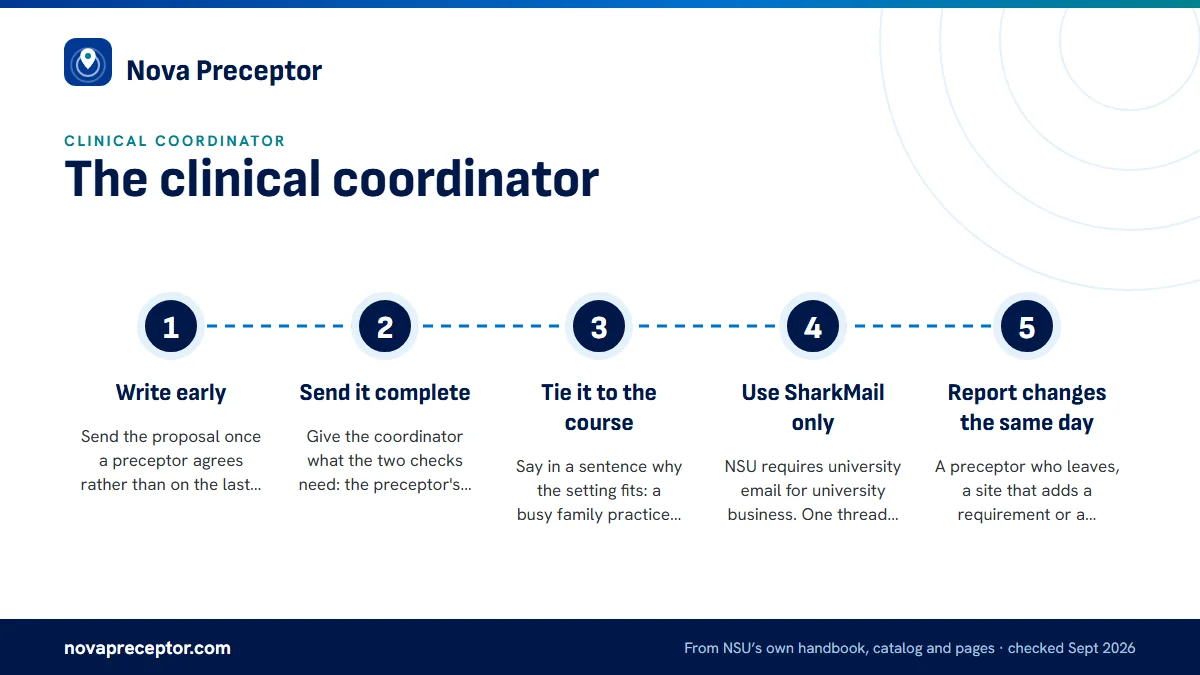
- Write earlySend the proposal once a preceptor agrees rather than on the last possible day. An early proposal leaves room to replace a preceptor who does not fit.
- Send it completeGive the coordinator what the two checks need: the preceptor's full name, credentials, license type and license state, specialty and patient population, plus the site's name, address and setting. Name the clinical course by number, for example
NSG 5549orNSG 5719. - Tie it to the courseSay in a sentence why the setting fits: a busy family practice for
NSG 5559, an inpatient medicine service forNSG 5639. You are making the coordinator's case for them. - Use SharkMail onlyNSU requires university email for university business. One thread per course keeps the record in one place and dated.
- Report changes the same dayA preceptor who leaves, a site that adds a requirement or a schedule that shifts is news the coordinator needs before the course, not during it.
- Keep patient details outNSU forbids sending protected health information to any email address outside NSU. Placement messages never need patient details, so leave them out entirely.
Why NSU students choose us for the coordinator step
We work backward from the coordinator's desk. Your placement advisor finds a preceptor near your home whose practice fits the clinical course, verifies the license type and state, collects the credentials and site details the coordinator's review turns on, and checks the site's own onboarding list. It all reaches you with time to spare before your two-semester notice date.
The notice is yours to send, from your own SharkMail; we make it the complete, well-organized proposal a busy coordinator can review in one pass. The decision stays with the coordinator. If a preceptor drops before or during the course, we find a replacement and prepare the new proposal with you. See how it works or use the form below.
Questions NSU students ask
Is the clinical coordinator the same person as my program director?
No. The program director leads your track and approves changes such as withdrawals from a course. The clinical coordinator, titled "Coordinator - Clinical Services" in NSU's HR system, reviews and approves your preceptor and site, and arranges a placement if you have none. Both hear about a missed clinical day, but a preceptor proposal goes to the coordinator. The who does what page maps every role.
How do I find out who my clinical coordinator is?
NSU does not publish which coordinator covers which track or region. Ask your program director, check your first clinical course in Canvas, and look for the title "Coordinator - Clinical Services" on ACON's people directory. Once you have a name, send a short SharkMail introduction with your track, campus and plan of study so the coordinator can connect your later notice to your file.
Can the clinical coordinator reject a preceptor I found?
Yes. Approval rests with the clinical coordinators, and a preceptor or site that falls short of NSU's standards for the course will not be approved. If a proposal does not fit, ask which requirement it missed, then offer another name while time remains before the course. That is the best reason to propose early and keep a second option ready.
Does NSU nursing have a clinical placement office?
Not one with that name. No Office of Clinical Education or Clinical Placement Office appears on NSU's nursing site, in the handbook or in either catalog. The clinical coordinators handle preceptor and site approval and placement, and the Nursing Office of Student Affairs handles compliance items such as immunizations, drug screens and background checks.
Does the clinical coordinator visit my clinical site?
NSU does not publish whether faculty make site visits or check-ins during APRN clinicals, or how often. Evaluation details of that kind belong to the graduate clinical guide and your course. Ask your coordinator or course faculty at the start of the semester, and tell your preceptor what to expect so a call or visit is not a surprise.
Related pages
Last checked 2026-09-25
We check these pages against NSU's own handbook, catalog and program pages. The graduate clinical guide, your course in Canvas, your clinical coordinator and your program director have the final word.
NSU lets you name your own preceptor. We make sure you have one, close to home and in time.
Tell us your NSU program, your home ZIP area and when your next clinical course starts. We find preceptors who fit the course and have everything ready for your clinical coordinator well before the two-semester notice.
- Preceptors matched to the course: primary care for FNP, acute care for AGACNP, psychiatric care for PMHNP, a practice site for DNP project hours
- Named early enough for NSU's two-semester notice, with license, credentials and site details ready for the coordinator
- Close to your home ZIP code, with clinic days we plan around your work schedule
Start your placement plan
Program, ZIP area and start term is all we need to begin.