NSU clinical site requirements: the right setting, cleared before day one
An NSU clinical site has two bars to clear. Your clinical coordinator confirms that it gives the course the clinical experience it needs, and the site then sets its own entry list, from fingerprinting to extra vaccines, which has to be finished before your first scheduled day or the placement is canceled. Here is how to judge the setting for each course and what to expect from the site's side.
Find a site that fits your course
Tell us your NSU track, your next clinical course and your home ZIP area.
What "appropriate clinical experience" means
The handbook's APRN placement rule (printed page 123) asks the coordinator to confirm that the site "provides the appropriate clinical experience." NSU does not define the phrase in public; the working standard sits with the coordinators and the graduate clinical guide. The practical reading is that the site must put you in front of the patients the course is about, often enough and under the right preceptor, to meet the course objectives week by week.
Two features of NSU's calendar sharpen that reading. Clinical hours start when the didactic course starts and run every week, and they may not be bunched into a few weeks at either end. A practice that sees the right patients only on scattered days, or can host you only in a short burst, suits the course poorly even when the specialty is right.
The site's paperwork has to line up in time as well. The site's own list is covered below; the documents NSU and your coordinator need are on the clinical paperwork page.
Settings that match each clinical course
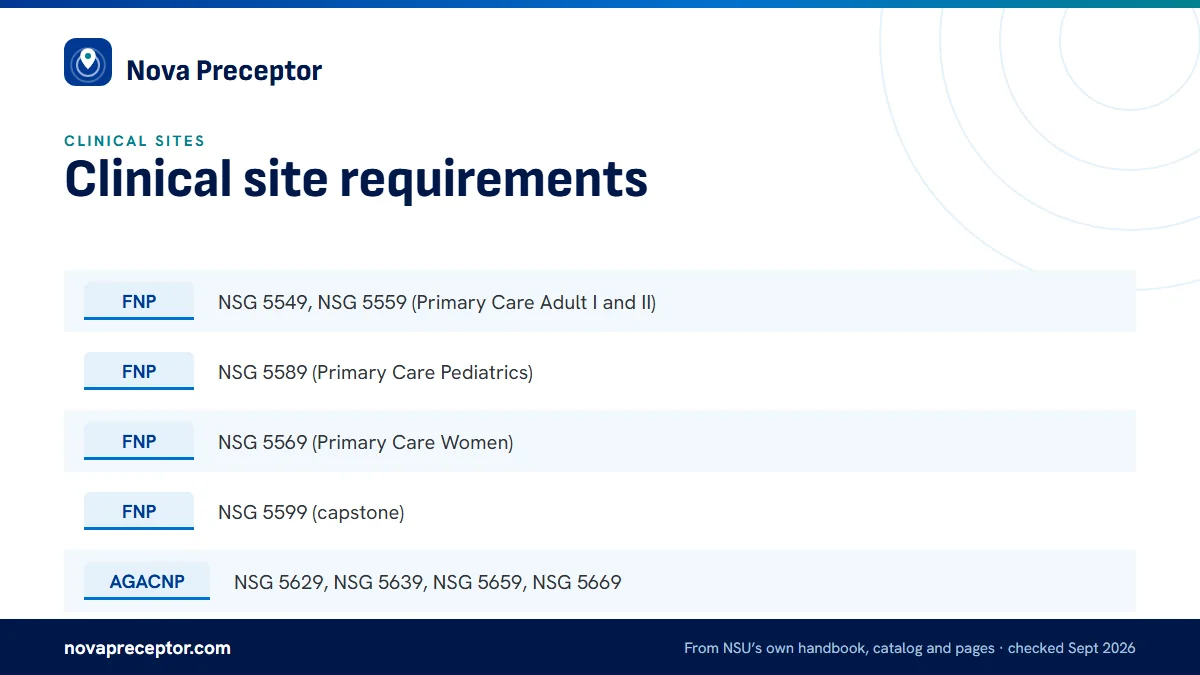
Course titles tell you the population. The settings below are our reading of what usually fits each title; your coordinator confirms the match for your proposal.
| Track | Clinical courses | Settings that usually fit |
|---|---|---|
| FNP | NSG 5549, NSG 5559 (Primary Care Adult I and II) | Family practice, internal medicine, adult primary care clinics, community health centers |
| FNP | NSG 5589 (Primary Care Pediatrics) | Pediatric offices, family practices with many young patients, community pediatric clinics |
| FNP | NSG 5569 (Primary Care Women) | OB/GYN and women's health practices, community health centers with women's services |
| FNP | NSG 5599 (capstone) | A family practice seeing all ages, where you can carry a larger share of visits |
| AGACNP | NSG 5629, NSG 5639, NSG 5659, NSG 5669 | Hospital inpatient services: hospitalist teams, intensive care, step-down units, specialty consult services |
| PMHNP | NSG 5719, NSG 5729, NSG 5739, NSG 5799 | Outpatient psychiatry, community mental health centers, inpatient psychiatric units; some child and adolescent exposure alongside NSG 5720 |
| DNP | NSG 7431 through NSG 7451 | A practice or health system setting where the DNP project can be carried out |
For primary care courses, look at community sites too. The state's TEACH program reimburses qualifying community facilities, including federally qualified health centers and community mental health centers, for the hours they host primary-care APRN students; see TEACH.
ACON's affiliation agreements
According to the handbook, ACON has affiliation agreements with many healthcare institutions, and those agreements are what allow student clinical experiences there (printed page 126). It does not publish the list, how a new agreement is set up, or how long one takes. Ask your coordinator whether a site is already covered before you put weeks into it.
Florida's larger systems publish their side. Most that describe a student process want an agreement with the school in place first, and some say a new one takes months: up to four months at Halifax Health and up to six months at Tampa General. Some accept requests only from the school, never from students, including Cleveland Clinic Florida and Mayo Clinic in Florida. None of this tells you whether any system has an agreement with NSU.
A private practice may have no student office at all, in which case the preceptor's yes and the practice manager's paperwork are most of the site process. The Florida health systems page sets out each large system's published rules.
What sites require before day one
NSU's college-level policies (handbook printed page 87) let each clinical facility set its own conditions for students. The examples NSU gives:
- A Florida Department of Health screening.
- Fingerprinting, which at NSU means the level 2 FDLE/VECHS background check, paid by the student when a facility asks; see background checks.
- The facility's own background check, which students may have to authorize.
- A drug and alcohol urinalysis.
- Proof of immunization, including vaccines beyond NSU's own list.
Three further details catch students out. Some rotation sites do not accept the QuantiFERON blood test for TB, so a site may want a skin test even when NSU's record is complete. The college has to give sites evidence that each student carries no contagious disease, and an individual hospital or agency can add testing at the student's expense. And sites may want life support cards: ACLS is already an AGACNP admission item, and some sites add BLS, ALS or PALS; see BLS, ACLS and PALS.
Expect a second portal as well. The handbook warns health-college students that immunization proof may have to go to several online portals, one for the program and others for each facility.
The day-one rule and what it costs
NSU's rule on facility requirements is short and strict. Any item still open when the first scheduled day arrives ends the placement, and a gap found after the start ends it too, with the student asked to leave. Where a site makes an immunization a condition of placement, the handbook adds that the university has no duty to find a different site.
Background findings carry similar weight. Admission to NSU does not oblige any facility to accept a student whose background check raises concerns, and a student no site will take may be unable to finish the program.
With hours tied to every week of the didactic course, a canceled start is hard to absorb. If it happens to you, start with our placement fell through guide.
NSU's DISA CastleBranch record and the site's list are separate. Only a finished site list gets you through the door on day one.
Rules that follow you onto the site
- Dress and badge. The site's dress code applies on top of NSU's, and your NSU ID badge is worn at every clinical; see the clinical dress code.
- Site policies. If you cannot deliver consistently safe care, or you break the host agency's policies, the handbook has you removed from the clinical area, with a possible referral to the Committee on Student Progress.
- Service animals. Clinical sites may have service-animal policies of their own. Raise it with the site and your coordinator before the placement is set, since an unfinished rotation can affect program completion.
- Transportation. The 2026-27 graduate catalog makes getting to clinical agencies the student's responsibility, so weigh the commute across a whole semester of weekly days.
- Insurance and exposures. You use your own health insurance for needs during clinical time. After a needlestick or other exposure, report through NSU's Environmental Health and Safety office and file the online postexposure incident form within 24 hours.
- Patient information. Protected health information may not be forwarded to non-NSU email, so keep patient details out of anything you send from the site.
Why NSU students choose us for sites
We vet the site as closely as the preceptor. Before a match reaches you, your placement advisor has confirmed that the setting fits the course, that the practice can host you every week of the term, and what the site will ask of you before day one, from its preferred TB test to fingerprinting.
You get the site's onboarding list months ahead, set against your DISA CastleBranch record, so nothing is open on the first morning. Approval belongs to the coordinator; we make the site half of your proposal clear and complete. Should the site rewrite its requirements or the preceptor leave, we source a new match near home. See how it works or use the form below.
Questions NSU students ask
Does NSU have an affiliation agreement with my hospital?
NSU does not publish its list. ACON's agreements cover many healthcare institutions, the handbook says, but which ones, and how new agreements are made, are not public. Ask your clinical coordinator directly, and read the hospital's own student-placement page, since many Florida systems accept students only from schools that already have an agreement in place.
Will my clinical site accept a QuantiFERON TB test?
Not always. NSU takes either a two-step skin test or an annual TB blood test such as QuantiFERON or T-Spot, but the handbook warns that some rotation sites may not accept QuantiFERON. Ask the site which method it wants as soon as the preceptor agrees, so a skin test can be booked in time. The immunizations page has NSU's full list.
Who pays for the tests a clinical site adds?
The student does. The handbook makes students responsible for their immunizations, for extra testing an individual hospital or agency requires, and for level 2 fingerprinting whenever a facility requests it; NSU lists that check's fee in the handbook. Count the site's list as part of the cost of accepting a placement.
Does NSU arrange transportation to clinical sites?
No. The 2026-27 graduate catalog says students are responsible for transportation to clinical agencies. That turns distance into a practical requirement: you travel to the site every week of the semester, so a site near home or near work makes the weekly schedule far easier to keep.
Can I bring my service animal to clinicals?
It depends on the site. The handbook notes that clinical sites may have their own service-animal policies, separate from NSU's, and that not completing a rotation can affect program completion. Raise it with your coordinator and the site before the placement is confirmed rather than on the first day.
Related pages
Last checked 2026-09-25
We check these pages against NSU's own handbook, catalog and program pages. The graduate clinical guide, your course in Canvas, your clinical coordinator and your program director have the final word.
- NSU Nursing Student Handbook 2025-2026, facility requirements (printed p. 87)
- NSU Nursing Student Handbook 2025-2026, affiliation agreements (printed p. 126)
- NSU Nursing Student Handbook 2025-2026, Graduate A.P.R.N. Students (printed p. 123)
- NSU Nursing Student Handbook 2025-2026, badges and service animals (printed p. 125)
- Ron and Kathy Assaf College of Nursing 2026-2027 Graduate Catalog
NSU lets you name your own preceptor. We make sure you have one, close to home and in time.
Tell us your NSU program, your home ZIP area and when your next clinical course starts. We find preceptors who fit the course and have everything ready for your clinical coordinator well before the two-semester notice.
- Preceptors matched to the course: primary care for FNP, acute care for AGACNP, psychiatric care for PMHNP, a practice site for DNP project hours
- Named early enough for NSU's two-semester notice, with license, credentials and site details ready for the coordinator
- Close to your home ZIP code, with clinic days we plan around your work schedule
Start your placement plan
Program, ZIP area and start term is all we need to begin.