Florida's TEACH program: why FQHCs and community clinics are worth asking
TEACH, Florida's Training, Education, and Clinicals in Health Funding Program (s. 409.91256), reimburses qualifying community facilities a set hourly amount for the clinical training they provide, and APRN students pursuing a primary-care specialty are an eligible category. For NSU FNP students that makes federally qualified health centers and similar clinics a strong place to look for a preceptor. The payment goes to the facility, not to you or your preceptor, and NSU's clinical coordinator still approves the site.
Look for a community site near you
Tell us your NSU course and home ZIP area.
What TEACH is and who runs it
The Legislature created TEACH in 2024 through SB 7016, part of that year's "Live Healthy" health-care package, and gave it to the Agency for Health Care Administration (AHCA) to run. It reimburses qualifying facilities for the hours of clinical training they provide to students in eligible fields. The mechanics, from the statute:
- Who is paid: the facility, at a set hourly amount in the statute for each hour of clinical training. Neither the student nor the individual preceptor is paid by TEACH.
- Caps: each facility has an annual cap, set higher for facilities that also run a residency program.
- Conditions: the facility signs an agreement with AHCA covering supervision, accreditation, preceptor standards and quarterly reports.
- Sunset: the statute expires on July 1, 2034.
Which facilities qualify
The statute names four kinds of facility:
- Federally qualified health centers (FQHCs)
- Community mental health centers
- Rural health clinics
- Certified community behavioral health clinics (CCBHCs)
A qualifying type is only the start. A facility takes part once it has signed its agreement with AHCA, so a clinic can be an FQHC and still sit outside TEACH, and a private physician office is not one of the four types at all.
AHCA's first report lists the organizations that drew the most reimbursement in year one, here alphabetically: Aspire Health Partners, BayCare Health System, Borinquen Healthcare Center, Citrus Health Network, Community Health of South Florida, Evara Health, Miami Beach Community Health Center, North Broward Hospital District, Suncoast Community Health Centers and Tampa Family Health Centers. Read the list as a picture of who hosted TEACH trainees in 2025, not as a statement about any school.
Where NSU's APRN tracks fit
The statute's category is "advanced practice registered nursing students pursuing a primary care specialty." NSU's FNP track is primary care from start to finish, so NSG 5549, NSG 5559, NSG 5589, NSG 5569 and the NSG 5599 capstone are the clearest match, and a primary-care FQHC is the kind of setting those courses describe. The FNP clinical courses page maps each course to its setting.
PMHNP is a judgment call. Community mental health centers and CCBHCs are qualifying facilities, but the statute's wording does not settle whether a psychiatric NP student counts as pursuing a primary-care specialty, so ask the facility how it treats PMHNP students. AGACNP courses need acute care, which is not what these community facilities are built around, so TEACH rarely enters an AGACNP search.
What the first year showed
AHCA's first TEACH report covers state fiscal year 2024-25, which for TEACH meant January through June 2025. In that half year, 59 facilities trained 1,819 students across 299 clinical sites in 41 of Florida's 67 counties, for 378,966 training hours. Rural health clinics did not take part.
Nursing students were a small share of that first year. The report says nursing participation was limited for lack of funding and that later legislation addressed it; the funding changes for fiscal 2025-26 could not be confirmed on AHCA's page. The report also counts out-of-state and international schools at about 24% of TEACH trainees, training under Florida-licensed preceptors through affiliation agreements with Florida sites, so NSU students are asking the same clinics as those programs.
Why FQHCs and community clinics are worth asking
A TEACH facility has already agreed with the state on supervision, preceptor standards and reporting, which is much of the groundwork a student placement needs. The per-hour reimbursement offsets part of the teaching time a preceptor gives you, a practical reason for a clinic to consider a student request. And these are primary-care and behavioral-health organizations, the settings NSU's FNP courses call for and, where the facility agrees, PMHNP courses too.
Three limits keep expectations realistic. TEACH does not place students or choose preceptors; each facility decides whom it hosts. NSU's clinical coordinator still confirms the site "provides the appropriate clinical experience," and NSU does not publish which sites it holds agreements with. And Florida's preceptor rule applies as at any Florida site: a Florida-licensed qualified preceptor, with your own RN license held under chapter 464. The clinical site requirements page covers what NSU looks for in a site.
How to raise TEACH when you contact a clinic
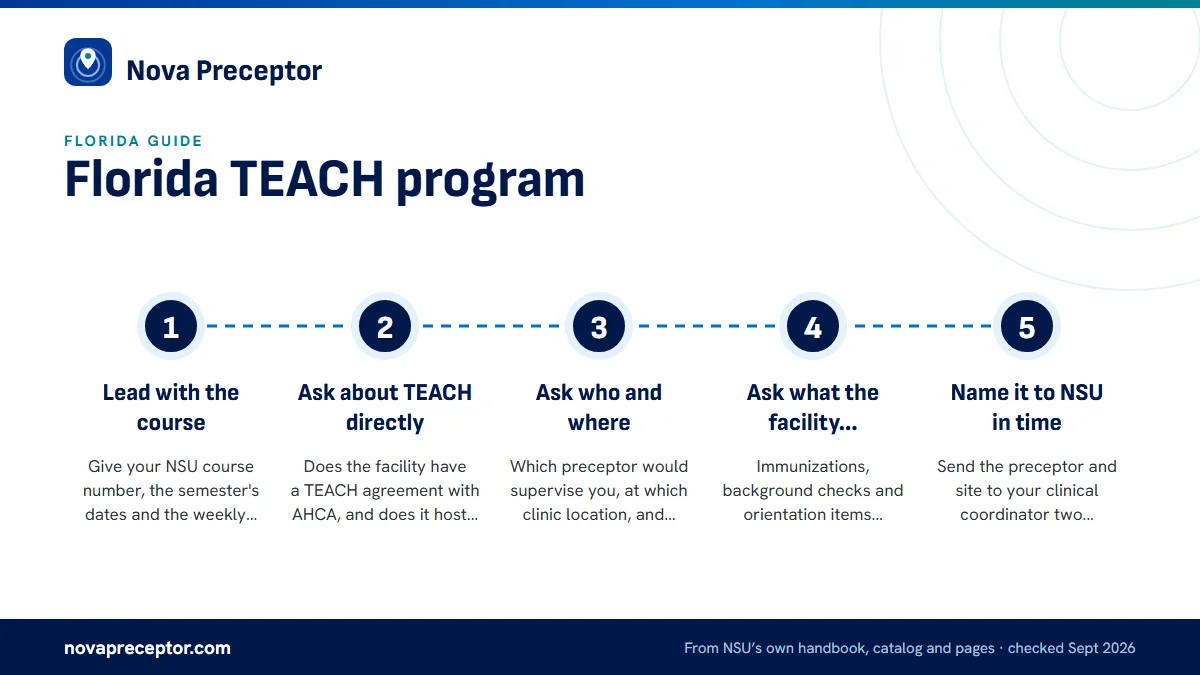
- Lead with the courseGive your NSU course number, the semester's dates and the weekly hours the course needs.
- Ask about TEACH directlyDoes the facility have a TEACH agreement with AHCA, and does it host APRN students under it?
- Ask who and whereWhich preceptor would supervise you, at which clinic location, and whether that preceptor's license and specialty fit your course.
- Ask what the facility requiresImmunizations, background checks and orientation items, which you line up alongside your CastleBranch record.
- Name it to NSU in timeSend the preceptor and site to your clinical coordinator two semesters before the course.
Why NSU students choose us for community-site searches
We approach FQHCs and community clinics near your home ZIP code with what a site wants to see: your NSU course, dates, weekly hours and compliance status. We raise TEACH where it applies, confirm the preceptor fits Florida's rule and your course, and have the package ready for your clinical coordinator before your notice date. Approval of the site and preceptor rests with NSU's clinical coordinator; we make sure the request lands complete and in line with NSU's rules. Share your course and ZIP area in the form below.
Questions NSU students ask
Does Florida's TEACH program pay students or preceptors?
Neither. TEACH reimburses the qualifying facility, such as an FQHC or community mental health center, a set hourly amount in the statute for clinical training time, up to an annual cap. Students and individual preceptors receive nothing from the program. Florida also has no preceptor tax credit, and with no state personal income tax there is nothing for one to attach to.
Can PMHNP students train at a TEACH facility?
A community mental health center or CCBHC can host a PMHNP student like any other site NSU approves. Whether the facility can claim TEACH reimbursement for that student depends on whether a psychiatric NP counts as pursuing a primary-care specialty, which the statute's wording leaves open. Ask the facility how it treats PMHNP students, and confirm the site with your clinical coordinator.
Does a TEACH facility have to accept me as a student?
No. TEACH reimburses facilities that choose to host trainees; it creates no right to a placement and does not assign students to sites. Each facility decides whom it takes, and NSU's clinical coordinator decides whether the site and preceptor meet NSU's requirements. Asking early, with your course, dates and weekly hours ready, gives a clinic what it needs to say yes.
How long will the TEACH program last?
The statute sunsets on July 1, 2034. Funding can shift from year to year: the first report says nursing-student participation was limited in year one for lack of funding and that later legislation addressed it. When you contact a facility, ask about its current TEACH status rather than relying on the 2025 report.
Do out-of-state nursing programs use TEACH sites too?
Yes. The first TEACH report found that out-of-state and international schools made up about 24% of trainees, all training under Florida-licensed preceptors through affiliation agreements with Florida sites. Florida's preceptor rule applies to them exactly as it applies to NSU students, so community clinics field requests from many programs at once.
Related pages
Last checked 2026-09-25
We check these pages against NSU's own handbook, catalog and program pages. The graduate clinical guide, your course in Canvas, your clinical coordinator and your program director have the final word.
NSU lets you name your own preceptor. We make sure you have one, close to home and in time.
Tell us your NSU program, your home ZIP area and when your next clinical course starts. We find preceptors who fit the course and have everything ready for your clinical coordinator well before the two-semester notice.
- Preceptors matched to the course: primary care for FNP, acute care for AGACNP, psychiatric care for PMHNP, a practice site for DNP project hours
- Named early enough for NSU's two-semester notice, with license, credentials and site details ready for the coordinator
- Close to your home ZIP code, with clinic days we plan around your work schedule
Start your placement plan
Program, ZIP area and start term is all we need to begin.