Bringing your own preceptor to NSU: fit, approach and approval
Bringing your own preceptor to NSU means finding a clinician and site that suit one specific clinical course, putting their names in front of your clinical coordinator a full two semesters early, and letting the coordinator confirm the match. Done well, it keeps your clinical hours near home, in the setting you want, on days that work with your job. This page covers which preceptor fits each NSU course, how to approach one and what the coordinator checks.
Find a preceptor who fits your course
Tell us your track and next clinical course. Your placement advisor searches near your home for the right practice.
What bringing your own preceptor means at NSU
NSU's handbook treats APRN students as active partners and gives them the first move. Once you have found a preceptor and a place to train, you report both to the clinical coordinator in time, and the coordinator confirms them. Only when nothing is requested does the coordinator step in and place you, anywhere within 150 miles of home, with no negotiating afterward (the 150-mile rule).
So bringing your own is really about deciding the details that matter to you: which town, which practice, which days of the week. Every preceptor and site you propose still goes through the coordinator. Your job is to propose ones that clearly pass, in time for the notice date.
Which preceptor fits which NSU course
NSU keeps its own rules on preceptor type inside the graduate clinical guide, which is unpublished, so start from the courses themselves. Their titles in the 2026-27 graduate catalog say what kind of practice each one needs.
| Track | Clinical course | Hours | Look for a preceptor in |
|---|---|---|---|
| FNP | NSG 5549 Primary Care Adult I Clinical; NSG 5559 Primary Care Adult II Clinical | 190 each | Adult or family primary care |
| FNP | NSG 5589 Primary Care Pediatrics Clinical | 95 | Primary care that sees children, pediatric or family |
| FNP | NSG 5569 Primary Care Women Clinical | 95 | Women's health within primary care |
| FNP | NSG 5599 Family Nurse Practitioner Capstone Clinical | 285 | Family primary care across the life span |
| AGACNP | NSG 5629, NSG 5639, NSG 5659 Adult-Gerontology Acute Care I, II and III Clinical | 190 each | Hospital and acute-care services for adults and older adults |
| AGACNP | NSG 5669 Adult-Gerontology Acute Care Capstone Clinical | 285 | Acute care |
| PMHNP | NSG 5719 (psychopathology and the DSM) and NSG 5729 (child and adolescent mental health) | 190 each | Psychiatric practice; for NSG 5729, one that sees children and adolescents |
| PMHNP | NSG 5739 (modalities of psychotherapy) and the NSG 5799 capstone | 190 and 285 | Psychiatric practice that includes therapy, then integrated psychiatric care |
Within Florida's rules the preceptor can be a Florida-licensed APRN in that specialty or a physician who practices it: a family NP or family physician for FNP courses, an acute-care NP, hospitalist or intensivist for AGACNP, a psychiatric NP or psychiatrist for PMHNP. Which of those NSU prefers for a given course is a question for your coordinator. The FNP, AGACNP and PMHNP course pages go deeper, course by course.
Florida's license test at Florida sites
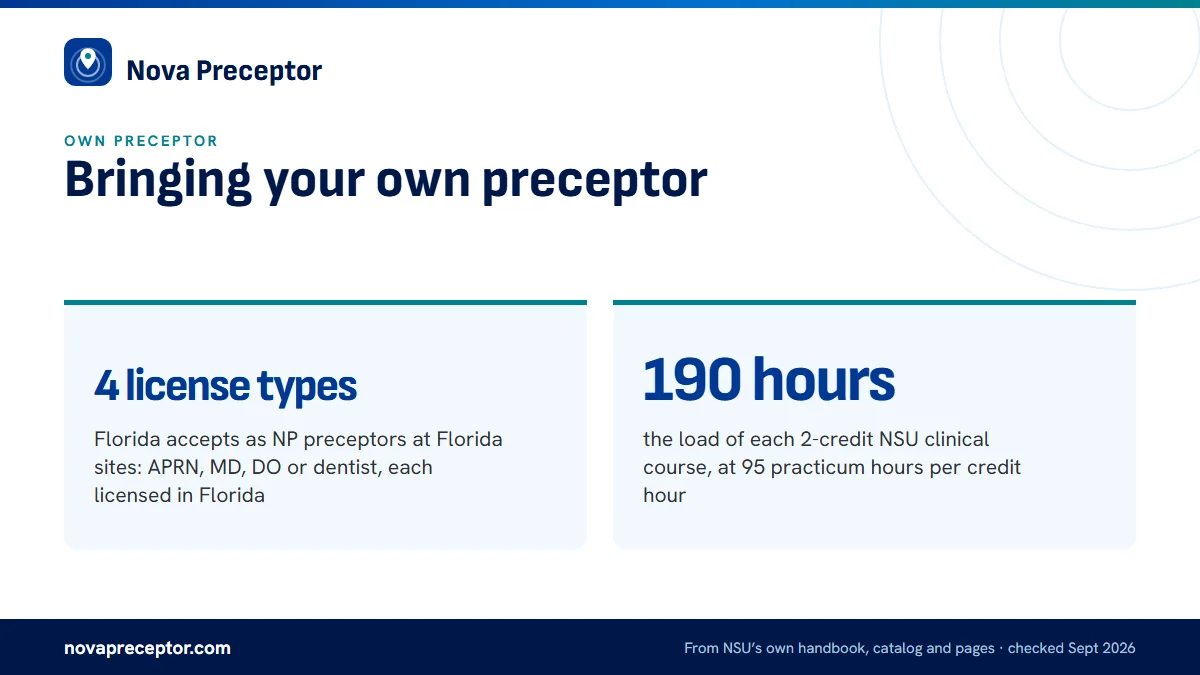
At any clinical site in Florida, state law sets a floor before NSU's own review. Florida Administrative Code rule 64B9-4.001(13) limits NP preceptors to certified, practicing APRNs and to physicians (MD or DO) and dentists, each holding a Florida license, and it requires you to hold an RN license under chapter 464. Physician assistants are not on that list, so a PA does not meet Florida's definition of a qualified preceptor for an NP student.
Protocol-based and autonomous APRNs both qualify, since the rule looks at the license rather than the practice arrangement. The details, including an open question about multistate RN licenses, are on Florida's preceptor rule and the protocol and autonomous APRN guide. Train outside Florida and the host state's own rules sit alongside NSU's instead.
Approaching a preceptor: what they will ask
A clinician weighing your request will want specifics. Have these answers ready before you call, email or stop by the practice.
Questions preceptors ask, and where NSU's answers are
- How many hours? NSU sets clinical time at 95 practicum hours per credit hour, so a 2-credit clinical runs 190 hours, FNP pediatrics and women's health 95 each, and each capstone 285 (the hour math). Certificate students should check their own plan, since NSU's certificate figures differ.
- What does a week look like? Hours start in the course's first week, continue weekly and cannot be squeezed into a few weeks at either end. Any missed day is made up.
- Which dates? NSU posts no graduate term calendar, so take the course start and end dates from your program or your course in Canvas and give them to the preceptor in writing.
- What will NSU send me? NSU does not publish its preceptor forms, agreement or orientation. Ask your clinical coordinator what the preceptor will receive, and when, so your answer is accurate.
- Does the site need an agreement with NSU? ACON holds affiliation agreements with many healthcare institutions, but the list, and how a new site is added, are not public. Raise it with the coordinator as soon as you have a site in mind.
- What will you have done before day one? Your DISA CastleBranch items plus anything the site adds, for example a fingerprint-based level 2 check, drug testing, additional vaccines, or BLS and ACLS cards.
Once a preceptor agrees, confirm the specifics in writing (course, semester, weekly days, total hours) before the notice goes to NSU.
What the clinical coordinator checks
The handbook gives the coordinator two questions. Does the preceptor meet NSU's requirements for clinical supervision? Does the site offer the clinical experience the course needs? It then says plainly that clinical coordinators approve the site and the preceptor. The first question is measured against NSU's own standards in the graduate clinical guide, the second against the course, which is why an excellent preceptor in the wrong setting can still be turned down for a particular clinical.
NSU publishes neither the documents the coordinator wants nor a time frame for the decision. Ask early, and give the coordinator a clean package: the preceptor's credential and license details, the site's details and a short note tying the practice to the course. The clinical coordinator page covers the role, and preceptor requirements collects what is public about NSU's standards. Hoping to train where you work? NSU publishes no rule on it; see clinicals at your employer.
Where students' own arrangements come unstuck
Watch for these avoidable mismatches before you propose anyone.
- A practice that does not match the course title, such as an outpatient clinic proposed for an acute-care clinical.
- A preceptor who can host 190 hours only as a few long days late in the term, which the weekly rule does not allow.
- A physician assistant, or a clinician licensed only in another state, proposed for a Florida site.
- A site requirement discovered late, such as fingerprinting that takes weeks to clear.
- A yes for the adult courses that does not stretch to pediatrics, women's health or the capstone, leaving later notices uncovered.
A preceptor's yes is not a placement until the coordinator confirms it. Keep searching for your later courses while you wait.
Where we come in
The own-preceptor route hands you the most control, and making it easy is what we do. Your placement advisor finds preceptors near your home whose practice matches each course, checks the Florida license question, and has the capacity conversation up front: weekly days, total hours, semester dates.
Then we package what your clinical coordinator will weigh, keep each site's checklist next to your CastleBranch status, and line each preceptor up ahead of its two-semester notice (your notice date). The coordinator has the final say; we give them a proposal that answers both of their questions on the first read. If a preceptor withdraws later, the replacement search starts straight away. Begin with the placement request form.
Questions NSU students ask
Can a physician be my preceptor at NSU?
Yes, as far as Florida is concerned: at a site in the state, a Florida-licensed MD or DO counts as a qualified NP preceptor. Whether NSU accepts a physician for a specific course is set out in the graduate clinical guide, which NSU does not publish. Choose a physician whose practice matches the course, and confirm with your clinical coordinator before you send the notice.
Can a physician assistant precept an NSU nurse practitioner student?
Not at a Florida site under state rules. Florida's definition of a qualified preceptor for NP students covers APRNs, MDs, DOs and dentists licensed in Florida; physician assistants are not included. NSU's own list of acceptable preceptor types is not public, so for a site outside Florida, ask your clinical coordinator.
Can one preceptor cover all my NSU clinical courses?
NSU publishes no rule on it. Each clinical course has its own notice and the coordinator judges fit course by course, so a family primary-care preceptor might suit several FNP courses while pediatrics or women's health needs a different practice. Whether hours may be split across sites is also unpublished, so ask your coordinator.
What paperwork does NSU need from my preceptor?
NSU does not publish its preceptor forms, agreement or orientation materials. Because the coordinator must confirm that the preceptor meets NSU's supervision requirements, expect to supply license and credential details at the least. Ask your clinical coordinator for the current list, and make the request through SharkMail so it is on record.
Can my preceptor be someone I work with?
NSU's public documents neither allow nor forbid training at the place you work, or under a colleague. The coordinator still decides whether the preceptor and site fit the course, so raise the question before you send your notice rather than after, and have a second option ready in case the answer is no.
Related pages
Last checked 2026-09-25
We check these pages against NSU's own handbook, catalog and program pages. The graduate clinical guide, your course in Canvas, your clinical coordinator and your program director have the final word.
NSU lets you name your own preceptor. We make sure you have one, close to home and in time.
Tell us your NSU program, your home ZIP area and when your next clinical course starts. We find preceptors who fit the course and have everything ready for your clinical coordinator well before the two-semester notice.
- Preceptors matched to the course: primary care for FNP, acute care for AGACNP, psychiatric care for PMHNP, a practice site for DNP project hours
- Named early enough for NSU's two-semester notice, with license, credentials and site details ready for the coordinator
- Close to your home ZIP code, with clinic days we plan around your work schedule
Start your placement plan
Program, ZIP area and start term is all we need to begin.