NSU's postgraduate FNP certificate: courses, 765 hours and preceptors
NSU's postgraduate FNP certificate is five courses, 24 credits and 765 clinical hours for nurses who already hold an accredited MSN: NSG 5542, NSG 5550, NSG 5560, NSG 5580 and NSG 5590. It is hybrid today and moves online in 2027, though NSU's sources name two different starting points. Because all five courses carry clinical hours, your first preceptor search can begin before your first term does.
Plan your FNP certificate preceptors
Tell us your start term and home ZIP area. We map every clinical course to a preceptor near you.
The five FNP certificate courses and their hours
The certificate is for a nurse who already holds a master's degree in nursing and wants to add the family nurse practitioner role. NSU's certificates page lists five courses, and each one carries its lecture content and its clinical hours in a single registration. The per-course hours below are NSU's; the 765 total is our addition, since the page gives the figures course by course.
| Course | Title | Credits | Clinical hours |
|---|---|---|---|
NSG 5542 | Primary Care: Adult I | 6 | 170 |
NSG 5550 | Primary Care: Adult II | 6 | 170 |
NSG 5560 | Primary Care Women | 3 | 85 |
NSG 5580 | Primary Care Pediatrics | 3 | 85 |
NSG 5590 | Family Nurse Practitioner Capstone (the FNP page calls it the Primary Care Integration Practicum) | 6 | 255 |
| Total | 24 | 765 (our sum) |
The pattern is 170 hours for each 6-credit adult course, 85 for each 3-credit course and 255 for the 6-credit capstone. NSU's master's FNP track now works another way: it pairs every didactic course with its own clinical course, such as NSG 5542 beside NSG 5549, and counts 95 hours per credit hour, which is how the MSN reaches 855. The arithmetic behind both totals lives on our page about 95 practicum hours per credit.
Before you enroll: the three Ps and the gap analysis
Before the first certificate course, you need three 3-credit graduate courses behind you: Advanced Pathophysiology (NSG 5531), Advanced Pharmacology (NSG 5510) and Advanced Health Assessment (NSG 5502). NSU's FNP page calls this the three-Ps rule. If your master's transcript lacks one of them, the certificates page has you apply first as a non-degree-seeking student and finish it.
The 2025-26 handbook adds a formal gap analysis for each certificate applicant, and its outcome settles which coursework or clinical hours, if any, you may skip. NSU publishes no standard waiver, so the hour count that governs your preceptor planning is the one in your own gap analysis. Our certificate gap analysis guide explains how the review fits with the hour figures for all three tracks.
Admission: a Florida RN license and the 225-mile residence rule
On the certificates page, the admission list starts with the basics: a 3.0 GPA in your master's, an NLNAC- or CCNE-accredited MSN, a CV, and a year of active independent clinical practice (residency positions and facility operations roles do not count toward it).
Two further items decide where your clinicals can happen. You must hold an active Florida RN license, which NSU says must remain current in the jurisdiction of the practicum, and you must live no more than 225 miles from the program campus. The 2025-26 handbook also asks for Florida licensure and puts the GPA floor at 2.75 for applicants with at least two years of experience, 3.0 for everyone else.
Here NSU's documents pull apart. The 2026-27 graduate catalog prints no mileage rule for any program, and it now accepts any unrestricted RN license from FNP master's applicants. If you live outside Florida, or farther than 225 miles from Palm Beach or Tampa Bay, ask admissions or the FNP program director to confirm your eligibility in writing before you apply. Every version of the license rule is laid out on RN license rules for NSU clinicals.
The Florida license matters at the site too. Under Florida Administrative Code 64B9-4.001(13), anyone training at a Florida clinical site needs RN licensure issued under the state's nursing chapter, 464, and the person precepting them needs a Florida license of their own, whether as an APRN, a physician (MD or DO) or a dentist. Our page on Florida's preceptor rule covers the detail.
Hybrid today, online in 2027: which date applies to you
The FNP certificate currently mixes online coursework with time on site, and the certificates page places FNP certificate students at the Palm Beach and Tampa Bay campuses. NSU has announced a move to fully online coursework, but its documents give two starting points. None of them publishes the certificate's intensive schedule or says whether any campus days survive the switch.
| Source | Format | Admit terms |
|---|---|---|
| Certificates page | Online and on site; FNP at Palm Beach and Tampa Bay | Deadlines August 1 (fall) and December 1 (winter) |
| FNP program page | Fully online coursework from the 2027-2028 academic year | Winter only if you have the three Ps; fall only if you still need them |
| 2026-27 graduate catalog | Hybrid now; online format from summer 2027 | Twice a year, with a fall and winter plan and a separate summer plan |
| 2025-26 catalog | Hybrid | FNP certificate in winter only |
A start between summer 2027 and fall 2027 is where the two dates disagree about campus travel. Ask the program director which format your cohort follows and whether the three Ps fix your admit term, and keep the answer in writing.
The summer plan and the missing NSG 5549
The 2026-27 catalog adds a summer certificate plan built like the master's track: a didactic course and a separate clinical course, with 190 hours for each 2-credit clinical, 95 for each 1-credit clinical and 285 for the 3-credit capstone clinical. For FNP it lists NSG 5542, then NSG 5550 with NSG 5559, NSG 5560 with NSG 5569, NSG 5580 with NSG 5589, and NSG 5590 with NSG 5599.
NSG 5549, Primary Care Adult I Clinical, is absent. Every other NSU plan pairs it with NSG 5542, so an omission in the catalog is the likeliest reading, but NSU has not said so. By our arithmetic the listed summer clinicals total 665 hours; adding NSG 5549 at 190 gives 855, the total the summer AGACNP and PMHNP certificate plans reach.
The gap has a practical edge. If NSG 5549 belongs in your first summer term, you need an adult primary-care preceptor named two semesters before that term opens.
Summer starters: confirm in writing whether your plan includes NSG 5549 before you count hours or ask a preceptor to commit.
When to line up each FNP certificate preceptor
Under the handbook, you have until two semesters before a clinical course begins to let the clinical coordinator know which preceptor and site you have lined up. Reach that point with nothing named and the coordinator chooses a site for you anywhere inside a 150-mile radius of your home ZIP code, a choice the handbook calls not negotiable. We explain how the two-semester notice is counted and what a 150-mile placement means on their own pages.
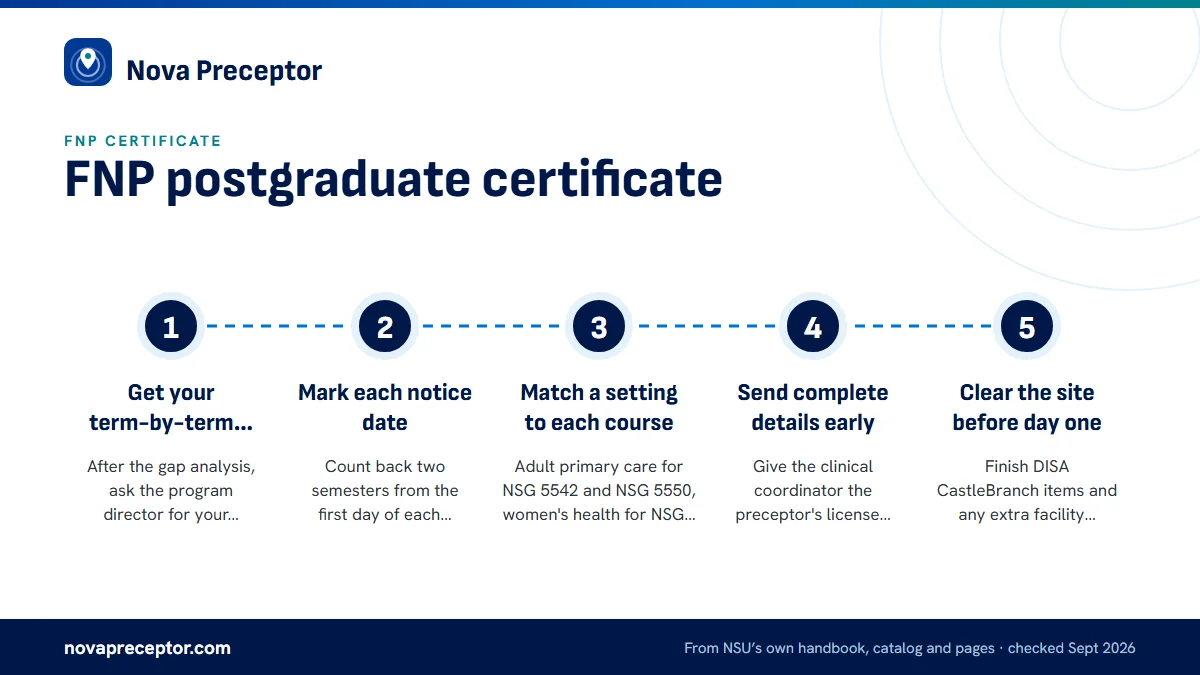
A certificate squeezes that timeline, because the whole program fits inside two years. If NSG 5542 sits in your first certificate term, counting back two semesters lands before your first day of class. Work through it in this order:
- Get your term-by-term planAfter the gap analysis, ask the program director for your sequence and whether you follow the fall and winter plan or the summer plan.
- Mark each notice dateCount back two semesters from the first day of each course with clinical hours.
- Match a setting to each courseAdult primary care for
NSG 5542andNSG 5550, women's health forNSG 5560, pediatrics forNSG 5580, and primary care again for theNSG 5590integration practicum. Our FNP clinical courses guide describes each one; the coordinator confirms the fit. - Send complete details earlyGive the clinical coordinator the preceptor's license, credentials and site details well ahead of the notice date.
- Clear the site before day oneFinish DISA CastleBranch items and any extra facility requirements before hours begin. Per the handbook, any facility requirement left open on your first scheduled day ends that placement before it begins.
Why FNP certificate students choose us
A certificate leaves little room between admission and the first clinical hours, and our process is built for that window. We begin with the term-by-term plan NSU gives you, find preceptors close to home who fit each FNP course, and have every one named ahead of that course's two-semester notice.
For each preceptor we gather what the clinical coordinator reviews: proof of licensure, credentials, a description of the practice and a clear note on why it suits adult primary care, women's health, pediatrics or the capstone. At Florida sites we check the preceptor's Florida license against the state rule. We also work through the site's own list with you, from CastleBranch items to immunizations and background checks, and if a preceptor steps away mid-program we are already looking for the next one.
The coordinator signs off on every preceptor and site, and our part is making sure the packet in front of them has nothing missing. Our step-by-step process explains the rest, or start with the form below.
Questions NSU students ask
Is NSU's FNP certificate online?
Not yet. It is hybrid now, with on-site time at the Palm Beach or Tampa Bay campus. NSU's program pages say fully online coursework begins with the 2027-2028 academic year, while the 2026-27 graduate catalog says summer 2027. Ask the FNP program director which format applies to your start term and whether any campus days remain after the change.
Can my first MSN reduce the FNP certificate's clinical hours?
Possibly. The 2025-26 handbook requires a formal gap analysis for certificate applicants, and that review decides whether coursework or clinical hours are waived. No standard waiver is published, so the number that counts is the one in your own gap analysis. Plan preceptor hours only after you have the result in hand.
Does NSU's FNP certificate require Florida RN licensure?
According to the certificates page, yes: you need an active Florida RN license, and it has to stay current wherever your practicum is. For the FNP master's track, the 2026-27 catalog no longer names Florida, so ask admissions whether the certificate will change once it moves online. Any Florida clinical site also needs you licensed in Florida under state rule.
What if I have not taken advanced pathophysiology, pharmacology or health assessment?
Take them first. All three, NSG 5502, NSG 5510 and NSG 5531, must be done before certificate coursework begins, and the certificates page routes applicants who lack them through non-degree-seeking status. The FNP program page ties this to your admit term: winter admission only if you already have the three courses, fall admission only if you still need them.
How long do I have to finish the FNP certificate?
The 2026-27 graduate catalog allows two years or six semesters at most. Since every certificate course carries clinical hours, a preceptor who leaves mid-course can push you toward that limit. Having each preceptor named early, with a second option in mind for the adult courses, protects your timeline.
Related pages
Last checked 2026-09-24
We check these pages against NSU's own handbook, catalog and program pages. The graduate clinical guide, your course in Canvas, your clinical coordinator and your program director have the final word.
- NSU A.P.R.N. Postgraduate Certificates page
- NSU M.S.N.-A.P.R.N. Family Nurse Practitioner page
- Ron and Kathy Assaf College of Nursing 2026-2027 Graduate Catalog
- NSU Nursing Student Handbook 2025-2026, certificate admission (printed p.107)
- NSU Nursing Student Handbook 2025-2026, graduate A.P.R.N. clinical rules (printed p.123)
NSU lets you name your own preceptor. We make sure you have one, close to home and in time.
Tell us your NSU program, your home ZIP area and when your next clinical course starts. We find preceptors who fit the course and have everything ready for your clinical coordinator well before the two-semester notice.
- Preceptors matched to the course: primary care for FNP, acute care for AGACNP, psychiatric care for PMHNP, a practice site for DNP project hours
- Named early enough for NSU's two-semester notice, with license, credentials and site details ready for the coordinator
- Close to your home ZIP code, with clinic days we plan around your work schedule
Start your placement plan
Program, ZIP area and start term is all we need to begin.