Pediatric and women's health preceptors for NSU FNP students
NSG 5589 Primary Care Pediatrics Clinical and NSG 5569 Primary Care Women Clinical are NSU's two 95-hour FNP clinicals, and you take them in the same semester. They are short, yet they are usually the hardest two preceptors to line up: each needs a specialty practice, both notices fall due together, and at a Florida site both preceptors must be Florida-licensed APRNs, MDs or DOs.
Get your placement plan
Tell us your NSU program and your home ZIP area. A placement advisor replies with preceptor and site options near you that fit your NSU course.
Two short clinicals in one semester
Both courses are 1-credit clinicals, each paired with a 2-credit didactic course: NSG 5580 Primary Care Pediatrics and NSG 5560 Primary Care Women. NSU schedules all four together, after the two adult primary care courses and before the capstone. Their 190 combined hours equal one adult clinical, divided between two specialties and usually two sites.
NSG 5589 pediatrics | NSG 5569 women's health | |
|---|---|---|
| Credits and hours | 1 credit, 95 hours | 1 credit, 95 hours |
| Paired didactic course | NSG 5580 Primary Care Pediatrics, 2 credits | NSG 5560 Primary Care Women, 2 credits |
| Semester: full-time / flex / BSN to DNP | V / VII / VI | V / VII / VI |
| Preceptor notice falls in semester | III / V / IV | III / V / IV |
Certificate students meet an older structure: NSU's certificates page lists NSG 5580 and NSG 5560 as 3-credit combined courses with 85 hours each, while the 2026-27 catalog's summer certificate plan uses the separate 95-hour clinicals. The 95 hours per credit page explains why the figures differ.
Why these two preceptors are the hardest to find
Adult primary care is a broad outpatient field, and many kinds of office can host NSG 5549 or NSG 5559. Pediatrics and women's health narrow the field in four ways at once.
- Specialty caseloads. Many adult-focused practices see few children and send gynecologic and prenatal care elsewhere, so the office that hosted your adult hours may not fit either title.
- Two approvals, one deadline. Both preceptors are due to your clinical coordinator in the same semester, two semesters ahead of the courses, so two searches have to run side by side.
- A whole term for 95 hours. NSU expects weekly attendance from the first week and bars compressing hours at either end, so a preceptor hosting a short clinical still has you in clinic across the entire semester.
- Demand from other programs. Pediatric and women's health offices in Florida hear from students of many schools, including out-of-state online programs whose students must meet the same Florida preceptor rule.
None of this means taking whatever comes along. It means starting these two searches earlier than feels necessary, ideally a full semester before the notice is due.
Settings that fit each course
Your clinical coordinator decides whether a site gives the right experience for each course, and NSU's detailed criteria sit in the graduate clinical guide rather than on a public page. Settings that match the two titles:
- For
NSG 5589: general pediatric practices; family practices with a real pediatric panel of well-child visits, immunizations and acute illness; pediatric clinics inside community health centers; county health departments that run child health services. - For
NSG 5569: OB/GYN practices; women's health and family planning clinics; family practices that provide gynecologic and prenatal care; women's health services at county health departments.
Community clinics are worth a close look for both. Florida's TEACH program pays four kinds of facility (FQHCs, rural health clinics, community mental health centers and certified community behavioral health clinics) for every hour they spend training APRN students headed for primary care; see the TEACH program.
Sites may add entry requirements of their own. NSU's handbook lists pediatric advanced life support among the items a clinical site can require, along with background checks and immunizations; the BLS, ACLS and PALS page covers the cards.
Florida's preceptor rule for these two courses
At a Florida site, the Board of Nursing's rule 64B9-4.001(13) lets four kinds of clinician precept an NP student (APRNs, MDs, DOs and dentists) and attaches a license condition: the preceptor must be licensed in Florida, and you must be an RN licensed under Florida's chapter 464. For pediatrics, that points to a Florida-licensed pediatric or family NP, a pediatrician or a family physician. For women's health, it points to a Florida-licensed APRN, an OB/GYN physician or a family physician who provides that care.
Two questions fall outside the rule. Whether NSU accepts a particular specialty, a nurse-midwife for NSG 5569 for instance, depends on NSU's own preceptor requirements, which are not public. And the rule is silent on whether an RN practicing in Florida on another compact state's multistate license counts as licensed under chapter 464. Put both to your clinical coordinator, and read the full Florida preceptor rule for the wording.
Planning both inside the same semester
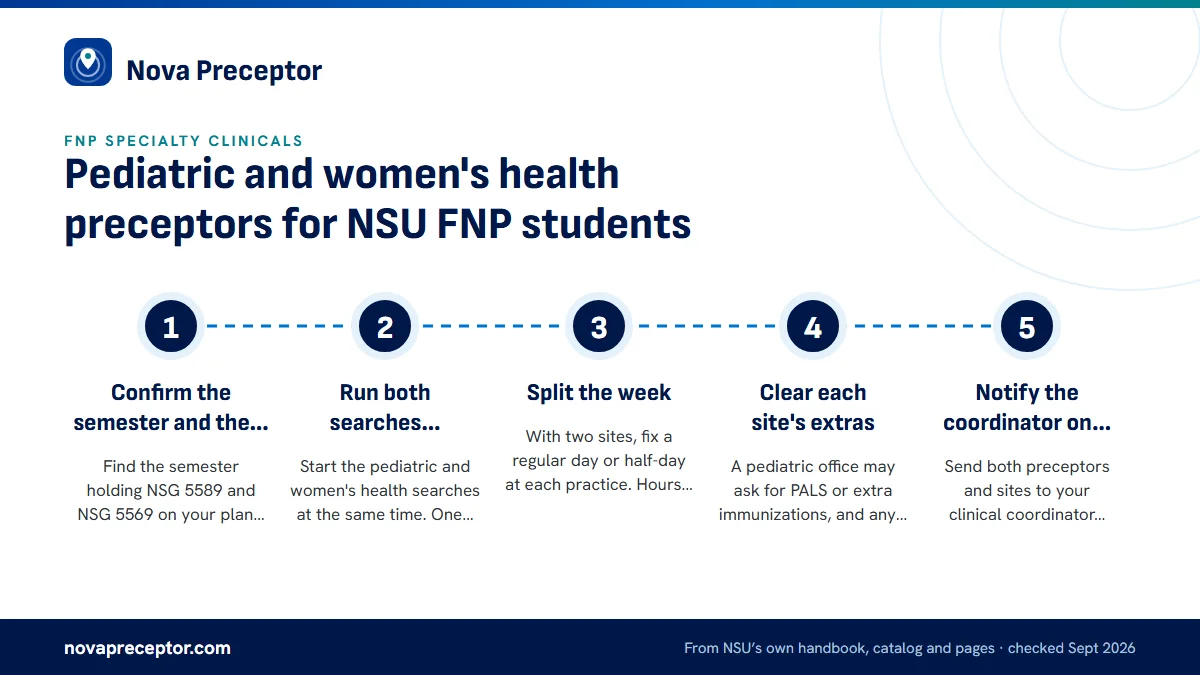
- Confirm the semester and the hoursFind the semester holding
NSG 5589andNSG 5569on your plan of study, and check with your program director whether your cohort owes 95 hours per course or the older 85. - Run both searches togetherStart the pediatric and women's health searches at the same time. One family practice with strong pediatric and women's health volume might suit both titles, but ask your coordinator before relying on a single site.
- Split the weekWith two sites, fix a regular day or half-day at each practice. Hours start with the didactic courses and cannot be bunched at the start or end of the term, so both schedules must run in parallel.
- Clear each site's extrasA pediatric office may ask for PALS or extra immunizations, and any facility can request a level 2 background check. Keep your CastleBranch record complete so neither placement is canceled on day one.
- Notify the coordinator on timeSend both preceptors and sites to your clinical coordinator two semesters ahead, then arrange to visit each site and meet each preceptor before your hours begin.
The wider FNP sequence, including where this semester sits in each plan, is on the FNP clinical courses page.
Why FNP students hand us these two searches
These are the FNP placements we begin first, because a late pediatric or women's health preceptor can stall an otherwise smooth sequence. We search for both near your home ZIP code at once, check each against the course title and Florida's license rule, and have both packets ready for your clinical coordinator before the two-semester notice. If one practice can host both courses and your coordinator agrees, we arrange that instead. When a pediatric office wants PALS or a women's clinic adds its own vaccine list, we tell you at the outset, so every item is in place well before your first clinic day.
Share your FNP plan and the semester in question with your placement advisor using the form below; how it works explains each step we take.
Questions NSU students ask
Can I do NSG 5589 in a family practice instead of a pediatric office?
Possibly, if the practice sees enough children to give you a real pediatric caseload across the whole term. The clinical coordinator decides whether the site gives the right experience for the course. When you submit a family practice, describe how much of the preceptor's panel is pediatric so the coordinator can judge the fit.
Does my NSG 5569 preceptor have to be an OB/GYN?
Not under Florida law. The state's rule accepts a Florida-licensed APRN, MD or DO as a preceptor, so a women's health NP or a family physician who provides gynecologic care can qualify. NSU's own preceptor requirements are not public, and your clinical coordinator confirms both the preceptor and the site.
Can I take the pediatrics and women's health clinicals in different semesters?
NSU's full-time, flex and BSN to DNP plans all put NSG 5580, NSG 5589, NSG 5560 and NSG 5569 in the same semester, and the MSN is a lock-step program with continuous enrollment. Any change would be your program director's decision, so plan on both clinicals running together.
How many hours a week are the pediatrics and women's health clinicals?
Each needs 95 hours. NSU does not publish graduate term lengths, but across a 16-week term that is roughly 6 hours a week per course, or about 12 for the pair. The handbook bars compressing hours at the start or end of the semester, and your course calendar in Canvas gives the real number of weeks.
Do I need PALS for the NSU pediatrics clinical?
NSU names ACLS only for AGACNP admission. For other clinicals, the handbook says sites may require basic life support, advanced life support or pediatric advanced life support. Ask each pediatric site what it requires before you submit it, and keep the card current through the whole semester.
Related pages
Last checked 2026-09-25
We check these pages against NSU's own handbook, catalog and program pages. The graduate clinical guide, your course in Canvas, your clinical coordinator and your program director have the final word.
- NSU Family Nurse Practitioner M.S.N.-A.P.R.N. page
- NSU Ron and Kathy Assaf College of Nursing 2026-2027 Graduate Catalog
- NSU Nursing Student Handbook 2025-2026: Graduate A.P.R.N. Students
- NSU Nursing Student Handbook 2025-2026: clinical site requirements
- Florida Administrative Code 64B9-4.001 (qualified preceptor)
NSU lets you name your own preceptor. We make sure you have one, close to home and in time.
Tell us your NSU program, your home ZIP area and when your next clinical course starts. We find preceptors who fit the course and have everything ready for your clinical coordinator well before the two-semester notice.
- Preceptors matched to the course: primary care for FNP, acute care for AGACNP, psychiatric care for PMHNP, a practice site for DNP project hours
- Named early enough for NSU's two-semester notice, with license, credentials and site details ready for the coordinator
- Close to your home ZIP code, with clinic days we plan around your work schedule
Start your placement plan
Program, ZIP area and start term is all we need to begin.