95 practicum hours per credit hour: NSU's clinical math
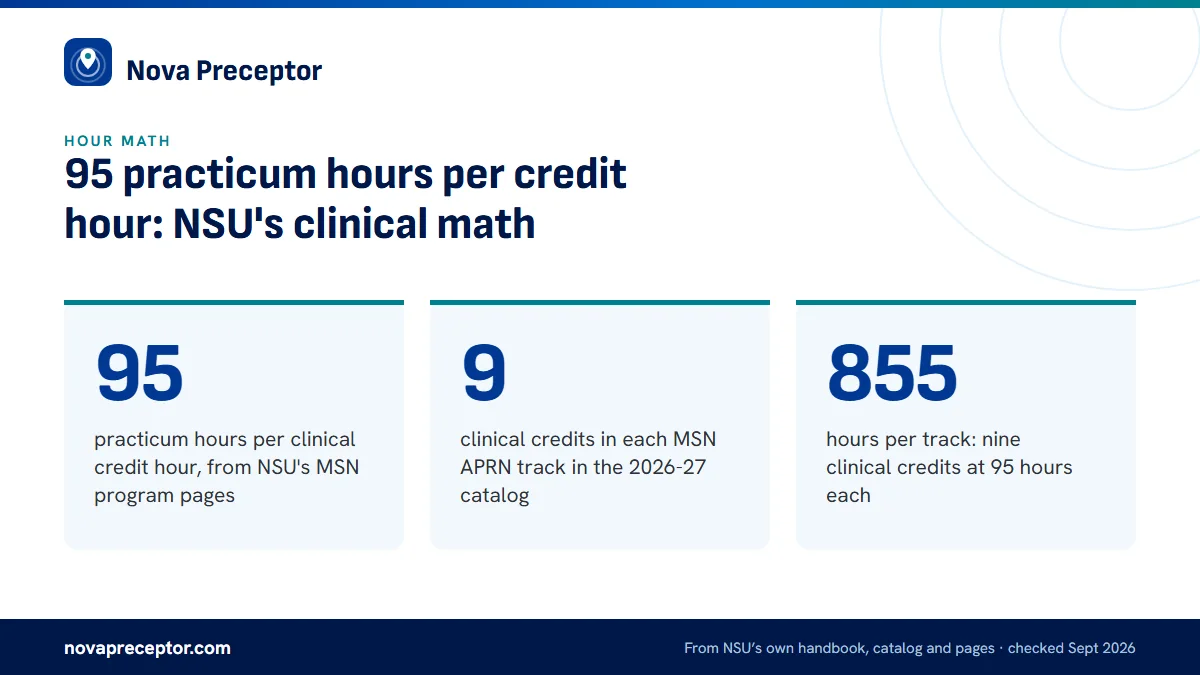
Every MSN APRN clinical course at NSU carries 95 practicum hours for each credit: 190 for a 2-credit clinical, 95 for a 1-credit one and 285 for a 3-credit capstone. Nine clinical credits per track come to 855 hours. The 2025-26 plan, and several certificate tables still online, use 170, 85 and 255 instead.
Get your placement plan
Tell us your NSU program and your home ZIP area. A placement advisor replies with preceptor and site options near you that fit your NSU course.
Where the 95-hour rate comes from
The rate appears as a footnote on NSU's Family NP, Adult-Gerontology Acute Care NP and Psychiatric-Mental Health NP pages: “*Requires 95 practicum hours per credit hour.” The asterisk marks the clinical courses in each plan of study. The ACON 2026-2027 Graduate Catalog then prints the hours beside each clinical, and every figure it gives matches the rate.
Only clinical credits carry practicum hours. Didactic courses such as NSG 5542 Primary Care Adult I or NSG 5620 Adult-Gerontology Acute Care I carry none, even though each runs in the same semester as its clinical partner. That is why a 4-credit didactic course plus its 2-credit clinical produces 190 hours rather than 570.
NSU's own web plans are not perfectly consistent about which courses get the asterisk: the AGACNP flex plan leaves NSG 5659 unstarred, and the PMHNP flex plan stars NSG 5720, a didactic course, where NSG 5729 belongs. The catalog settles it. The clinicals are the course numbers ending in 9.
The three sizes of MSN clinical course
Every MSN APRN clinical is one of three sizes, and the size tells you how much time a preceptor is signing up for.
| Clinical credits | Hours at 95 per credit | NSU courses of this size |
|---|---|---|
| 1 | 95 | NSG 5589 Primary Care Pediatrics Clinical and NSG 5569 Primary Care Women Clinical (FNP) |
| 2 | 190 | NSG 5549 and NSG 5559 (FNP); NSG 5629, NSG 5639 and NSG 5659 (AGACNP); NSG 5719, NSG 5729 and NSG 5739 (PMHNP) |
| 3 | 285 | NSG 5599, NSG 5669 and NSG 5799, the capstone clinicals |
FNP reaches nine clinical credits as 2 + 2 + 1 + 1 + 3; AGACNP and PMHNP reach it as 2 + 2 + 2 + 3. Nine at 95 is 855 for all three tracks. NSU prints the per-course hours but not that total, so read 855 as a sum you can check yourself rather than a number you will find quoted. The course pages give the detail: FNP, AGACNP and PMHNP.
The older plan: 170, 85 and 255 inside combined courses
Before the MSN went online, NSU's 2025-26 health colleges catalog described a 51-credit hybrid program in which clinical hours lived inside combined didactic-and-clinical courses rather than separate clinicals. For FNP, each adult primary care course carried 170 hours, pediatrics and women's health 85 each, and the capstone 255, for 765 in all. AGACNP and PMHNP followed the same 170-and-255 pattern. The delivery was different too: that catalog placed FNP in a hybrid format at Palm Beach and Tampa Bay, AGACNP in an executive format of one weekend a month at Palm Beach, and PMHNP in a hybrid format at Miramar and Tampa Bay.
Those older figures line up with 85 hours per clinical credit: 170 is two credits' worth and 255 is three. NSU never printed an 85-hour rate, so take that as our arithmetic. It does explain the gap neatly, though: nine clinical credits each gaining 10 hours is exactly the 90 hours separating 765 from 855.
Why the totals moved from 765 to 855
NSU has not published its reasons for the change, so the honest answer is a list of what changed. The current curriculum gives every clinical its own course number, trims the core from 15 credits to 12 (the older core held NSG 5101 and NSG 5571; the new one adds NSG 5512 Diagnostic Reasoning), moves coursework online with short on-campus intensives, and sets clinical hours at 95 per credit. Program credits fell from 51 to 45 for FNP and AGACNP and 48 for PMHNP, while clinical hours rose.
For you the change shows up course by course. A 2-credit clinical now asks a preceptor for 190 hours instead of 170, each short FNP specialty clinical for 95 instead of 85, and a capstone for 285 instead of 255. If you began under the older plan, ask your program director which figures your remaining courses carry before you give any preceptor a number. The 2026-27 changes page covers the rest of the move online.
Certificates still show the older numbers
The certificates page, and the certificate sections of the three MSN track pages, still list combined courses: 6-credit courses with 170 hours, 3-credit courses with 85, and 6-credit capstones with 255 or 225. That gives the FNP certificate 765 hours. The AGACNP certificate comes to 765 or 735 depending on the capstone: the certificates page lists NSG 5660 at 225 hours, while the AGACNP page and both catalogs list 255.
The PMHNP certificate is where the two systems collide. The web pages give 170 hours to each of NSG 5710, NSG 5720 and NSG 5730 and 255 to NSG 5790, or 765; the 2026-27 catalog gives 190 and 285, or 855. That catalog also adds summer certificate plans built from the MSN-style didactic and clinical pairs. Its summer FNP list includes NSG 5542 without NSG 5549, which looks like an omission rather than a real change. Waivers and personal totals are on the certificate gap analysis page.
Certificate students: NSU's published hour figures for the same certificate do not agree. Confirm your total with your program director before you ask anyone to precept you.
Other NSU conversions: DNP project hours and BSN clock hours
The 95-hour rate belongs to the MSN clinicals, including the ones inside BSN to DNP. The DNP project courses convert differently: NSU's BSN to DNP page says “2 credits practicum = 150 practicum hours”, which works out to 75 hours per practicum credit. NSG 7431, NSG 7444, NSG 7445 and NSG 7451 each carry 2 practicum credits and 150 hours; the DNP project practicum page explains the practice site they need.
Undergraduate clinicals count clock hours. NSU's BSN key sets 1 clinical credit at 50 clock hours, 2 at 100 and 3 at 150, for a computed 750 across the program. None of this alters the MSN clinicals inside BSN to DNP: NSG 5549 is 190 hours whether you take it in the MSN or on the way to the doctorate. The clinical hours hub sets every program's total side by side.
Getting the number right with your preceptor
Preceptors agree to hours, not credits, so the conversion matters on the day you ask. We bring the exact figure for your course and cohort to every preceptor conversation, spread across the weeks of your term the way NSU requires, so nobody finds out in week ten that a capstone needs 285 hours rather than 255. Where NSU's figures for your certificate disagree, we plan to the higher number until your program director confirms otherwise, which keeps your preceptor's commitment on the safe side.
We look for that preceptor close to your home ZIP code and package the details your clinical coordinator reviews well ahead of NSU's two-semester notice. Start with the form below, or see how it works step by step.
Questions NSU students ask
Does NSU use 95 hours per credit for every nursing course?
No. The 95-hour rate covers the MSN APRN clinical courses, which also appear in BSN to DNP and in the 2026-27 summer certificate plans. DNP project courses convert at 150 hours for 2 practicum credits, and the BSN uses 50 clock hours per clinical credit. Didactic courses carry no practicum hours at all.
Is 855 hours printed anywhere by NSU?
Not as an MSN program total. The 2026-27 catalog prints 190, 95 and 285 beside each clinical course, and the web pages print the 95-per-credit rate; adding them gives 855 for FNP, AGACNP and PMHNP alike. The one total NSU does print is 1,455 for BSN to DNP, which matches 855 clinical hours plus 600 project hours.
I started NSU under the 765-hour plan. Do my hours change?
NSU does not publish a transition rule for students who began under the 2025-26 hybrid plan. Your program director and each clinical course's syllabus in Canvas set the figure you have to reach. Ask before you confirm hours with a preceptor, because the gap is 20 hours on every 2-credit clinical and 30 on a capstone.
Why is the AGACNP certificate 735 hours on one NSU page?
The certificates page gives the NSG 5660 capstone 225 hours, while the AGACNP program page and both catalogs give it 255. With three 170-hour courses before it, that makes 735 or 765. The 2026-27 catalog's summer certificate uses separate clinical courses and reaches 855. Treat all three as open until your program director confirms.
How many hours a week is a 190-hour clinical?
It depends on how many weeks your course runs, which you will find in Canvas; NSU does not post graduate term lengths. As an illustration, 190 hours over 16 weeks averages just under 12 a week, and a 95-hour clinical about 6. NSU requires weekly attendance from the start of didactic work and bars bunching hours at either end of the semester.
Related pages
Last checked 2026-09-25
We check these pages against NSU's own handbook, catalog and program pages. The graduate clinical guide, your course in Canvas, your clinical coordinator and your program director have the final word.
NSU lets you name your own preceptor. We make sure you have one, close to home and in time.
Tell us your NSU program, your home ZIP area and when your next clinical course starts. We find preceptors who fit the course and have everything ready for your clinical coordinator well before the two-semester notice.
- Preceptors matched to the course: primary care for FNP, acute care for AGACNP, psychiatric care for PMHNP, a practice site for DNP project hours
- Named early enough for NSU's two-semester notice, with license, credentials and site details ready for the coordinator
- Close to your home ZIP code, with clinic days we plan around your work schedule
Start your placement plan
Program, ZIP area and start term is all we need to begin.