The NSU clinical placement process, from first search to final hour
NSU's handbook sets one path for APRN students who bring their own preceptor: find a preceptor and site, report them to your clinical coordinator a full two semesters ahead of the course, receive the coordinator's confirmation, clear the paperwork, visit the site, then log hours weekly from the course's opening week. Students who name no one take the other path, a coordinator placement up to 150 miles from home. Here is the whole sequence in order, with a page for each step.
Plan your placement path
Tell us your track, plan and next clinical course. Your placement advisor maps every step against NSU's dates.
One handbook paragraph, two routes
Almost everything NSU publishes about APRN clinical placement sits in a single paragraph of the Nursing Student Handbook 2025-2026, headed "Graduate A.P.R.N. Students" on printed page 123. It opens by describing APRN students as active partners in their own education, then sets out what happens before and during each clinical course.
Read closely, that paragraph gives you two routes. On the first, you line up a preceptor and a site, report them in time, and the clinical coordinator confirms that both qualify. On the second, nothing has been requested, so the coordinator assigns a site anywhere inside a 150-mile circle around where you live. The steps below follow the first route from beginning to end. The second has its own page.
The seven steps, in NSU's order
Each step comes from the handbook paragraph or the pages it relies on. Order matters: a step finished late holds up everything behind it.
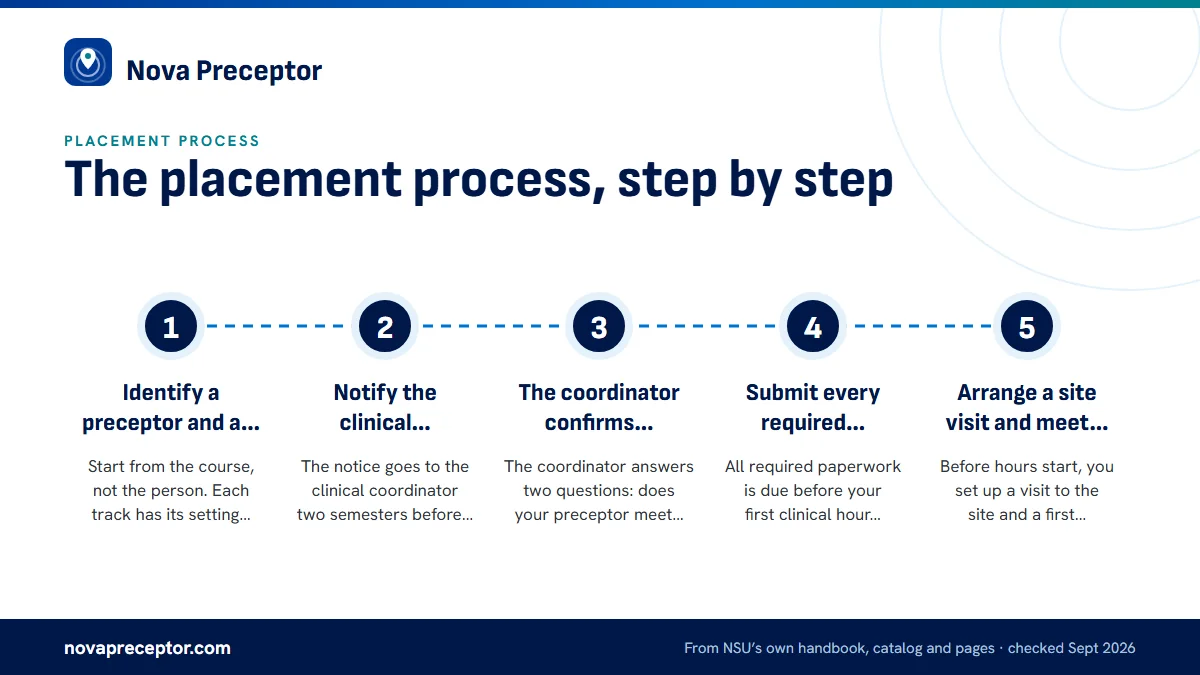
- Identify a preceptor and a clinical siteStart from the course, not the person. Each track has its setting: primary care (FNP), acute care (AGACNP), psychiatric practice (PMHNP). Florida adds a license test at Florida sites, for your preceptor and for your own RN license (Florida's preceptor rule). Bringing your own preceptor covers fit and how to ask.
- Notify the clinical coordinator two semesters aheadThe notice goes to the clinical coordinator two semesters before the clinical course begins, and every clinical course carries its own, so an FNP student sends five. The two-semester deadline page turns your start term into a date.
- The coordinator confirms preceptor and siteThe coordinator answers two questions: does your preceptor meet NSU's requirements for clinical supervision, and does this site offer the right kind of patients and practice for this course? NSU's handbook puts approval of both with the clinical coordinators (working with your coordinator).
- Submit every required document before hours beginAll required paperwork is due before your first clinical hour: your DISA CastleBranch items (immunizations, physical exam, background check) plus anything the facility adds, such as level 2 fingerprinting or a drug screen. If a facility item is still missing when day one arrives, the handbook says the placement is canceled. See clinical paperwork and CastleBranch.
- Arrange a site visit and meet the preceptorBefore hours start, you set up a visit to the site and a first meeting with the preceptor. The handbook pairs this with the paperwork and warns that missing either may jeopardize your progression, both in the course and in the APRN program. Bring your NSU ID badge, required at every clinical site.
- Log hours weekly from the course's first weekHours begin when the didactic course begins, happen weekly, and may not be crowded into the opening or closing weeks. Plan one steady schedule for the term; the weekly hours rule shows what that means beside a full-time job.
- Make up every absenceBefore a missed clinical day, three people need at least two hours' warning: your preceptor, someone at the site and your program director. Tell the clinical coordinator as well. Every absence is made up, and religious holidays do not excuse clinical time (clinical absences).
If a preceptor withdraws or a site cancels partway through, the cycle restarts at step one for that course. The placement fell through guide covers the first moves.
Where each step falls on the calendar
For one clinical course the steps stretch across most of a year. The table sets them against that course's semester, counted NSU's way, with fall, winter and summer running back to back.
| Step | When | Who is involved | Where the detail lives |
|---|---|---|---|
| Identify preceptor and site | Before the notice semester; earlier is safer | You, the preceptor, the site | Course syllabus, graduate clinical guide |
| Notify the coordinator | By the start of the semester two before the course | You, the clinical coordinator | Your coordinator (form not public) |
| Coordinator confirms | After the notice, before the course | Clinical coordinator | NSU standards (not public) |
| Paperwork | Before the first clinical hour | You, ACON Student Affairs, the site | DISA CastleBranch, the site's checklist |
| Site visit | Before the first clinical hour | You, the preceptor | Handbook, printed p.123 |
| Weekly hours | Week one to the last week of the course | You, the preceptor, course faculty | Your course in Canvas |
| Absences | Two hours' notice; every hour made up | Preceptor, site, program director, coordinator | Handbook, printed p.123 |
Each clinical course repeats the cycle, so the cycles overlap: on a full-time plan you often log hours for one course while sending the notice for a later one.
The other route: a placement by the coordinator
When a student has requested no preceptor or site, the handbook has the clinical coordinator make the placement, measured out to 150 miles from the student's residential ZIP code, and it rules out negotiating once the placement is made. This is a genuine route: NSU takes on finding the site.
What changes is control. The coordinator, not you, picks the town, the practice and the clinic days, and 150 miles is an outer limit rather than a typical distance. How coordinators pick sites, and how far students usually travel, are not published. The route-by-route comparison weighs the two side by side.
The parts of the process NSU keeps internal
APRN students are directed by the handbook to "the graduate clinical guide," and that guide holds most of the working detail. NSU does not post it on nova.edu, and none of the following is public either:
- the form or portal used for the two-semester notice, and any term-by-term deadline dates
- NSU's preceptor qualifications, such as license type, years of experience and specialty match
- the preceptor packet, agreement or orientation NSU uses
- the system used to log clinical hours and patient encounters
- the sites NSU holds affiliation agreements with, and how long a new agreement takes
Request the current guide from your clinical coordinator or program director early in the program, and put those requests in SharkMail so every answer is dated and on file. Our graduate clinical guide page suggests where to begin reading.
How long NSU has used this process
The APRN placement paragraph is not new. It appears in the 2023-24 handbook, word for word again in 2024-25, and a third time in the 2025-26 edition that NSU still serves in September 2026.
The 2023-24 history has a wrinkle. An archived copy of that edition from September 25, 2023 shows a section called "Promptness" where the clinical text later sits, while a March 5, 2024 copy carries the full APRN paragraph. The likeliest reading is that NSU added the section during the 2023-24 year, after first posting the handbook; that is an inference from archived copies, not a date NSU gives.
No 2026-27 handbook has been posted, and the 2026-27 graduate catalog differs from the handbook on delivery format, license state and residence radius. Ask your program director whether the new catalog changes anything for your class (2026-27 changes). BSN students gained their own sentence on this page in 2025-26: placement within 75 miles of campus (BSN clinicals).
Why NSU students hand the whole path to us
Our placement advisors work every step on this page, in NSU's order, for each of your clinical courses. We begin from your plan of study and the date each notice is due, search close to your home for a preceptor whose practice suits the course, and settle the Florida license question before the name goes anywhere.
Next we assemble what the coordinator weighs: credentials and license for the preceptor, the site's particulars and a note on why the practice suits the course. Your CastleBranch items get tracked against each site's own list, so day one arrives with nothing missing, and your advisor remains reachable all semester to start a replacement search if a preceptor steps away. The decision belongs to your clinical coordinator; our part is putting a complete, rule-ready proposal in front of them. Start with the placement request form.
Questions NSU students ask
Does NSU find clinical placements for its nurse practitioner students?
Yes, as the fallback route. When an APRN student has requested no preceptor or site, the handbook has the clinical coordinator choose one, up to 150 miles from the student's home, and the choice cannot be negotiated once made. NSU's program pages make no broader promise about placement.
Can I start NSU clinical hours before the semester begins?
Plan on hours starting in week one of the course, not before: the handbook ties the start of clinical hours to the start of the didactic course. The paperwork and the site visit, though, both belong before that first hour, so the weeks just before a clinical semester are busy ones.
What happens if I skip the pre-clinical site visit?
The handbook groups the site visit with the required paperwork and warns that falling short on either puts your standing in the course, and in the APRN program, in doubt. Treat the visit as a required step, book it once the coordinator confirms your site, and use it to settle your weekly days with the preceptor.
Is the NSU clinical placement process the same for BSN students?
No. Entry and Accelerated BSN students do not name preceptors under the APRN rule. Their handbook sentence has two parts: home must be no more than 150 miles from the assigned campus, and the clinical coordinator places them no more than 75 miles from it. The BSN clinicals page covers their path in full.
Do DNP project hours follow the same placement process?
NSU does not say. The placement paragraph speaks to APRN clinical courses, and NSU publishes neither who supervises DNP practicum hours nor whether DNP students find their own practice site. Ask your program director early, and see the DNP project practicum page for what the catalog does state.
Related pages
Last checked 2026-09-25
We check these pages against NSU's own handbook, catalog and program pages. The graduate clinical guide, your course in Canvas, your clinical coordinator and your program director have the final word.
- NSU Nursing Student Handbook 2025-2026, printed p.123
- NSU Nursing Student Handbook 2023-2024, archived copy of March 5, 2024
- NSU Nursing Student Handbook 2024-2025, archived copy
- NSU Ron and Kathy Assaf College of Nursing 2026-2027 Graduate Catalog
- NSU nursing health and safety requirements (DISA CastleBranch)
NSU lets you name your own preceptor. We make sure you have one, close to home and in time.
Tell us your NSU program, your home ZIP area and when your next clinical course starts. We find preceptors who fit the course and have everything ready for your clinical coordinator well before the two-semester notice.
- Preceptors matched to the course: primary care for FNP, acute care for AGACNP, psychiatric care for PMHNP, a practice site for DNP project hours
- Named early enough for NSU's two-semester notice, with license, credentials and site details ready for the coordinator
- Close to your home ZIP code, with clinic days we plan around your work schedule
Start your placement plan
Program, ZIP area and start term is all we need to begin.