NSU clinical paperwork: everything in before your first hour
NSU's handbook asks APRN students to have every required document in before clinical hours begin and to go and meet the preceptor at the site beforehand, and it warns that missing either step can put progression at risk. The paperwork runs along three lines: what your clinical coordinator needs, what DISA CastleBranch holds, and what the site asks for. Here is how to keep all three moving on time.
Start your paperwork with a matched preceptor
Tell us your NSU track, your next clinical course and your home ZIP area.
The rule in NSU's words
The requirement sits in the handbook's graduate APRN section on printed page 123. Students "are required to submit all required paperwork prior to the start of clinical hours and to make arrangements to visit the clinical site and meet their preceptor." The sentence after it sets the stakes: falling short "may jeopardize progression in the course and the A.P.R.N. program."
Two nearby rules fix the timing. APRN clinical hours are meant to start in the same week as the course's didactic work, and they may not be squeezed into the opening or closing weeks of the term. So "before hours start" means before the first week of the course, not before whichever week you hoped to begin. The weekly clinical hours rule covers the schedule side.
Nothing in the rule makes an exception for a late preceptor or a slow site. The deadline is the course calendar, and every document has to fit inside it.
What the paperwork covers
NSU keeps the names of its clinical forms out of public view; your course and the graduate clinical guide carry them. In broad terms the paperwork falls into three strands, each with a different owner.
- Preceptor and site details for your clinical coordinator. Because the coordinator weighs the preceptor against NSU's supervision rules and the site against the course, expect to supply the preceptor's credentials and license details and the site's information, in whatever format the guide sets. This strand begins with your notice two semesters ahead.
- Your NSU compliance record in DISA CastleBranch. Immunization records, the physical examination form and the background check, uploaded by the due date your program sets and monitored by ACON's Office of Student Affairs. See DISA CastleBranch.
- The site's own onboarding. A facility can set its own list, such as a health screening, fingerprinting, a drug test or extra vaccines, often through its own portal and orientation modules. See clinical site requirements.
Behind all three may sit an affiliation agreement between ACON and the institution. Those agreements are made at the college level rather than by students, and NSU does not publish how new ones are set up, so ask your coordinator early whether your site needs one.
Visiting the site and meeting your preceptor
The site visit belongs to the same requirement, so plan it the way you plan paperwork: with a date on the calendar. Arrange it once the coordinator has your proposal and the site's onboarding is under way, and hold it before the course's first week. Use the visit to settle what forms cannot:
- The weekly days and hours you will attend for the whole semester, matched to the preceptor's clinic schedule.
- Where to report, who at the site handles student onboarding, and how any site badge or system access is issued.
- The site's dress rules, on top of NSU's teal scrubs, white jacket and ID badge.
- What the course expects: bring the syllabus and objectives so the preceptor sees what
NSG 5549orNSG 5719actually asks for. - How and when the preceptor will complete NSU's evaluations of you.
Afterward, confirm the agreed schedule in writing to the preceptor and keep a copy with your course records.
Paperwork counts toward your grade
The paperwork does not end at the start line. NSU's grading section (printed page 101) bases course grades on meeting every didactic and clinical objective and on turning in your clinical paperwork. Logs, evaluations and whatever else your course collects during the semester are part of the grade, not an administrative extra.
The incomplete rules point the same way. To receive an incomplete you must be passing and have finished at least 50 percent of the coursework, and a clinical course adds its attendance expectations. A student behind on both hours and submissions at the end of a term has fewer options than one who kept up week by week.
What exactly you submit, and how often, is set by your course and the guide. Our graduate clinical guide page sets out which sections to read before anything else.
A timeline that keeps you ahead
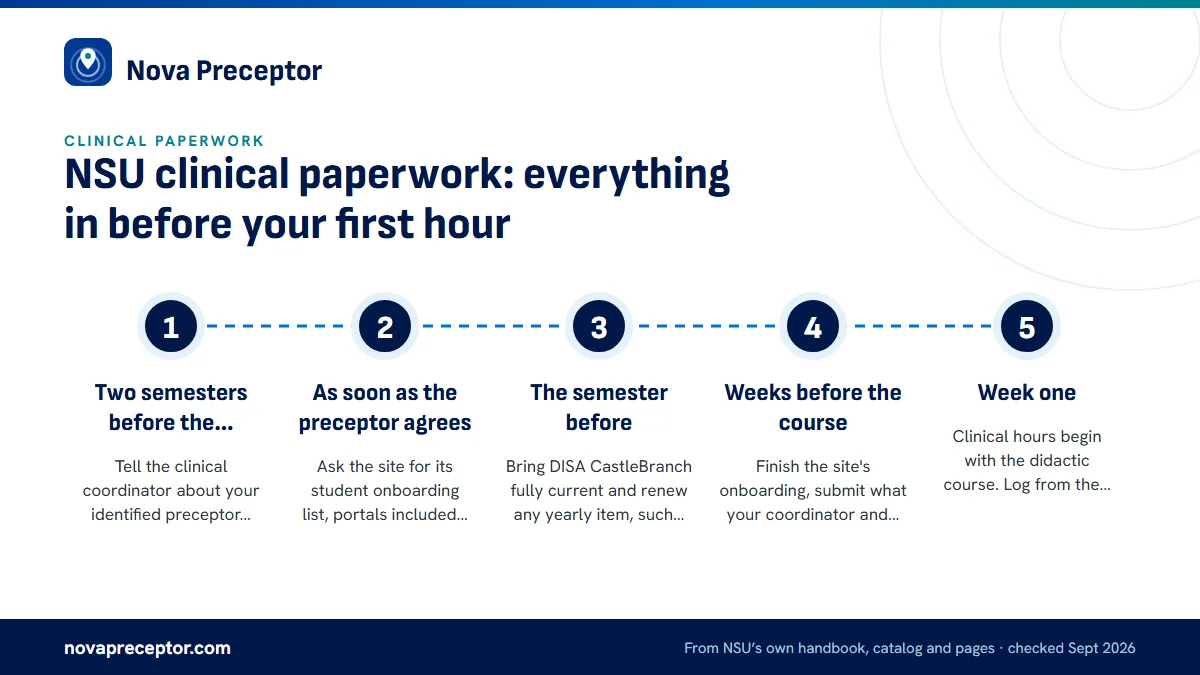
- Two semesters before the courseTell the clinical coordinator about your identified preceptor and site. Work out that date on the two-semester deadline page.
- As soon as the preceptor agreesAsk the site for its student onboarding list, portals included, and flag anything with a long lead time, such as fingerprinting or a titer.
- The semester beforeBring DISA CastleBranch fully current and renew any yearly item, such as the flu shot or TB test, that would lapse during the clinical course.
- Weeks before the courseFinish the site's onboarding, submit what your coordinator and course require, and visit the site to meet your preceptor.
- Week oneClinical hours begin with the didactic course. Log from the first day in the system your course uses.
- Through the semesterKeep clinical submissions current every week; they count toward the course grade.
Your program and course set the exact dates. This sequence is simply the way to stay inside them.
What goes wrong, and what it risks
Most paperwork failures are timing failures. The usual ones:
- A site portal nobody opened, because the student assumed NSU's CastleBranch record would satisfy the site.
- Fingerprints for a level 2 background check taken too late for the results to return.
- A yearly TB test or flu shot that lapses in the middle of the clinical semester.
- Preceptor forms left unsigned because nobody told the preceptor they were coming.
- A site that will not accept the TB method already on file.
The consequences escalate quickly. The placement rule says missing paperwork or the site visit may jeopardize progression. The facility rule is harder: an unmet site condition on your first scheduled day ends the placement before it begins, and one discovered mid-rotation ends it then. Since hours follow the weekly calendar, lost weeks are hard to win back, and withdrawing from a clinical course needs the program director's prior approval and can lengthen the program. If it has already happened, read placement fell through.
A complete CastleBranch record is not a complete site file. Ask every site for its own list.
Why NSU students choose us for the paperwork
Paperwork is where good placements come apart, so we start it the day a preceptor agrees. Your placement advisor gathers the preceptor's license and credentials and the site's details for your coordinator, collects the site's full onboarding list, and sets both beside your DISA CastleBranch record in one dated checklist.
You know two semesters ahead what is due, to whom and by when, and your preceptor knows what NSU will ask them to sign. The clinical coordinator gives the approval; we make the file behind your request complete and on time. If a preceptor withdraws, we find a replacement and rebuild the paperwork with you. See how it works or use the form below.
Questions NSU students ask
What paperwork do NSU APRN students submit before clinicals?
NSU does not publish its form names; they are in the graduate clinical guide and your course. In broad terms, expect three strands: preceptor and site details for your clinical coordinator, your immunization, physical exam and background records in DISA CastleBranch, and the clinical site's own onboarding. All of it has to be complete before your first clinical hour.
Do I have to visit my clinical site before I start?
Yes. The handbook requires APRN students to arrange a visit to the clinical site and meet their preceptor before clinical hours begin, alongside the paperwork. Use the visit to agree on weekly days, reporting details and how evaluations will work, then confirm the schedule in writing so both of you start from the same plan.
Does clinical paperwork affect my NSU grade?
It does. The handbook's grading section lists submission of clinical paperwork next to completion of didactic and clinical objectives as the basis for grades. Late or missing logs and evaluations can cost you, and at the end of the term they can limit your options, since an incomplete needs passing status and half the coursework done.
Can I start clinical hours before my paperwork is done?
Not under NSU's rule, which asks for all required paperwork before hours start. A site requirement still open on day one also cancels the placement under the handbook's facility rule. Because hours are expected from the first week of the course, finish everything before the term begins rather than planning to catch up.
Who handles the affiliation agreement with my site?
Agreements sit at the college level, not with students. ACON has agreements with a wide range of healthcare institutions, yet NSU keeps the list, and the process for new ones, to itself. Ask your clinical coordinator early whether your proposed site is covered, since some Florida health systems say a new agreement can take several months.
Related pages
Last checked 2026-09-25
We check these pages against NSU's own handbook, catalog and program pages. The graduate clinical guide, your course in Canvas, your clinical coordinator and your program director have the final word.
- NSU Nursing Student Handbook 2025-2026, Graduate A.P.R.N. Students (printed p. 123)
- NSU Nursing Student Handbook 2025-2026, grading (printed p. 101)
- NSU Nursing Student Handbook 2025-2026, incompletes (printed p. 103)
- NSU Nursing Student Handbook 2025-2026, facility requirements (printed p. 87)
- NSU College of Nursing: Health and Safety Requirements
NSU lets you name your own preceptor. We make sure you have one, close to home and in time.
Tell us your NSU program, your home ZIP area and when your next clinical course starts. We find preceptors who fit the course and have everything ready for your clinical coordinator well before the two-semester notice.
- Preceptors matched to the course: primary care for FNP, acute care for AGACNP, psychiatric care for PMHNP, a practice site for DNP project hours
- Named early enough for NSU's two-semester notice, with license, credentials and site details ready for the coordinator
- Close to your home ZIP code, with clinic days we plan around your work schedule
Start your placement plan
Program, ZIP area and start term is all we need to begin.