NSU's 150-mile placement rule: what happens when you name no preceptor
When an NSU APRN student has not named a preceptor and site in time, the clinical coordinator sends them to a site up to 150 miles from their residential ZIP code, a placement the handbook puts beyond negotiation once it is made. It is a real route to a clinical site. It also hands the choice of town, setting and clinic days to NSU, which is why students who want a site near home name their own preceptor first.
Keep your clinical site close to home
Tell us your ZIP code, track and next clinical course. Your placement advisor starts the search near you.
The rule in full
Here is the rule exactly as NSU prints it, two sentences from printed page 123 of the Nursing Student Handbook 2025-2026, in the part written for graduate APRN students:
"If an A.P.R.N. student does not have a preceptor requested or clinical site, the clinical coordinator will place the A.P.R.N. student within the 150-mile radius of the student's residential ZIP code. This placement, once made, is not negotiable."
The sentence just before it covers students who already have someone lined up: they report that preceptor and site to the coordinator, giving two semesters' warning for each clinical course. The 150-mile placement is the other branch of that choice: nothing requested, so NSU chooses. Either way a clinical coordinator approves the preceptor and site, as the placement process page sets out step by step.
Reading the two sentences clause by clause
Each phrase in the rule does a specific job, and a few of them are easy to misread.
- "does not have a preceptor requested or clinical site": the trigger. It works course by course, so a student who named a preceptor for one clinical can still be placed for the next if nothing is requested in time.
- "the clinical coordinator will place": NSU picks the preceptor and the site. The handbook describes no step where the student ranks options or suggests an area.
- "within the 150-mile radius": an outer limit, not a promised distance. NSU does not say whether it means a straight line or a driving distance, and roads nearly always run longer than a straight line.
- "the student's residential ZIP code": the circle is centered on where you live, not on a campus or your workplace. The handbook has students keep their mailing address current in Self-Service Banner, so update it there and ask your coordinator which address the radius uses.
- "once made, is not negotiable": after the site is assigned, the handbook leaves no room to bargain for a closer site, another setting or different days. It does not say what happens if a student cannot take the placement, so speak to your program director before assuming anything.
The handbook sentence itself attaches no other condition, and NSU does not publish how coordinators find sites, how many students they place or how long it takes. If you are weighing this route, ask your coordinator how placements are handled for your cohort and track.
How far 150 miles reaches in Florida
By Florida standards a 150-mile radius is a very large circle. From most places in the state it crosses several counties in every direction, and from South Florida it spans the peninsula from one coast toward the other. The table gives approximate straight-line reach from three places NSU students commonly live near. Where a placement actually lands depends on where sites are, and NSU publishes no typical distance.
| If you live near | The radius reaches |
|---|---|
| Fort Lauderdale / Davie (NSU's main campus) | All of Broward, Miami-Dade and Palm Beach counties, north beyond Palm Beach County into the Treasure Coast, and west across the Everglades to Naples on the Gulf coast |
| Tampa (the Tampa Bay campus area) | The Tampa Bay counties, east past Orlando and south to Fort Myers |
| Fort Myers | North to Tampa Bay and east across the state to Fort Lauderdale and Miami |
A placement out near the rim of that circle is a long highway drive in each direction. Near NSU's South Florida campuses, where clinics and hospitals are dense, a placement may well land much closer; the rule simply makes no promise either way.
What a coordinator placement means for work and commuting
Distance weighs more at NSU than it might elsewhere because of how clinical time is scheduled. The handbook starts your hours in the first week of the didactic course, expects clinical attendance every week, and rules out bunching hours into the first or last weeks of the term. The 2026-27 graduate catalog adds that getting to clinical agencies is the student's responsibility.
Put together, a placement far from home means a long drive on every clinical day, every week, for the whole semester, in courses of 95 to 285 hours. The site's clinic days become your clinic days, and because the placement is fixed once made, any clash with your work schedule is yours to solve. The weekly hours rule shows how the load spreads across a term.
None of that makes the route a poor one. It gives a student without contacts a site the coordinator has already judged suitable, and for someone with a flexible job who lives among many sites, it can work well. The trade is control over where and when.
Two radii that are easy to confuse
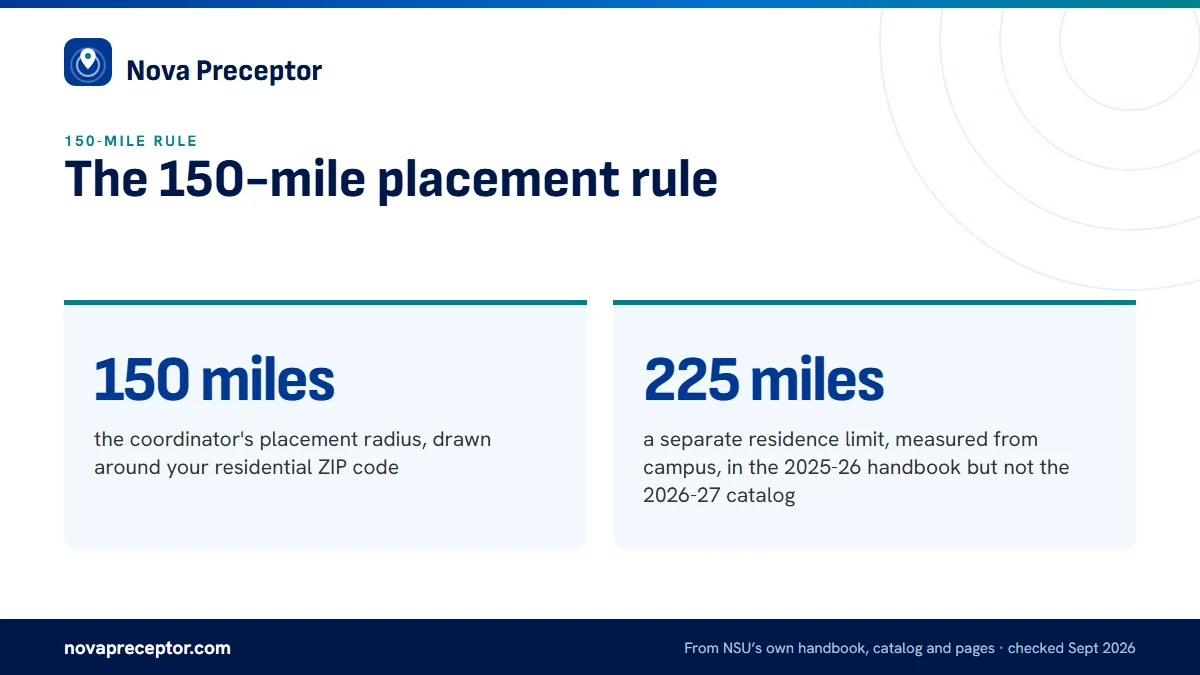
NSU's documents hold a second distance rule, and it measures something else. The placement radius runs 150 miles from your home ZIP code. The residence rule limits how far from campus you may live.
| Rule | Measured from | Distance | Where NSU states it |
|---|---|---|---|
| APRN coordinator placement | Your residential ZIP code | Within 150 miles | Handbook 2025-26, printed p.123 |
| APRN residence (MSN, certificates, APRN-route BSN to DNP) | Your campus | Within 225 miles | Handbook 2025-26, printed pp.138-139; Miles from Campus policy, effective July 3, 2024; 2025-26 catalog; certificates page |
| APRN residence before July 2024 | Your campus | Within 150 miles | Handbook 2023-24; 2024-25 health professions catalog |
| BSN residence and placement | Your assigned campus | Live within 150 miles; placed within 75 miles | Handbook 2025-26, printed p.123 |
The residence rule is itself unsettled. The 2026-27 graduate catalog, NSU's newest statement of graduate rules, gives no residence radius for the now-online MSN APRN, yet the certificates page still lists 225 miles. The handbook never explains how the 225-mile limit and the 150-mile circle fit together, so if either affects you, get your program director's answer in writing. The 2026-27 changes page follows the residence rule, and BSN clinicals covers the 75-mile rule.
Older NSU documents can mislead here: until mid-2024, "150 miles" described both where APRN students had to live and how far away a placement could be.
Keeping location and schedule in your hands
The same handbook paragraph offers the alternative. Put forward your own preceptor and site, early enough to give the coordinator two semesters' notice for that course, and the coordinator's job becomes checking your choice rather than making one. You decide the town and the practice, and you settle the weekly days with your preceptor; the coordinator's review of your preceptor's qualifications and the site's fit for the course still applies.
Because the route works course by course, you can plan the next clinical now. Bringing your own preceptor covers what fits each course, the two-semester deadline gives your date, and the two-route comparison weighs one against the other. For students living in another state, whether NSU's coordinators assign out-of-state sites is an open question; see clinicals outside Florida.
Why NSU students choose us before the placement point
Students come to us because they want the site chosen around their home and their job. Your placement advisor searches outward from your ZIP code, nearest first, for a preceptor whose practice fits the course and who can offer steady weekly days that work with your shifts. We check the Florida license question and the site's student requirements early, and time everything so your notice reaches the clinical coordinator well ahead of the two-semester mark.
The coordinator still reviews and approves the preceptor and site. What we add is a proposal that arrives complete and matched to NSU's rules, and a replacement search if a preceptor later steps away. Start with the placement request form.
Questions NSU students ask
Is NSU's 150-mile radius measured in driving miles?
NSU does not say. The handbook uses the word radius, which suggests a straight line from your residential ZIP code, but it never defines how the distance is measured. Driving routes usually run longer than a straight line, so a site inside the circle can still mean a long commute. Ask your clinical coordinator which measure they use.
Can I refuse or swap an NSU clinical placement?
The handbook says a coordinator placement, once made, is not negotiable, and it describes no way to trade it for a closer site or different days. It also does not spell out what happens if a student cannot take it. Talk to your program director at once; withdrawing from a clinical course needs the director's prior approval and can lengthen your program.
Does the 150-mile placement rule apply to NSU BSN students?
No. The 150-mile placement applies to APRN students. Entry and Accelerated BSN students are placed by the clinical coordinator within 75 miles of their campus and must live within 150 miles of it, a separate pair of rules on the same handbook page.
Will NSU place me outside Florida if I live in another state?
NSU has not published an answer. Its FNP and PMHNP tracks now take any unrestricted RN license, which must stay current wherever the practicum takes place, and the placement sentence mentions only your residential ZIP code. Out-of-state placement practice remains unpublished, so put the question to your clinical coordinator directly.
Is NSU's 225-mile rule the same as the 150-mile rule?
No. The 225-mile rule is about where you live, measured from your campus; NSU set it in a policy change effective July 3, 2024 and repeats it in the 2025-26 handbook, but the 2026-27 catalog omits it. The 150-mile rule is about where the coordinator can place you, counted from your home ZIP code if no preceptor of yours is on file.
Related pages
Last checked 2026-09-25
We check these pages against NSU's own handbook, catalog and program pages. The graduate clinical guide, your course in Canvas, your clinical coordinator and your program director have the final word.
NSU lets you name your own preceptor. We make sure you have one, close to home and in time.
Tell us your NSU program, your home ZIP area and when your next clinical course starts. We find preceptors who fit the course and have everything ready for your clinical coordinator well before the two-semester notice.
- Preceptors matched to the course: primary care for FNP, acute care for AGACNP, psychiatric care for PMHNP, a practice site for DNP project hours
- Named early enough for NSU's two-semester notice, with license, credentials and site details ready for the coordinator
- Close to your home ZIP code, with clinic days we plan around your work schedule
Start your placement plan
Program, ZIP area and start term is all we need to begin.