NSU's online MSN in 2026-27: what changed and what to confirm
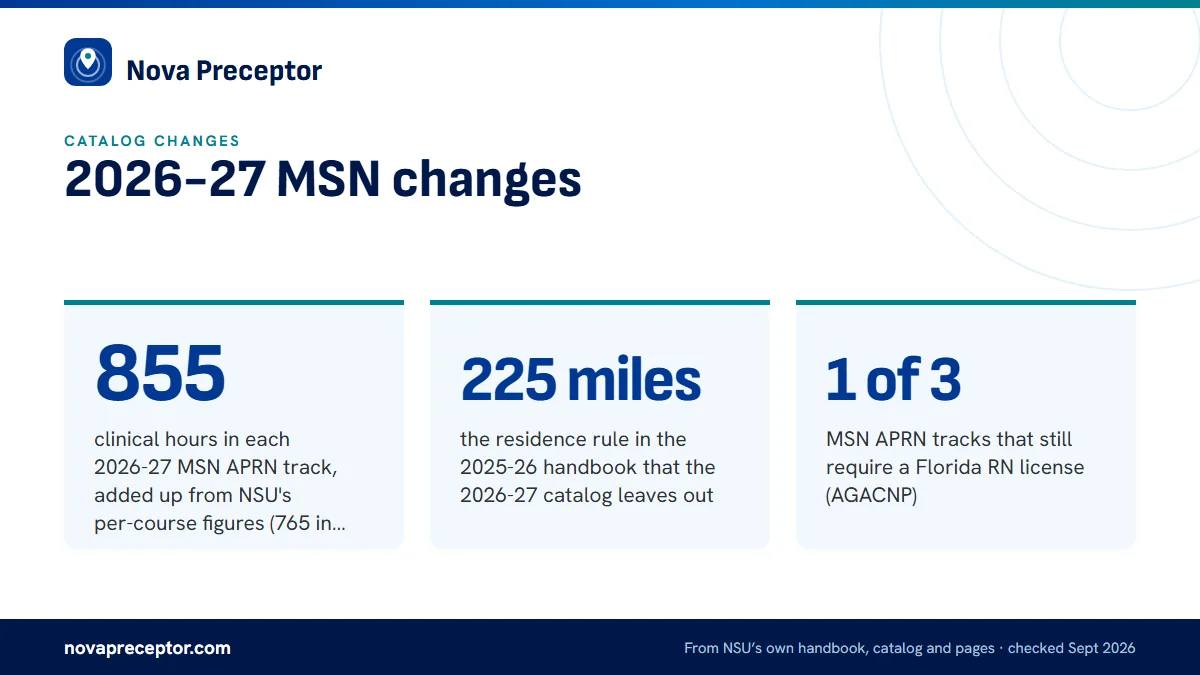
NSU's 2026-27 graduate catalog and current program pages describe a different MSN APRN from the one in the 2025-26 handbook: online coursework with short on-campus intensives, a Florida RN license only for AGACNP, no mileage rule, 45 or 48 credits and 855 clinical hours. Some NSU pages still print the older rules, so a few points are open. Below is each change side by side, what is still unsettled, and what it means for where you can do clinicals.
Plan your clinicals under the new rules
Tell us your track, start term and home ZIP area.
Old rules and new rules, side by side
NSU has not posted a 2026-2027 Nursing Student Handbook. The 2025-26 flipbook is still the one ACON links, and the 2026-27 Graduate Catalog, released in late August 2026, is the only newer rulebook.
| Topic | 2025-26 handbook and catalog | 2026-27 catalog and current pages |
|---|---|---|
| Format | Hybrid: FNP at Palm Beach and Tampa Bay, AGACNP one weekend per month at Palm Beach, PMHNP at Miramar and Tampa Bay | Online, with 3 intensives for FNP and AGACNP and 1 for PMHNP |
| RN license | Florida RN for every APRN track, kept in Florida throughout | Florida RN for AGACNP only; FNP and PMHNP need any unrestricted RN license |
| Where you live | Within 225 miles of campus | No mileage or residency rule |
| Credits | 51, with a 15-credit core | 45 for FNP and AGACNP, 48 for PMHNP, with a 12-credit core |
| Clinical hours | 765 for FNP (170, 170, 85, 85, 255) | 855 per track (190, 190, 95, 95, 285 for FNP) |
| BSN to DNP | Hybrid clinicals, 225-mile rule, 75 credits, 1,365 hours | Online clinical courses, 73 or 76 credits, 1,455 hours |
Online coursework, in-person clinicals
All three track pages now carry the headline "Now in an Online Format," and the new catalog describes an online degree with full-time and flex plans; live Zoom sessions are optional. The in-person parts are short intensives attached to particular courses (FNP and AGACNP have three each, PMHNP has one) at Palm Beach or Tampa Bay. The intensives page lists them course by course, including the PMHNP campus conflict.
The move online leaves the clinical side where it was. Hours are still done in person with a preceptor, still start when didactic coursework starts and still run weekly, and the new catalog makes you "responsible for transportation to clinical agencies." The two-semester notice and the 150-mile placement radius come from the 2025-26 handbook, which remains NSU's current published handbook.
Florida RN for AGACNP; any unrestricted RN for FNP and PMHNP
NSU's graduate admissions page and the 2026-27 catalog now say AGACNP applicants need "a current, unrestricted state of Florida professional nursing (R.N.) licensure," while FNP and PMHNP applicants need a current, unrestricted RN license with no state named. Every track adds a condition tied to the jurisdiction of the practicum: the license has to remain current there for the whole program. BSN to DNP follows the same split by concentration.
The older sources disagree. The 2025-26 handbook says APRN entrants need an unrestricted Florida RN license, and the 2025-26 catalog wants that license kept in Florida from start to finish. The certificates page still asks for a Florida license too. The RN license page sorts out which license fits which site, including Florida's own rule for students at Florida sites.
The 225-mile rule: gone from the catalog, still on the certificates page
A policy change effective July 3, 2024 told MSN APRN, post-master's certificate and APRN-track BSN to DNP students they "must live within 225 miles of their campus." The 2025-26 handbook repeats it, and the 2025-26 catalog words it as "living within a 225-mile drive from the program campus."
The 2026-27 catalog has no mileage or residency rule anywhere, and the current FNP, AGACNP and PMHNP pages say nothing about one. The certificates page, though, still asks for residence inside 225 miles of the program campus. NSU has not said whether the 225-mile rule still binds students entering in 2026-27, so ask before you rely on either reading.
Keep this apart from the 150-mile figure. That one is a placement radius: if you have not named a preceptor, the clinical coordinator assigns a site inside a 150-mile radius of your residential ZIP code. It sits in the handbook's clinical section and has its own 150-mile placement page.
Fewer credits, more clinical hours
The older plan had 51 credits, a 15-credit core that included NSG 5101 and NSG 5571, and clinical hours built into 6-credit courses. The current plan has a 12-credit core (NSG 5000, NSG 5111, NSG 5220, NSG 5130, NSG 5512) and gives each clinical block its own course at "95 practicum hours per credit hour," so a 2-credit clinical carries 190 hours, a 1-credit clinical 95, and the 3-credit capstone 285. Nine clinical credits make 855 hours per track. The 95-hours-per-credit page shows the math course by course.
Certificates are messier. FNP sits at 765 hours, while AGACNP shows either 765 or 735 and PMHNP either 765 or 855, depending on which NSU source you read. They are hybrid today; the catalog moves them online "starting summer 2027," while the program pages point to the 2027-28 academic year. The catalog admits certificate students twice a year with summer plans, while the web pages say winter-only or fall-only depending on prerequisites.
For preceptor planning, use the hour figure on your own Degree Works plan. A preceptor who agreed to 170 hours and is then asked for 190 needs more weeks or more hours each week.
What it means for where you can do clinicals
The phrase "jurisdiction of the practicum" suggests NSU expects some online students to train where they are licensed, which may be outside Florida. NSU has not said whether its coordinators place APRN students in other states, and its list of clinical agreements by state is not public. The published rule is still the handbook's: name a preceptor two semesters ahead of each clinical course, or accept a coordinator placement no more than 150 miles from your home ZIP code.
If you live far from NSU's campuses, in north Florida or in another state, naming your own preceptor is how you keep the site close to home. Inside Florida, the state's rule applies at every site: your preceptor holds a Florida license, and your own RN license must come under chapter 464 (see Florida's preceptor rule). Outside Florida, your license has to be valid where the site is; the outside-Florida page covers SARA and the rest.
What to confirm, and who to ask
- Applicants: ask graduate admissions which RN license your track needs and whether the 225-mile residence rule applies to your start term.
- Enrolled students: ask your program director which set of rules governs your class for credits, hours and residence, and, for PMHNP, which campus hosts your intensive.
- Your clinical coordinator: whether a site in your city or state can be approved, and what the graduate clinical guide requires of preceptors.
- The Office of Licensure and State Relations: state-authorization questions for a practicum outside Florida.
- Degree Works: the credit and hour figures your own plan of study shows.
Ask through SharkMail, which NSU requires for university business, so every answer is in writing and dated.
Why NSU students choose us through the changes
Shifting rules make timing and fit harder to judge, and judging them is our specialty. We work from the plan and hour figures that apply to you, find a preceptor near home whose practice fits the course and whose license fits the site's state, and have everything ready for your clinical coordinator before your notice date. When a source conflict touches your placement, we flag it early. The clinical coordinator makes the approval decision, and we hand over a preceptor file that is already checked against NSU's rules. Tell us your track and start term in the form below.
Questions NSU students ask
Is a Florida RN license required for NSU's online FNP or PMHNP?
Not under the 2026-27 catalog or the graduate admissions page, which ask FNP and PMHNP applicants for a current, unrestricted RN license from any state. The 2025-26 handbook and catalog named Florida for all APRN tracks, a conflict to settle with admissions or your program director. At a Florida clinical site, the state's own rule separately calls for an RN license issued under chapter 464.
Is NSU's MSN APRN fully online now?
The coursework is: lectures are online, with optional live Zoom sessions. You still travel for short on-campus intensives (three for FNP and AGACNP, one for PMHNP), and every clinical hour is done in person with a preceptor at an approved site. The online format changes where you study, not how clinicals work.
Does NSU's 225-mile residence rule still apply?
NSU has not said. The July 2024 policy change, the 2025-26 handbook and the 2025-26 catalog require MSN APRN students to live within 225 miles of campus. The 2026-27 catalog has no mileage rule, while the certificates page still lists one. Ask graduate admissions if you are applying, or your program director if you are already enrolled.
Why does my plan show 765 clinical hours when NSU's website implies 855?
The 765 figure comes from the older MSN plan, which built clinical hours into 6-credit courses (170, 170, 85, 85 and 255 for FNP). The current plan uses separate clinical courses at 95 hours per credit hour, which adds up to 855. Certificate plans still show the older figures in places. Your program director can confirm which set applies to your class.
Will NSU place me in my home state if I live outside Florida?
NSU has not published an answer. Its handbook says only that a student with no named preceptor is placed by the clinical coordinator somewhere inside 150 miles of the student's residential ZIP code. Naming your own preceptor near home, two semesters ahead, is the route that keeps the choice of site with you, wherever you live.
Related pages
Last checked 2026-09-25
We check these pages against NSU's own handbook, catalog and program pages. The graduate clinical guide, your course in Canvas, your clinical coordinator and your program director have the final word.
NSU lets you name your own preceptor. We make sure you have one, close to home and in time.
Tell us your NSU program, your home ZIP area and when your next clinical course starts. We find preceptors who fit the course and have everything ready for your clinical coordinator well before the two-semester notice.
- Preceptors matched to the course: primary care for FNP, acute care for AGACNP, psychiatric care for PMHNP, a practice site for DNP project hours
- Named early enough for NSU's two-semester notice, with license, credentials and site details ready for the coordinator
- Close to your home ZIP code, with clinic days we plan around your work schedule
Start your placement plan
Program, ZIP area and start term is all we need to begin.