Doing NSU clinicals where you work
NSU publishes no rule for or against doing APRN clinical hours at your own employer, or with a co-worker or supervisor as your preceptor. The answer comes from your clinical coordinator, who approves every preceptor and site, and from your employer, since some Florida systems bar staff from rotating where they work. Here is what NSU does say, what to ask and what makes a workplace setting easier to approve.
Weigh your workplace against other options
Tell us your NSU track, your employer's setting and your home ZIP area.
What NSU publishes: nothing either way
We checked the 2025-26 Nursing Student Handbook, the 2025-26 and 2026-27 catalogs and the MSN, certificate and DNP program pages. None of them says whether an APRN student may complete clinical hours at an employer, in their own unit, or under a co-worker or supervisor. The graduate clinical guide, which NSU keeps off its public site, may address it, and your coordinator will know.
Silence is not permission. The coordinator still confirms that any preceptor meets NSU's supervision requirements and that any site offers the clinical experience the course needs, and a workplace proposal goes through the same review as every other. Treat it as a proposal awaiting approval, with a second option ready.
The question is common for a reason. MSN APRN admission asks for current clinical practice, so students typically arrive with a nursing job, and the hospital or clinic they already know can look like the obvious site.
NSU rules that shape the answer
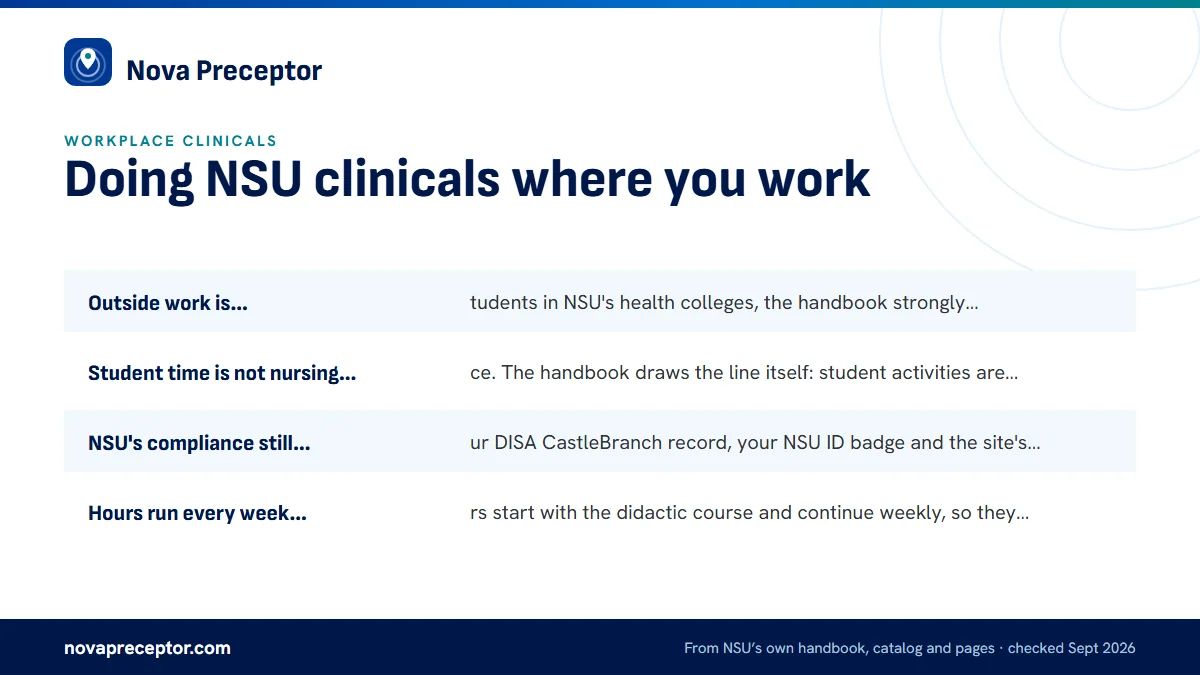
- Outside work is discouraged. For students in NSU's health colleges, the handbook strongly discourages outside employment during regular terms (printed page 92). Entry and Accelerated BSN students who work are advised to keep to 20 hours a week or less, and nurse anesthesiology students may not work at all.
- Student time is not nursing practice. The handbook draws the line itself: student activities are not the practice of nursing, while students holding the right license may do that professional work as far as the law allows (printed page 84). On clinical days you are an NSU student under a preceptor, not an RN on shift.
- NSU's compliance still applies. Your DISA CastleBranch record, your NSU ID badge and the site's student onboarding apply to you as a student, whatever your employee file already holds.
- Hours run every week. Clinical hours start with the didactic course and continue weekly, so they have to sit beside your paid schedule all semester. See the weekly clinical hours rule.
Some Florida employers decide it for you
Before you raise it with NSU, read your employer's student placement policy. Florida systems that publish one take different positions:
- Baptist Health South Florida says employees may not rotate at the facility where they work.
- BayCare addresses its own employees and their home units in its published student materials, so read the current version before proposing a BayCare unit where you work.
- Halifax Health gives its own employees priority for student placements.
- Tampa General ranks its team members, alongside programs holding a current agreement, next after its academic partner, the University of South Florida.
None of these policies says anything about NSU in particular. Many large systems publish nothing on the question at all, so ask your employer's education or student placement office directly and get the answer in writing. The Florida health systems page summarizes each system's published process.
What makes a workplace setting fit
Where both NSU and the employer are open to it, a few features make a workplace proposal far easier to approve. They share one test: would the arrangement look the same if you did not work there?
- A different unit or role. A primary care clinic in the system where you work as an ICU nurse is a genuinely new clinical experience; your own unit, with your own colleagues, is much harder to separate from your job.
- The right preceptor for the course. An NP or physician whose practice matches the course, such as an adult primary care provider for
NSG 5549or an inpatient acute care NP forNSG 5629, holding a Florida license at a Florida site. - A preceptor who is not your boss. A manager or supervising physician grading you as a student and as an employee at once invites questions about both evaluations.
- Hours kept apart from paid work. Clinical time on days you are not scheduled for your job, logged separately, so every hour in your log is precepted student time.
- A student identity on clinical days. Your NSU badge and NSU's clinical dress rather than your staff badge and unit scrubs; the clinical dress code page covers the uniform.
These are practical tests, not published NSU rules. The coordinator's view decides.
What to ask your clinical coordinator
Put the question in writing, in SharkMail, well before your two-semester notice date, so a no still leaves time to find another site.
- Does NSU accept clinical hours at a student's employer, and in the student's own unit or department?
- May a co-worker precept me? May my manager, or a physician I work under?
- Does my employer need an affiliation agreement with NSU even though I am on staff, and will I go through its student onboarding?
- Can one course be split between my workplace and another site?
- Does the graduate clinical guide say anything about workplace placements that I should read first?
Give your job title, your unit and the proposed preceptor's role, so the coordinator answers your actual situation rather than the general case. The clinical coordinator page covers how to work with them.
Why NSU students choose us when work is in the mix
A workplace site can look like the easy answer, so we test it with you first: whether your employer allows it, whether the unit and preceptor fit the course, and whether your clinical hours can stay separate from your shifts.
Where the workplace fits, we prepare the preceptor and site details your coordinator will check. Where it does not, or the employer says no, we match you with a preceptor near home on a weekly schedule built around your job, well before your two-semester notice date. The coordinator decides; you get a strong, complete proposal and a backup ready to go. If a preceptor later drops, we find a replacement. See how it works.
Questions NSU students ask
Can I do my NSU clinicals at the hospital where I work?
NSU publishes no rule either way, so the answer comes from your clinical coordinator and your employer. The coordinator approves the preceptor and site as with any proposal, and some Florida systems, Baptist Health South Florida among them, bar employees from rotating where they work. Ask both in writing, early enough to change course.
Can a co-worker be my NSU preceptor?
NSU does not address it publicly. A co-worker in a different unit or role, who holds the right license and practices in the course's specialty, makes a stronger proposal than a colleague from your own unit. Ask your clinical coordinator before you ask the co-worker, and check your employer's student policy too.
Can my manager or supervising physician precept me?
NSU publishes no rule on it. Being evaluated as a student by the person who also evaluates your job performance mixes two roles, and a coordinator may prefer a preceptor with no employment authority over you. Raise it with your clinical coordinator directly before you make any plans around it.
Do the hours I work as an RN count toward clinical hours?
No NSU source says paid RN work counts toward APRN clinical hours, and the handbook treats student activity and nursing practice as separate things. Clinical hours are precepted student hours, logged in the system your course uses. Keep them on different days from paid shifts so your log stays clean.
Will working full time affect my NSU clinicals?
It can. NSU's health colleges strongly discourage outside work during regular terms, and APRN clinical hours run weekly from the first week of the course with no compressing. You need predictable clinical days every week of the semester, so plan your work schedule and your preceptor's together. See full-time vs flex plans.
Related pages
Last checked 2026-09-25
We check these pages against NSU's own handbook, catalog and program pages. The graduate clinical guide, your course in Canvas, your clinical coordinator and your program director have the final word.
NSU lets you name your own preceptor. We make sure you have one, close to home and in time.
Tell us your NSU program, your home ZIP area and when your next clinical course starts. We find preceptors who fit the course and have everything ready for your clinical coordinator well before the two-semester notice.
- Preceptors matched to the course: primary care for FNP, acute care for AGACNP, psychiatric care for PMHNP, a practice site for DNP project hours
- Named early enough for NSU's two-semester notice, with license, credentials and site details ready for the coordinator
- Close to your home ZIP code, with clinic days we plan around your work schedule
Start your placement plan
Program, ZIP area and start term is all we need to begin.