NSU's clinical dress code: teal scrubs, white jacket, ID badge
For ACON clinicals, dress means teal scrubs with your name and "NSU" stitched on, a white clinical jacket and your NSU ID badge at every clinical. The handbook also rules out artificial nails and lashes, requires tattoos to be covered and keeps institutional scrubs off campus. Your clinical site's own dress rules then apply on top of NSU's.
Start day one ready
Share your NSU program, ZIP area and next clinical term.
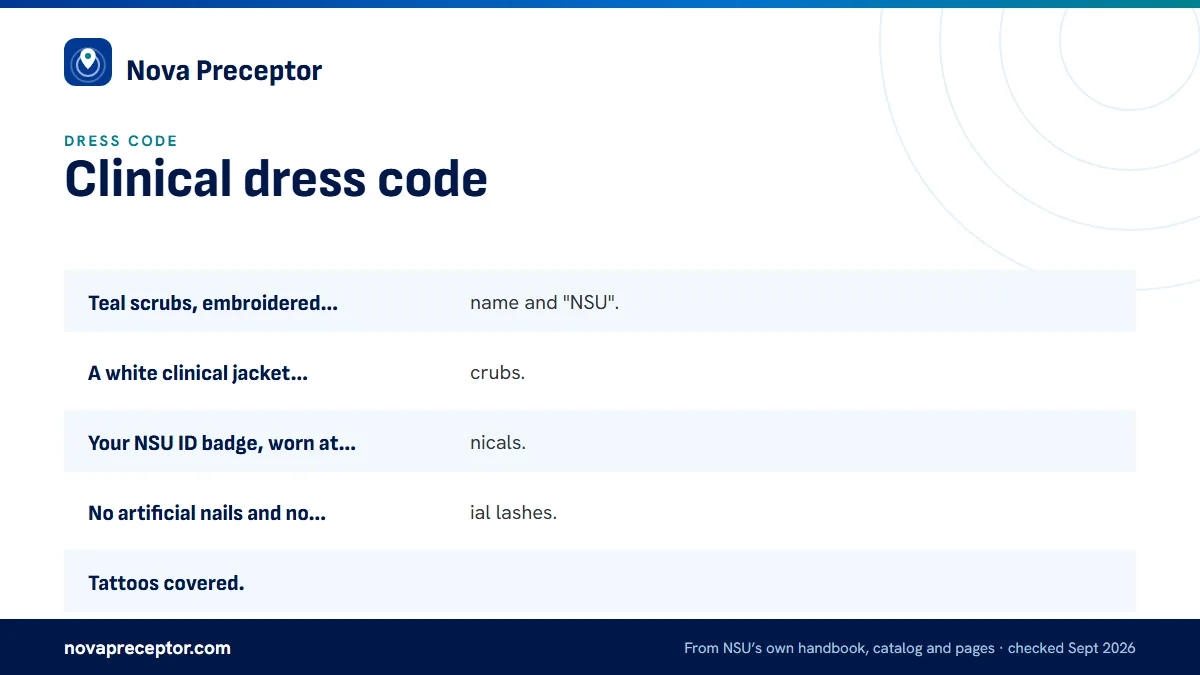
The uniform NSU sets
The dress code sits in ACON's section of the 2025-26 Nursing Student Handbook, on printed pages 124 and 125. Its core is short and specific.
- Teal scrubs, embroidered with your name and "NSU".
- A white clinical jacket over the scrubs.
- Your NSU ID badge, worn at all clinicals.
- No artificial nails and no artificial lashes.
- Tattoos covered.
The handbook describes the uniform but does not name a supplier in its public text, so ask your program office or check orientation material for where to order the embroidered set. Order early: embroidery adds time, and the set has to be ready for your first clinical day.
The dress code appears in the college-wide part of ACON's section rather than under one program. If your clinical faculty or course gives a track-specific instruction for APRN clinicals, follow it and confirm any doubt with your program director. Read the dress section once in the handbook itself, since this page summarizes it.
Your ID badge, on campus and at every site
The badge rule reaches further than any other part of the code: the handbook wants your identification badge on you "at all times," whether you are on an NSU campus or at a clinical site. You collect it from the One-Stop Shop, which sits in the Horvitz Administration Building. Students tied to a regional campus have a second route, an online badge request through NSU's card office page.
NSU's official identification card is the SharkCard, which also handles library and building access, printing and parking. If you study online and cannot easily reach the One-Stop Shop, ask whether the online request applies to you; it is the route NSU offers students who are not on the campus where badges are issued. Either way, have the badge in hand before your first clinical day and your first on-campus intensive.
Many facilities issue their own student badge during onboarding. Wear what the site requires alongside your NSU badge, and if the two rules seem to clash, ask the site's student contact and your clinical faculty before the first shift, not on it.
Grooming rules: nails, lashes and tattoos
The three grooming rules NSU spells out all come from patient care. Artificial nails are a long-standing infection-control concern in clinical settings, which is why acrylics, extensions and similar products are out. Artificial lashes are also listed, so plan your appearance for clinical days rather than for the rest of your week.
Tattoos must be covered. The white clinical jacket covers the arms for much of a clinical day, and a long-sleeved layer under the scrub top can cover the rest where the site permits it. A tattoo on the hands, neck or face takes more thought; ask your clinical faculty early what NSU accepts rather than improvising on day one.
NSU's rule names artificial nails without listing products, so gel polish on natural nails is a question to ask rather than assume. If you are unsure whether a product counts as artificial, ask before your first clinical and follow the stricter of NSU's answer and the site's rule.
No institutional scrubs on campus
One rule points the other way, at campus rather than the clinical site: "No institutional scrubs may be worn by any ACON student at any time while on campus." Institutional scrubs usually means the hospital-issued sets many nurses wear at work, and the rule applies to every ACON student.
It matters most for working RNs in the MSN APRN tracks. Online coursework still brings you to Palm Beach or Tampa Bay for intensives, and arriving straight from a night shift in your employer's scrubs breaks the rule. Pack a change of clothes, or come in NSU teal if the intensive calls for clinical dress.
The rule also works as a reminder about identity. On campus and on student clinical hours you are an NSU student, and the uniform should say so; your employer's scrubs and badge say something else. Keeping student and staff roles apart at one facility is the subject of clinicals at your employer.
Coming to an intensive from a shift? Change out of your employer's scrubs before you reach campus.
How a site's rules stack on top of NSU's
NSU's dress code is the floor, not the ceiling. A hospital, practice or clinic can add its own rules on shoes, hair, jewelry, scrub colors in particular units or attire for procedural areas, and some outpatient practices ask students to wear business clothing under a white coat instead of scrubs. Ask for the site's dress policy with the rest of its onboarding list, and when the two differ, confirm with your clinical faculty how to meet both.
The handbook gives a reason to take this seriously. Failing to follow a host facility's policies is one of the grounds it gives for sending a student off the clinical floor, with a possible referral to NSU's Committee on Student Progress on top (printed page 114). Dress rules count as site policy, and any clinical time lost that way has to be made up.
One more rule belongs here: the handbook's social media policy bans posting photos or videos of patients or patient care areas (printed page 126). A first-day photo in your teal scrubs is best taken at home, not on the unit. Our clinical site requirements page covers the rest of what sites ask for.
Why NSU students prepare for day one with us
Every match we make includes the site's full onboarding picture, dress and badge rules among them, so you know two semesters ahead whether the site expects teal scrubs, business clothing under your white jacket or its own student badge. Your uniform, badge and grooming plans can all be settled weeks before your first morning, including any embroidery order that needs lead time.
Your placement advisor builds those details into a first-day checklist alongside the paperwork, the DISA CastleBranch items and the preceptor credentials your clinical coordinator reviews. Should a site revise its policies or a preceptor become unavailable, finding a replacement close to home is our job. Start with how it works, or use the request form at the bottom of this page.
Questions NSU students ask
What color scrubs do NSU nursing students wear?
Teal. The Nursing Student Handbook's dress code calls for teal scrubs embroidered with the student's name and "NSU," worn with a white clinical jacket and the NSU ID badge at all clinicals. A clinical site can add its own rules, and some outpatient sites prefer business clothing under a white coat, so check each site's policy.
Can I wear my hospital scrubs to NSU?
No. The handbook states that no institutional scrubs may be worn by any ACON student at any time while on campus. That covers intensives on the Palm Beach or Tampa Bay campus, so change out of your employer's scrubs before you arrive. On student clinical hours, wear NSU's uniform and badge unless the site gives a different instruction.
Where do I get my NSU ID badge for clinicals?
Pick it up at the One-Stop Shop, located in the Horvitz Administration Building. Regional-campus students can request one online instead, through NSU's card office page. Because the handbook expects the badge on you whenever you are on campus or on site, get it well before your first clinical day or intensive.
Are acrylic or gel nails allowed at NSU clinicals?
Artificial nails are not allowed under the handbook's dress code, which rules out acrylics and nail extensions. The rule does not mention gel polish on natural nails by name, so ask your clinical faculty before your first clinical day. The site may have its own nail policy, and the stricter rule is the one to follow.
Do I have to cover tattoos at NSU clinical sites?
Yes. NSU's dress code requires tattoos to be covered at clinicals. The white clinical jacket and a long-sleeved layer under the scrub top, where the site allows it, cover most arm tattoos. For tattoos on the hands, neck or face, ask your clinical faculty early how NSU wants them handled.
Related pages
Last checked 2026-09-25
We check these pages against NSU's own handbook, catalog and program pages. The graduate clinical guide, your course in Canvas, your clinical coordinator and your program director have the final word.
NSU lets you name your own preceptor. We make sure you have one, close to home and in time.
Tell us your NSU program, your home ZIP area and when your next clinical course starts. We find preceptors who fit the course and have everything ready for your clinical coordinator well before the two-semester notice.
- Preceptors matched to the course: primary care for FNP, acute care for AGACNP, psychiatric care for PMHNP, a practice site for DNP project hours
- Named early enough for NSU's two-semester notice, with license, credentials and site details ready for the coordinator
- Close to your home ZIP code, with clinic days we plan around your work schedule
Start your placement plan
Program, ZIP area and start term is all we need to begin.