Protocol and autonomous APRNs in Florida, and what they mean for your preceptor
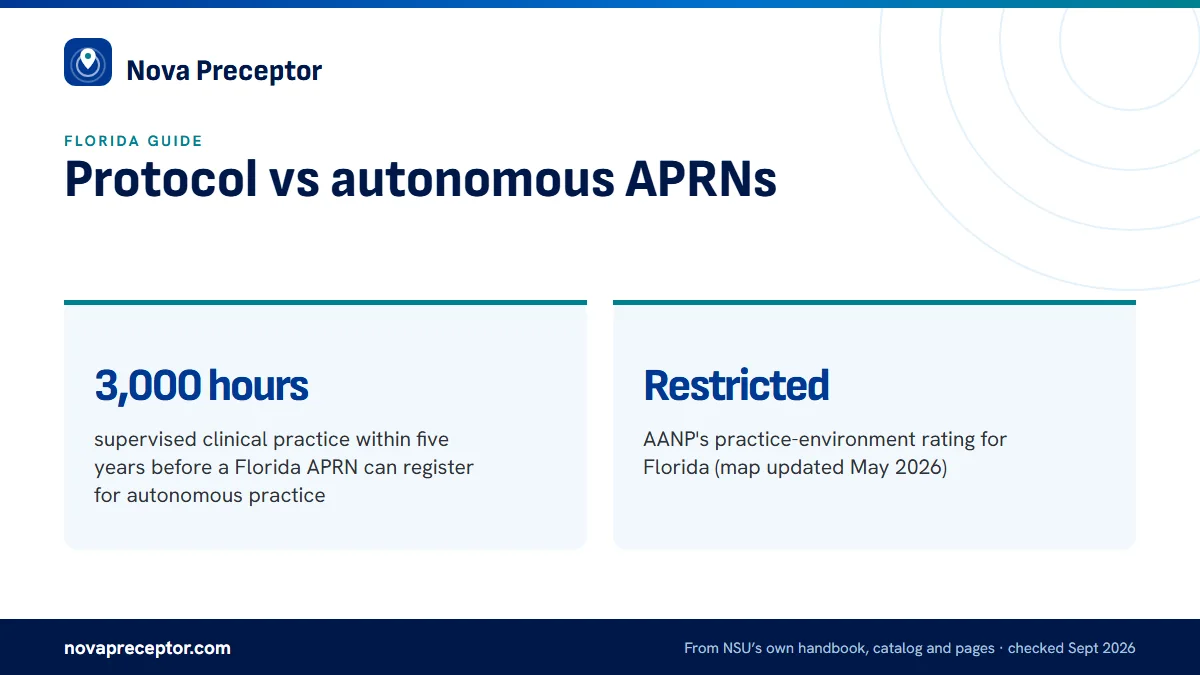
Protocol practice under a supervising physician is the default for Florida APRNs (s. 464.012). Since 2020, an APRN with 3,000 supervised hours can register for autonomous practice under s. 464.0123, but only in primary care. Both count as qualified preceptors under Florida's rule, so for an NSU student the difference is about fit: which course, which patients and which practice.
Find the right kind of Florida preceptor
Tell us your NSU track, next clinical course and home ZIP area.
Protocol practice: the default under s. 464.012
Under s. 464.012(3), a Florida APRN performs advanced functions "within the framework of an established protocol" kept at the practice site, in a supervisory relationship with a physician (or a dentist). The Board of Nursing's APRN licensure checklist ends with filing that protocol at the practice location. For certified nurse practitioners, the statute's functions include managing selected medical problems and stable chronic disease.
One physician's supervision can only stretch so far. Section 458.348(4) lets a primary-care physician supervise APRNs and PAs in up to four offices beyond the primary practice and a specialist in two, and the physician must notify the Board of Medicine within 30 days of entering a protocol relationship. AANP's Florida fact sheet sums up the effect: select NPs keep a career-long protocol agreement with a physician.
Autonomous practice under s. 464.0123
HB 607 (2020) opened a second path. The Board of Nursing's registration form, DH-MQA 5050, describes autonomous practice as advanced practice by an APRN who "is not subject to supervision by a physician or a supervisory protocol." To register, an APRN needs:
- An active, unencumbered Florida APRN license.
- At least 3,000 clinical practice hours under MD or DO supervision within the past five years; the form says these may include clinical instructional hours.
- Three graduate semester hours in differential diagnosis and three in pharmacology, completed within five years.
- No discipline under s. 456.072 or s. 464.018 in the past five years.
- Professional liability coverage at the minimum the statute sets, or an equivalent letter of credit, unless exempt.
Scope is the real limit. Autonomous practice is allowed only in "primary care practice, including family medicine, general pediatrics, and general internal medicine," with no surgery beyond subcutaneous procedures. The Board's own definition of primary care practice, in rule 64B9-4.001(12), covers acute and chronic illness "inclusive of behavioral and mental health conditions." The registration rule took effect October 14, 2020, and the practice-standard rule followed on October 26, 2021.
2026: HB 693 failed, and Florida stays Restricted
A 2026 bill would have widened autonomy. CS/HB 693, a health and human services package, would have revised the autonomous APRN requirements; NCSBN's 2026 APRN Roundtable described it as removing the primary-care limit so all APRNs could apply. It died in Senate Rules on March 13, 2026, so the 2020 framework still governs every preceptor you meet in 2026-27.
AANP rates Florida "Restricted Practice" on its state practice environment map. Its Florida fact sheet adds that the state defines NPs as primary-care providers under s. 464.0123, lets them sign death certificates, and does not currently let them sign DNR orders.
FNP students: both kinds of preceptor fit
Every FNP clinical is primary care: NSG 5549 and NSG 5559 in adult primary care, NSG 5589 in pediatrics, NSG 5569 in women's health and the NSG 5599 capstone. Because autonomous registration exists only in primary care, FNP students are the NSU group most likely to meet an autonomous APRN preceptor, in family medicine, general pediatrics or general internal medicine. A protocol APRN in a physician's practice fits the same courses just as well, and Florida's preceptor rule treats both alike.
One practical difference: a protocol APRN works with a supervising physician who is also a qualified preceptor under Florida's rule, and one physician's protocol can span several offices, so ask which office you would train in. The FNP clinical courses page covers settings course by course.
AGACNP and PMHNP students: mostly protocol preceptors
AGACNP clinicals (NSG 5629, NSG 5639, NSG 5659 and the NSG 5669 capstone) run in acute care, which falls outside the primary-care scope of autonomous practice. An AGACNP preceptor will usually be an APRN practicing under a protocol, or a physician, and that is simply how Florida law sets up acute-care practice. The AGACNP clinical courses page covers the hospital settings.
PMHNP is less clear-cut. Psychiatric-only NPs generally stay under protocol, but the Board's primary-care definition includes behavioral and mental health conditions, so a psychiatric APRN whose work fits it may hold an autonomous registration. Ask. Florida's prescribing rules matter more here: Schedule II controlled substances are capped at a 7-day supply except psychiatric medications prescribed by psychiatric nurses, and only APRNs who are also psychiatric nurses may prescribe psychiatric controlled substances to patients under 18. For the child and adolescent content that runs alongside NSG 5729, a preceptor who is a psychiatric nurse can show you the full prescribing picture. See the PMHNP clinical courses page.
Questions to ask a Florida APRN before you name them
- Do you practice under a protocol, or do you hold an autonomous registration? Either works under Florida's preceptor rule.
- If under protocol, who is your supervising physician, and at which office would I train?
- Does your patient mix match my NSU course: primary care, acute care or psychiatric care?
- Can you take me every week from the first week of the course? NSU hours start with didactic coursework and cannot be compressed.
- Is your Florida APRN license active, and are you nationally certified in your specialty?
NSU's clinical coordinator then confirms the preceptor meets NSU requirements. NSU does not publish whether it treats protocol and autonomous preceptors differently, so ask if the answer affects your plan. The weekly hours page explains the scheduling rule, and Florida's preceptor rule covers the license side.
Why NSU students choose us to find the right Florida APRN
We sort Florida preceptors by the details on this page (protocol or autonomous, specialty, patient mix, office, weekly availability) and match them to your NSU course and home ZIP code. You get a preceptor who fits, named to your clinical coordinator before the two-semester notice, with the license and practice details the coordinator checks. Your clinical coordinator has the last word, and we make that review easy by sending a preceptor profile with nothing missing. Tell us about your next course in the form below.
Questions NSU students ask
Can an autonomous APRN precept an NSU FNP student in Florida?
Yes. Florida's preceptor rule accepts any certified, practicing APRN with a Florida license, and an autonomous registration does not change that. Autonomous APRNs practice only in primary care, which is what NSU's FNP clinicals call for. NSU's clinical coordinator still confirms the preceptor meets NSU's own requirements in the graduate clinical guide.
Can an AGACNP student have an autonomous APRN as a preceptor?
It would be unusual. Autonomous practice in Florida is limited to primary care, and AGACNP clinicals are acute care, so acute-care APRNs practice under a physician protocol unless their work fits the Board's primary-care definition. A protocol APRN or a physician is the usual AGACNP preceptor, and both are qualified under Florida's rule.
Did Florida give nurse practitioners full practice authority in 2026?
No. CS/HB 693, which would have removed the primary-care limit on autonomous practice, died in Senate Rules on March 13, 2026. AANP still rates Florida as Restricted Practice. Autonomous registration under s. 464.0123 remains limited to primary care and requires 3,000 supervised hours within the past five years.
Can a PMHNP practice autonomously in Florida?
Possibly. Autonomous practice is limited to primary care, but the Board of Nursing's definition of primary care practice includes behavioral and mental health conditions. Whether a psychiatric APRN's practice fits is settled by that APRN's own registration. For your clinicals, a protocol PMHNP and an autonomous one can both be qualified preceptors at a Florida site.
What does practicing under a protocol mean for a Florida NP?
The APRN works within an established written protocol with a supervising physician, or a dentist, kept at the practice site under s. 464.012. It is the default arrangement for Florida APRNs. Filing the protocol at the practice location is the last step of APRN licensure, and the physician must notify the Board of Medicine within 30 days.
Related pages
Last checked 2026-09-25
We check these pages against NSU's own handbook, catalog and program pages. The graduate clinical guide, your course in Canvas, your clinical coordinator and your program director have the final word.
NSU lets you name your own preceptor. We make sure you have one, close to home and in time.
Tell us your NSU program, your home ZIP area and when your next clinical course starts. We find preceptors who fit the course and have everything ready for your clinical coordinator well before the two-semester notice.
- Preceptors matched to the course: primary care for FNP, acute care for AGACNP, psychiatric care for PMHNP, a practice site for DNP project hours
- Named early enough for NSU's two-semester notice, with license, credentials and site details ready for the coordinator
- Close to your home ZIP code, with clinic days we plan around your work schedule
Start your placement plan
Program, ZIP area and start term is all we need to begin.