NSU's BSN to DNP, AGACNP concentration: acute-care clinicals, then the DNP project
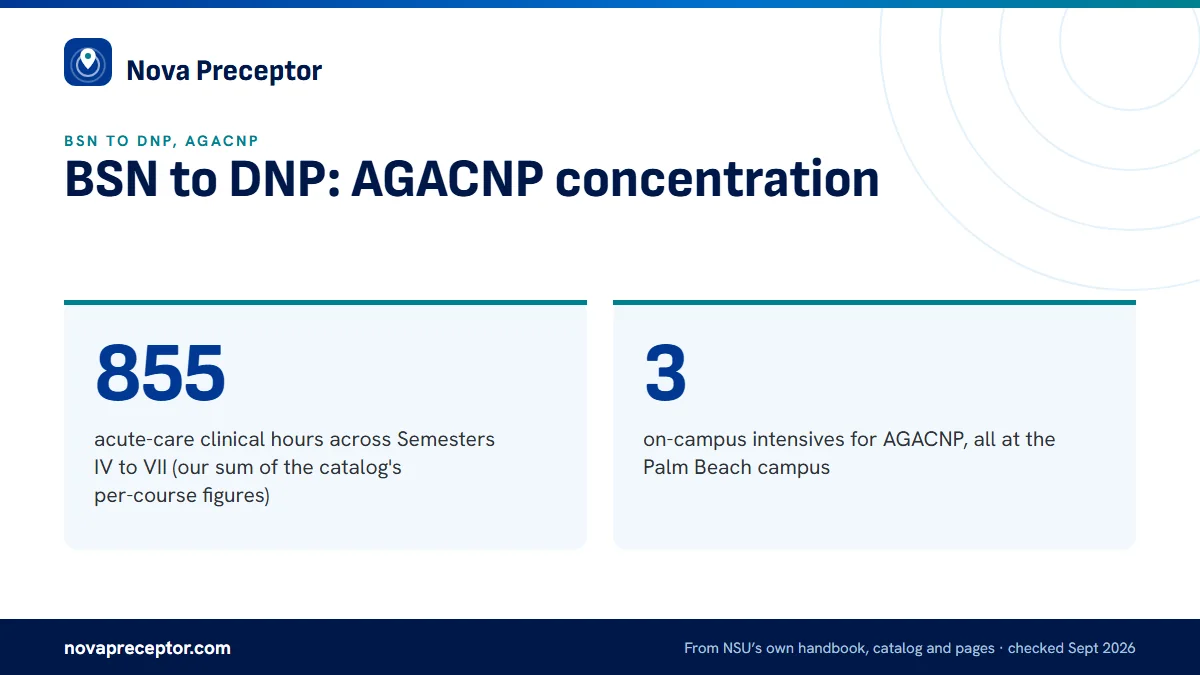
The AGACNP concentration of NSU's BSN to DNP takes a bachelor's-prepared nurse to adult-gerontology acute care practice and a DNP in 73 credits. Four paired acute-care courses, NSG 5620/NSG 5629 through NSG 5660/NSG 5669, fill Semesters IV to VII with 855 clinical hours, after which the doctoral project courses contribute another 600. Admission hinges on Florida RN licensure and ACLS, and three Palm Beach intensives sit along the way.
Plan your acute-care placements
Tell us your start term and home ZIP area. We line up acute-care preceptors for each semester of the block.
Where acute care sits inside the 73 credits
NSU runs one BSN to DNP program with three APRN concentrations, and it awards both an MSN and a DNP. The AGACNP concentration shares its doctoral courses and its four project courses with the FNP and PMHNP concentrations, and it carries the same 73 credits as FNP. What sets it apart is the specialty block: four acute-care courses, each with its own clinical course, placed in Semesters IV, V, VI and VII of NSU's sequence.
Across the program the 2026-27 catalog counts 1,455 hours, identical for all three concentrations. For AGACNP, 855 of them are acute-care clinical hours and 600 come from the four project courses, NSG 7431 to NSG 7451, at 150 apiece. The program page puts it more loosely, as more than 500 hours in each degree, and the 2025-26 catalog described an earlier 75-credit plan with 1,365 hours. Coursework is online, with three AGACNP intensives on campus and one to two Virtual Intensive days in every project course.
The acute-care clinical block, semester by semester
Each semester of the block pairs a 4-credit didactic course with a 2-credit clinical at 190 hours, except the capstone, which pairs 3 didactic credits with a 3-credit, 285-hour clinical. The intensive column comes from NSU's program pages.
| Semester | Didactic course | Clinical course | Clinical hours | Intensive |
|---|---|---|---|---|
| IV | NSG 5620 Adult-Gerontology Acute Care I | NSG 5629 | 190 | 4 days, Palm Beach |
| V | NSG 5630 Adult-Gerontology Acute Care II | NSG 5639 | 190 | none listed |
| VI | NSG 5650 Adult-Gerontology Acute Care III | NSG 5659 | 190 | 2 days, Palm Beach |
| VII | NSG 5660 Adult-Gerontology Acute Care Capstone | NSG 5669 | 285 | none listed |
| Total | 855 |
Before the block come the foundation courses, among them the three Ps: pathophysiology (NSG 5531), pharmacology (NSG 5510) and health assessment (NSG 5502), the last with a 2-day Palm Beach intensive. After it, Semesters VIII to XI hold the four project courses. AGACNP clinical courses at NSU looks at the setting behind each clinical.
Florida RN and ACLS from the first day
The AGACNP concentration is the one BSN to DNP option where NSU's license rule reads the same everywhere. NSU's admissions page makes Florida RN licensure, unrestricted and current, a condition for AGACNP applicants, together with ACLS certification, and the 2025-26 handbook asked every APRN entrant for a Florida license as well. The 2026-27 catalog's BSN to DNP entry adds three items: an active, unencumbered US RN license, official records of every supervised hour of practice since your bachelor's degree, and a statement that BSN to DNP students must satisfy the APRN admission criteria for clinical practice.
Florida law points the same way: its qualified-preceptor rule expects both people at a Florida site to be licensed in the state, you as an RN and your preceptor as an APRN, physician or dentist; see Florida's preceptor rule. Hospitals can also stack more cards on top of ACLS, and the handbook lists BLS, ALS and PALS among possible site demands; BLS, ACLS and PALS covers renewals.
Residence is less settled. Under the 2025-26 handbook and the July 2024 policy change, APRN-track BSN to DNP students take hybrid clinical courses and must reside no more than 225 miles from campus. The 2026-27 catalog calls them online and prints no mileage rule. Ask the program director which applies to you.
Three Palm Beach intensives and the virtual project days
All three AGACNP intensives are at the Palm Beach campus: 2 days in NSG 5502, 4 days in NSG 5620 and 2 days in NSG 5650. The 4-day block in NSG 5620 lands in the same semester as your first acute-care clinical, so the week you travel is a week your preceptor needs to know about. NSU does not publish intensive dates in advance, and it notes that scheduled intensives can change.
The doctoral half adds Virtual Intensive days, one to two in each project course, attended online. NSU's program page frames the whole BSN to DNP as online study with one to three campus intensives by concentration, and AGACNP sits at the top of that range. Our on-campus intensives page tracks the published schedule by track.
Tell each acute-care preceptor about intensive days as soon as you have dates; weekly hours still have to be spread across the whole semester.
Timing your acute-care preceptors, then the project site
The handbook sets the clock: a preceptor and site you found yourself must be reported to the clinical coordinator two semesters ahead of each clinical course, and a student who reports none is placed by the coordinator within 150 miles of home, with no room to negotiate. Our two-semester deadline page explains the count. For the AGACNP block, counting back two program semesters gives these notice points:
NSG 5629(Semester IV): notice at the start of Semester II, which means searching during Semester I.NSG 5639(Semester V): notice at the start of Semester III.NSG 5659(Semester VI): notice at the start of Semester IV, while your first acute-care clinical is under way.NSG 5669(Semester VII): notice at the start of Semester V, for the largest block of hours.
Acute-care facilities can bring their own entry list. The handbook's examples include FDLE and VECHS fingerprinting for a level 2 check, vaccines beyond NSU's standard list and separate uploads to a facility portal, and any of them left undone by the placement's start date cancels it.
The project courses follow on from Semester VIII, and NSU publishes no two-semester rule for the practice site that hosts your DNP project. Put the question to your DNP faculty while you are in NSG 5660; the DNP project practicum page covers what those 600 hours involve.
Grades and the time limit
Grading changes with the course level. The handbook scores 5000-level courses, the entire acute-care block included, against the master's cutoff of 80 points (B-), with no rounding. Doctoral and project courses at the 7000 level need at least a B. The 2026-27 catalog's DNP section goes further and sets B as the floor for every required course, alongside continuous enrollment. If you ever earn a B- in a 5000-level course, ask your program director which rule governs it.
Failing a course puts you on academic probation with a referral to the Committee on Student Progress, and a second failure can end the program. NSU's 11-semester sequence sits inside a ceiling of 17 semesters, or 5.66 years, and any delayed acute-care course shifts every later notice point with it.
Why AGACNP BSN to DNP students choose us
Four acute-care placements in four straight semesters, each needing a qualified preceptor and a facility that has cleared you, is a demanding run. We plan it end to end. Your placement advisor lays the block over your calendar, recruits an acute-care preceptor near your home for each clinical from NSG 5629 to NSG 5669, and names each one ahead of its notice point.
We build the file the clinical coordinator reviews: license, credentials, facility and unit details, and the acute-care fit. We track each facility's own requirements so you arrive cleared, we find a replacement if a preceptor moves on, and after the capstone we help you secure a practice site for the project hours. Every preceptor and site still needs the clinical coordinator's sign-off, and we assemble each file so nothing holds that decision up. Our process walks through each step; the form below starts yours.
Questions NSU students ask
Is the BSN to DNP AGACNP concentration 73 or 76 credits?
Seventy-three. NSU's BSN to DNP page lists 73 to 76 credits because the PMHNP concentration adds NSG 5532 Neurobiology Psychopharmacology and reaches 76. The AGACNP and FNP concentrations are both 73 credits, with 1,455 clinical and practicum hours in the 2026-27 catalog.
Do I need ACLS to apply to the AGACNP concentration?
Yes. For anyone applying to the AGACNP concentration, NSU's admissions page asks for a valid ACLS certification and an unrestricted Florida RN license. Keep the ACLS card renewed through the acute-care block, since hospital sites can also ask for BLS, ALS or PALS.
Are all the AGACNP intensives at Palm Beach?
Yes, according to NSU's program pages: NSG 5502 for 2 days, NSG 5620 for 4 days and NSG 5650 for 2 days, all at the Palm Beach campus. The project courses add one to two Virtual Intensive days each, held online. Dates are announced later, and NSU warns that the schedule can move.
What comes after the acute-care clinicals?
Four DNP project courses: NSG 7431 Project I: Mentored Scholarship, NSG 7444 Project II: Project Plan, NSG 7445 Project III: Implementation and NSG 7451 Project IV: Evaluation. Each carries 150 practicum hours, 600 in total, alongside the remaining doctoral coursework, such as NSG 7040 Biostatistics I.
Why does AGACNP need a Florida license when FNP does not?
Under the admissions page and the 2026-27 catalog, AGACNP is the only concentration that must hold a Florida RN license, while FNP and PMHNP applicants may hold any unrestricted RN license. The 2025-26 handbook required Florida for all three. Florida's own rule also requires a Florida-licensed student at any Florida clinical site.
Related pages
Last checked 2026-09-24
We check these pages against NSU's own handbook, catalog and program pages. The graduate clinical guide, your course in Canvas, your clinical coordinator and your program director have the final word.
NSU lets you name your own preceptor. We make sure you have one, close to home and in time.
Tell us your NSU program, your home ZIP area and when your next clinical course starts. We find preceptors who fit the course and have everything ready for your clinical coordinator well before the two-semester notice.
- Preceptors matched to the course: primary care for FNP, acute care for AGACNP, psychiatric care for PMHNP, a practice site for DNP project hours
- Named early enough for NSU's two-semester notice, with license, credentials and site details ready for the coordinator
- Close to your home ZIP code, with clinic days we plan around your work schedule
Start your placement plan
Program, ZIP area and start term is all we need to begin.