Behind on hours in an NSU clinical course: how to get back on track
Act while the semester is still running. NSU expects APRN hours every week from the start of the course, bars cramming them into the final weeks and requires every absence to be made up, so a gap only grows if you wait. Work out the exact shortfall, take it to your course faculty and clinical coordinator this week, and add clinic time only in ways NSU approves.
Need extra clinic capacity?
Tell us the course, the hours you have logged and the weeks left in the term.
Why a shortfall is urgent at NSU
Three handbook rules close the usual escape routes. Hours begin when the didactic course begins, attendance is expected every week, and hours may not be compressed at the beginning or end of the semester. A plan to catch up in the last fortnight runs straight into the third rule, and a long pause followed by double shifts strains the second. The weekly hours rule explains the reasoning behind all three.
The stakes are real. Clinical courses are graded on completing the clinical objectives and submitting clinical paperwork, the MSN passing grade is 80 points (B-), and the clinicals run in a fixed sequence, so an unfinished course can hold up the next. The failing a clinical course page covers what follows a failed grade.
Measure the gap first
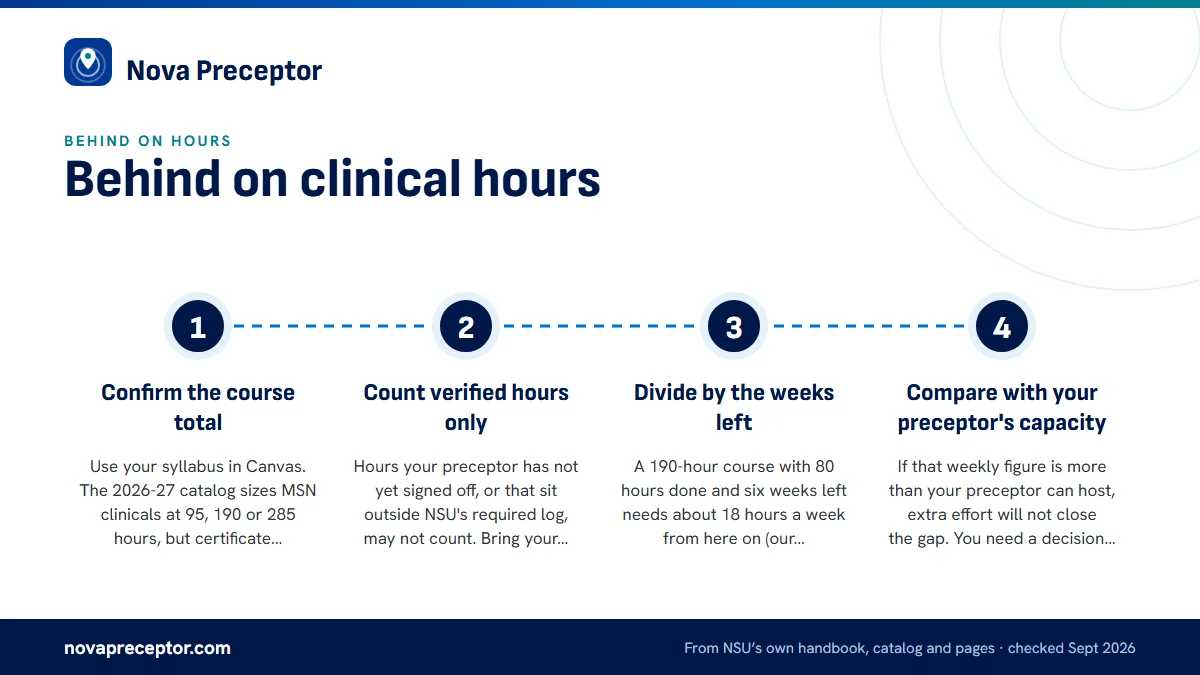
Before you talk to anyone, put numbers on the problem. You need three figures: the hours the course requires, the hours you have logged and verified, and the clinical weeks left.
- Confirm the course totalUse your syllabus in Canvas. The 2026-27 catalog sizes MSN clinicals at 95, 190 or 285 hours, but certificate students and earlier cohorts may carry 85, 170 or 255.
- Count verified hours onlyHours your preceptor has not yet signed off, or that sit outside NSU's required log, may not count. Bring your records up to date first.
- Divide by the weeks leftA 190-hour course with 80 hours done and six weeks left needs about 18 hours a week from here on (our arithmetic), well above the pace the course was built around.
- Compare with your preceptor's capacityIf that weekly figure is more than your preceptor can host, extra effort will not close the gap. You need a decision from NSU.
Making up missed time
Every absence has to be made up, whatever the reason. The handbook asks graduate students to warn the preceptor, the site and the program director two hours before a missed clinical; if that notice was never given for some of your missed days, tell your course faculty now rather than letting it surface later. The clinical absences guide has the full notice rule.
NSU's public documents do not spell out how make-up hours sit beside the no-compression rule. Ask your course faculty directly how many extra hours a week they will accept and whether make-up days need approval before you work them. Spreading the recovery across the remaining weeks keeps you closest to the weekly-attendance expectation. Log each make-up session the same day, with your preceptor's sign-off, so the recovery is visible to faculty.
When an incomplete is on the table
If the hours cannot be finished this term, an incomplete (I) may let you complete them afterward. NSU keeps it for unusual, urgent circumstances and sets these conditions:
- You are in passing status.
- At least 50 percent of the coursework is complete.
- In a clinical course, you have met attendance expectations, which is why steady weekly attendance matters even while you are behind.
- The rest is finished on a timeline agreed with your faculty member, no later than one semester after the course ends.
Your faculty member or program director decides, and on appeal the program director's word is final. Registering for the course again does not clear an incomplete. DNP students have one more rule: a student who cannot complete a course's practicum objectives re-registers for that course the next semester and pays all fees. Details are on the withdrawals and incompletes page.
What to discuss with course faculty and your coordinator
NSU's chain of communication runs from your course faculty member to your adviser, then your program director, then the dean of Academic Programs. Start with course faculty, and bring in your clinical coordinator whenever the answer involves your preceptor or site. Go with your numbers and these questions:
- How far behind is too far for this course, and by what date must the hours be done?
- May I add clinic days with my current preceptor, and is there a weekly maximum?
- Could a second preceptor or site add hours, and what would the coordinator need to approve it?
- Would I qualify for an incomplete if the hours run past the term?
- How would a late finish affect the start of my next clinical course?
Ask for the answers in a SharkMail reply so you have them in writing.
Adding clinic days or a second site
The simplest fix is more time with the preceptor you already have: an extra half-day a week, or a longer clinic day, if their schedule allows. Raise it early in the conversation, because the answer decides whether you need a second option at all.
A second site is less certain. NSU does not publish how many preceptors or sites a course may use, or whether a course's hours may be split between them, so ask your coordinator before approaching anyone. If the answer is yes, a second preceptor goes through the same review as the first: NSU's supervision requirements, a setting that fits the course and, at a Florida site, a Florida license.
Work no hours at a new site before your clinical coordinator approves it. NSU's coordinators approve every clinical site and preceptor.
How we help you catch up
When NSU agrees to extra hours at a second site, speed decides whether the term can be saved. Your placement advisor looks near your home for a preceptor in your course's setting who has room for you in the weeks left, confirms their license and weekly capacity, and prepares the details your coordinator reviews so the approval can move quickly.
We also look ahead. A term that ends late shifts the dates for your next course, so we check that the next preceptor is still on track for its two-semester notice and still has room for you when that course begins. Tell us the course, your hours logged, the weeks left and the days you can add through the placement form.
Questions NSU students ask
Can I make up NSU clinical hours in the last week of the semester?
Not as a catch-all. The handbook bars compressing clinical hours at the beginning or end of the semester, so piling the shortfall into the final week runs against the rule. Spread make-up time over the weeks you have left and ask your course faculty how much extra time per week they will accept.
Can I get an incomplete for unfinished clinical hours?
Possibly. NSU's conditions are passing status, at least half the coursework done and, for a clinical course, met attendance expectations. The remaining hours must be finished within one semester of the course's end, and your faculty member or program director makes the decision. Ask early, before the final weeks, while you still meet the conditions.
Will being behind on hours make me fail the course?
Not automatically, but it can. Clinical courses are graded on completing the clinical objectives and submitting clinical paperwork, and the MSN passing grade is 80 points (B-) with no rounding. A failed course brings academic probation and a Committee on Student Progress referral, so raise a shortfall with your course faculty early.
Can I split my remaining hours across two preceptors?
NSU does not publish whether a course's hours may be split between preceptors or sites. Ask your clinical coordinator before you approach a second preceptor. If it is allowed, the new preceptor and site need the coordinator's approval like the first, and at a Florida site the preceptor must hold a Florida license.
Is there a maximum number of clinical hours per week?
NSU's public documents set no weekly maximum. The practical limits are your preceptor's schedule, the site's own rules and the no-compression rule, which targets hours bunched at either end of the term. Ask your course faculty what weekly pace they will accept while you recover, and get the answer in writing.
Related pages
Last checked 2026-09-25
We check these pages against NSU's own handbook, catalog and program pages. The graduate clinical guide, your course in Canvas, your clinical coordinator and your program director have the final word.
NSU lets you name your own preceptor. We make sure you have one, close to home and in time.
Tell us your NSU program, your home ZIP area and when your next clinical course starts. We find preceptors who fit the course and have everything ready for your clinical coordinator well before the two-semester notice.
- Preceptors matched to the course: primary care for FNP, acute care for AGACNP, psychiatric care for PMHNP, a practice site for DNP project hours
- Named early enough for NSU's two-semester notice, with license, credentials and site details ready for the coordinator
- Close to your home ZIP code, with clinic days we plan around your work schedule
Start your placement plan
Program, ZIP area and start term is all we need to begin.