Entering NSU's MSN APRN with a non-nursing bachelor's: the NSG 5000B bridge
If you are a registered nurse whose bachelor's degree is in another field, NSU's way into the MSN APRN is NSG 5000B Transition to Advanced Nursing Practice, a six-credit course offered only in the fall term. It adds credits to whichever track you choose and ties your start to a fall, which shifts the calendar for your first preceptor. Here is what NSU publishes about the bridge, what it leaves unsaid, and how to plan the two-semester notice around it.
Plan ahead from the bridge
Tell us your track and start term, and your placement advisor begins your first preceptor search while you are in NSG 5000B.
NSG 5000B, added on top of your track's 45 or 48NSG 5000B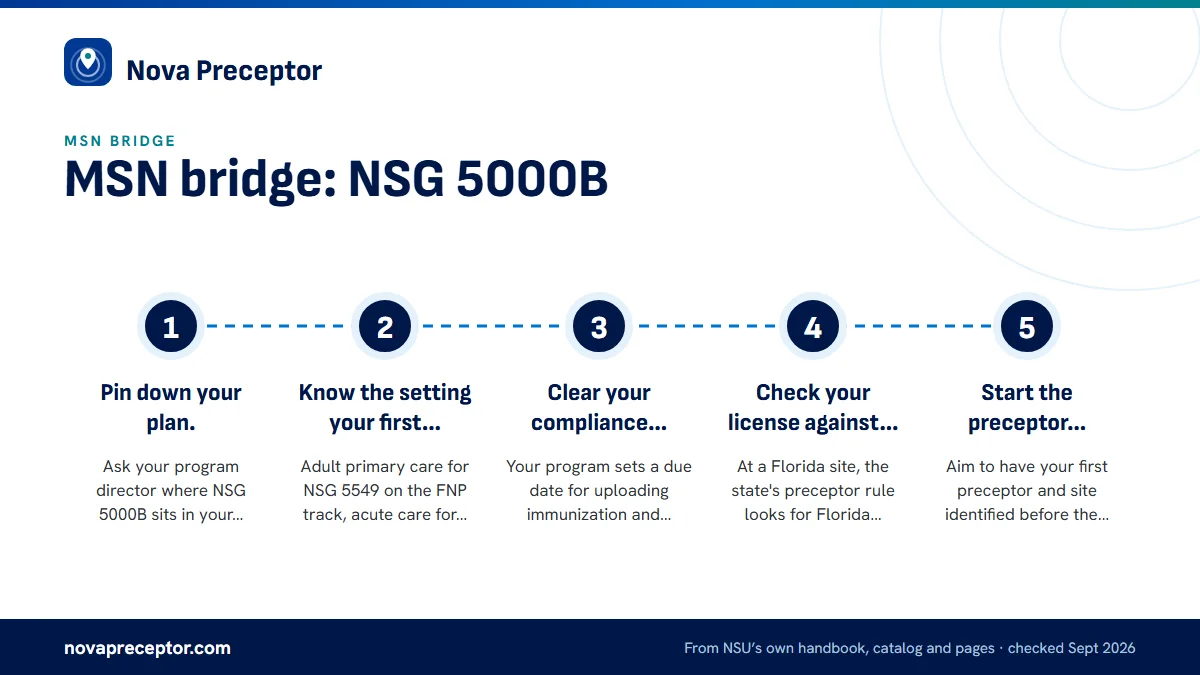
Who takes NSG 5000B
NSU's FNP, AGACNP and PMHNP pages each list NSG 5000B Transition to Advanced Nursing Practice as a bridge course for RNs whose bachelor's degree is in a field other than nursing. NSU's admissions page and newest catalog set the entry terms for this group: a 3.0 GPA plus the bridge course. Everything else on the MSN admission list still applies.
What bridge applicants still need
- An RN license: unrestricted and from any state for FNP and PMHNP under the 2026-27 catalog, a Florida license for AGACNP, and current in the jurisdiction of the practicum for the whole program.
- Twelve months of active independent clinical practice, which NSU says excludes position residencies and facility operations roles, and a current year or more of hands-on patient care.
- A CV, an interview with the program director and, for the acute-care track, current ACLS certification.
The license line is the one to read twice. Under the 2025-26 handbook and catalog, all three APRN tracks needed Florida licensure; the 2026-27 catalog keeps that rule for AGACNP alone. If you live outside Florida, confirm with admissions which rule covers your entering class before you plan clinicals around it.
What the bridge adds to your program
The bridge sits on top of your track, not inside it. NSU's track totals (45 credits for family or acute care, 48 for psychiatric) leave NSG 5000B out, so a bridge student's plan comes to 51 or 54 credits by our arithmetic. Your tuition and financial aid questions follow from that larger total, so raise them with NSU's Office of Financial Aid early.
The MSN's structure applies from your first term. You must stay enrolled in a graduate course every term, and NSU describes the curriculum as lock-step. For finishing, the handbook allows 11 semesters or one and a half times the program's normal length, while the 2026-27 catalog mentions only the time-and-a-half limit. Whether the bridge term uses up part of that allowance is not stated, so ask your program director.
None of this changes the clinical side of the degree. Once you are in your track, you follow the same clinical courses, hour totals and preceptor rules as every other MSN APRN student.
Fall only: what it does to your start
The MSN APRN takes new students twice a year, in fall and winter. The 2026-27 catalog adds that NSG 5000B is "only offered in the fall term," which in practice points a bridge student toward a fall start. NSU does not publish how a winter admit with a non-nursing bachelor's would be scheduled, so if winter is your target, ask admissions before you apply.
NSU's program pages give August 1 as the fall application deadline. Build backward from it: transcripts, the CV, the interview and license verification all take time, and because the bridge runs only in fall, missing that deadline means waiting for the next fall.
The fall start then sets everything that follows. With three semesters a year (fall, winter and summer), your semester numbering, your first clinical course and your first preceptor notice all count forward from the fall you begin. NSU's semesters and start terms explains the calendar.
How the bridge moves your first clinical
NSU prints NSG 5000B as a separate bridge row beside each track's plan and does not say whether it takes its own semester before semester I or runs alongside it. That one detail decides your preceptor calendar, so settle it with your program director first.
| Track | First clinical | Full-time: runs in | Full-time: notice by start of | Flex: runs in | Flex: notice by start of |
|---|---|---|---|---|---|
| FNP | NSG 5549 | III | I | V | III |
| AGACNP | NSG 5629 | III | I | V | III |
| PMHNP | NSG 5719 | III | I | VI | IV |
- If the bridge is its own fall semester, your track's semester I starts the term after it. On the full-time plan your first clinical then lands in your fourth term at NSU, and the first two-semester notice falls at about the start of track semester I, right as the bridge ends.
- If the bridge runs alongside semester I, your clinical timing matches every other student's, and full-time students owe the first clinical's notice at about the moment the bridge begins.
Either way, the flex plan gives a bridge student the most breathing room: two track semesters (three for PMHNP) pass before the first notice is due. The two-semester deadline guide turns these counts into terms, and full-time versus flex weighs the two plans.
A bridge student on the full-time plan can owe the first preceptor notice within a semester of arriving at NSU. Find out where NSG 5000B sits in your plan before classes begin.
Using the bridge term to get ahead
Whichever way your plan runs, the months around the bridge are the time for clinical groundwork, before course deadlines start to stack up.
- Pin down your plan. Ask your program director where
NSG 5000Bsits in your sequence and confirm full-time or flex, then ask your clinical coordinator for the date and method of your first notice. - Know the setting your first clinical needs. Adult primary care for
NSG 5549on the FNP track, acute care forNSG 5629on the AGACNP track, psychiatric care forNSG 5719on the PMHNP track. - Clear your compliance early. Your program sets a due date for uploading immunization and physical exam records to DISA CastleBranch. Hepatitis B alone needs three doses and a positive titer, TB screening and flu shots repeat every year, and some sites refuse the QuantiFERON blood test, so ask before you choose a TB method; CastleBranch at NSU has the full list.
- Check your license against your site. At a Florida site, the state's preceptor rule looks for Florida licensure on both sides: yours as an RN under chapter 464, and your preceptor's. If you live elsewhere, confirm how NSU's practicum-jurisdiction wording applies to you.
- Start the preceptor search. Aim to have your first preceptor and site identified before the notice point, someone who can take you every week starting in week one of the course, with a visit to meet them before hour one.
Why bridge students choose us
The bridge can leave very little time between admission and your first preceptor notice, and early planning is what we do best. Your placement advisor starts while you are still in NSG 5000B: we locate a nearby preceptor whose practice matches your first clinical course, confirm weekly availability for the whole term, and have the preceptor's license, credentials and site details ready before the notice point.
From there we plan the rest of your clinicals in NSU's order and keep your CastleBranch items current along the way, with a replacement lined up if a preceptor drops out. Your clinical coordinator makes the final call on every preceptor and site. What we control is the quality of what arrives on their desk: complete, accurate and matched to NSU's rules on the first submission. Tell us your track and plan in the form below.
Questions NSU students ask
Is NSG 5000B the same course as NSG 5000?
No. NSG 5000 Advanced Nurse Roles is a two-credit course in semester I of the shared core that every MSN APRN student takes. NSG 5000B Transition to Advanced Nursing Practice is the six-credit bridge for nurses who studied something other than nursing for their bachelor's. NSU's track plans list both, so bridge students take the pair.
Do I need a higher GPA to enter NSU's MSN with a non-nursing bachelor's?
NSU's standard admission accepts either a 3.0 GPA with 12 months of active independent clinical practice or a 2.75 with 24 months. For applicants whose bachelor's is outside nursing, the admissions page and the catalog state a 3.0 GPA plus NSG 5000B, and no 2.75 option is listed for them. Confirm your own case with admissions.
Does NSU still offer an RN to MSN program?
Not at present. NSU's master's index and the 2026-27 graduate catalog list only the three APRN tracks, and older RN to MSN web addresses return errors. The RN to BSN is missing from the current undergraduate catalog as well. A registered nurse with a bachelor's in another field enters the MSN APRN through NSG 5000B instead.
Does NSG 5000B include clinical hours?
NSU's track plans show no practicum hours for NSG 5000B. Your clinical hours come later, in the track's clinical courses: 855 for each MSN track under the 2026-27 catalog, by our sum of the per-course figures. That is why the preceptor question starts with your first clinical course rather than with the bridge.
Is there a bridge like this for NSU's DNP?
Yes, a separate one. The post-master's DNP lists NSG 7299 Transition to D.N.P., six credits and also fall only, for applicants whose master's degree is in a related field rather than nursing. It leads into the DNP project courses, which carry their own practicum hours, so it is a different path from the MSN bridge.
Related pages
Last checked 2026-09-24
We check these pages against NSU's own handbook, catalog and program pages. The graduate clinical guide, your course in Canvas, your clinical coordinator and your program director have the final word.
NSU lets you name your own preceptor. We make sure you have one, close to home and in time.
Tell us your NSU program, your home ZIP area and when your next clinical course starts. We find preceptors who fit the course and have everything ready for your clinical coordinator well before the two-semester notice.
- Preceptors matched to the course: primary care for FNP, acute care for AGACNP, psychiatric care for PMHNP, a practice site for DNP project hours
- Named early enough for NSU's two-semester notice, with license, credentials and site details ready for the coordinator
- Close to your home ZIP code, with clinic days we plan around your work schedule
Start your placement plan
Program, ZIP area and start term is all we need to begin.