Health insurance for NSU nursing students in clinicals
NSU requires every student to carry health insurance and automatically charges enrolled students for its UnitedHealthcare Student Health Insurance Plan unless they waive it. Health-college students may not drop coverage while in the program, and any medical bill from clinical training is theirs alone. The plan you keep has to work where your rotations and intensives actually happen.
Train close to home and your network
Share your NSU program, ZIP area and next clinical term.
NSU's rule: every student carries coverage
The requirement is university-wide. NSU's bursar puts it this way: "NSU requires all students to maintain medical health insurance coverage. Once enrolled, students are automatically charged for the Student Health Insurance Plan." The carrier is UnitedHealthcare, and the plan NSU offers is a Choice Plus plan. The Student Health Insurance office sits within the Office of the University Bursar.
Automatic means the charge appears whether or not you meant to buy the plan. Students who already have coverage waive out online through the bursar's Student Health Insurance page, which carries the waiver steps and timing for each year. Missing that step is how students with perfectly good employer coverage end up billed for a second plan.
The health colleges then add rules of their own, covered below, and those rules require coverage from every student in them. If you study online, check the bursar's page for how the automatic charge applies to your enrollment; the requirement to be insured applies either way.
Waiving the student plan
Many nursing students arrive with coverage through an employer, a spouse or a marketplace plan, and that is the usual reason to waive. The waiver is completed online, and the bursar's page is the authority on what it asks for and when it closes, so check it at the start of each academic year rather than relying on last year's experience.
A waiver is not the end of the obligation. The health colleges' rule that you may not drop coverage while in the program still applies, so the coverage you waived with has to stay in force. Nurses change jobs during graduate school, and a new employer's plan can start weeks after the old one ends.
If your outside coverage is about to lapse, contact the Office of the University Bursar about the student plan before the gap opens, not after a bill arrives. Keep your waiver confirmation and your current insurance card with your other clinical documents, since a site's onboarding may ask about coverage.
No dropping coverage, and clinical bills are yours
The college-level policies for NSU's health colleges go further than the university rule (printed page 92): "All students are required to carry health insurance… Students may not drop insurance coverage while in the program. The student has the exclusive responsibility for any medical bills arising during the student's clinical training."
That last sentence is the one to plan around. An exposure, an injury or an illness that starts during clinical hours is billed to you and your insurer. ACON's own section repeats the point in practical terms: "Students must use this health insurance for any needs during clinical/class times" (printed page 113).
If you do clinical hours at the facility where you work, keep student hours and paid hours clearly separate in your own records. The handbook treats bills from clinical training as the student's responsibility, and our page on clinicals at your employer covers the other questions a workplace site raises.
Any medical bill that arises during your clinical training is your responsibility, so your coverage must work at the site.
Coverage outside Florida, and inside it
The same handbook page carries a specific warning. Students whose coverage comes from "states other than Florida" are told to "check with their carriers to be sure they have comprehensive healthcare coverage in the region of Florida where they will be attending classes or practicum rotations." Some plans built around one state's network treat care elsewhere as out of network, and a student can learn that only when the first bill arrives.
Online students face the question in two directions. Under NSU's 2026-27 catalog, FNP and PMHNP applicants may be licensed as RNs in any state, while the MSN tracks still bring you to Florida for on-campus intensives at Palm Beach or Tampa Bay. A student living outside Florida may need a plan that works at home, at the practicum site and during the intensive days.
Ask your carrier specific questions: is urgent care covered in the county of my clinical site, and in Palm Beach or Hillsborough County during an intensive? Get the answer in writing if you can. Our page on clinicals outside Florida covers the license and residence side of studying from another state.
Where NSU students get care
NSU's Student Medical Center is in the Dr. Sanford L. Ziff Health Care Center in Fort Lauderdale. Students on regional campuses use an "NSU-designated physician for their area," according to the handbook, so ask your program which physician serves your region before you need one.
For clinical days, plan closer to the site. Before your first day, look up the urgent care center and emergency department nearest the site that your plan covers, and save the address on your phone with your insurance card photo. If an exposure happens, the site will have its own immediate steps; your insurance handles what follows.
The same planning helps with compliance. Physical exams and immunization records have to reach DISA CastleBranch by your program's due date, and knowing which in-network clinic can do a titer or a TB test quickly saves time when a renewal comes due.
A coverage check before each clinical semester
Coverage problems tend to surface at the worst moment: an exposure on a Tuesday afternoon at a site two counties from home. A few minutes of checking before each clinical semester heads off the common ones. Run through this list whenever a new clinical course, a new site or a new job is about to begin.
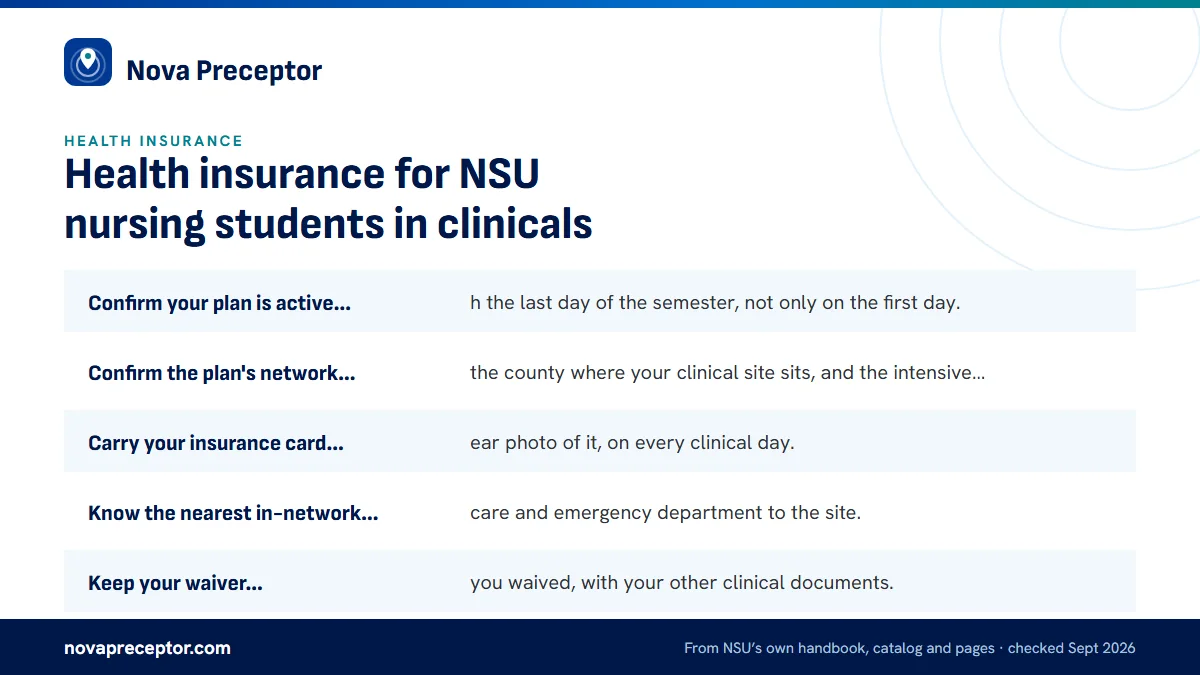
- Confirm your plan is active through the last day of the semester, not only on the first day.
- Confirm the plan's network covers the county where your clinical site sits, and the intensive campus if you travel to one.
- Carry your insurance card, or a clear photo of it, on every clinical day.
- Know the nearest in-network urgent care and emergency department to the site.
- Keep your waiver confirmation, if you waived, with your other clinical documents.
- Tell the Office of the University Bursar before any change in coverage, not after.
Why NSU students plan clinicals with us
A preceptor near your home ZIP code is easier on your schedule, and it is usually easier on your insurance too, because the site sits inside the area your plan already serves. We find preceptors close to where you live, in the setting your NSU course needs, and name them early enough for the two-semester notice. Fewer miles on clinical days also means less time on the road between work, home and the site.
Along with the preceptor, you get the site's onboarding list, so coverage questions, immunizations and clearances are settled months before the first clinical day. The coordinator receives complete credentials and site details, and should a preceptor drop out, your placement advisor lines up the next one. Our how it works page lays out the steps; to begin, enter your program and home ZIP area below.
Questions NSU students ask
Can I waive NSU's student health insurance?
Yes. NSU automatically charges enrolled students for the UnitedHealthcare Student Health Insurance Plan, and students with other coverage waive out online through the bursar's Student Health Insurance page. That page sets the waiver steps and timing each year. Keep your confirmation, and remember that the coverage you waive with must stay in force for the whole program.
Who pays if I am hurt or exposed at a clinical site?
You and your insurer. The college-level policies for NSU's health colleges give the student exclusive responsibility for any medical bills arising during clinical training, and ACON tells students to use their health insurance for needs during clinical and class times. Check before your first day that your plan covers care near the site.
I live outside Florida. Will my insurance work for NSU clinicals?
Check with your carrier. The handbook warns students with coverage from other states to confirm comprehensive coverage in the part of Florida where they attend classes or rotations. Online MSN students may also need coverage at an out-of-state practicum site and during intensive days at Palm Beach or Tampa Bay, so ask about each location.
Can I drop my health insurance after my clinical courses end?
No. The health colleges' rule says students may not drop insurance coverage while in the program, and the program runs until you graduate, not until your last clinical hour. NSU's university-wide rule also requires every student to maintain coverage. If your coverage is about to change, talk to the bursar's Student Health Insurance office first.
Related pages
Last checked 2026-09-25
We check these pages against NSU's own handbook, catalog and program pages. The graduate clinical guide, your course in Canvas, your clinical coordinator and your program director have the final word.
- NSU Office of the University Bursar: Student Health Insurance
- NSU Nursing Student Handbook 2025-2026, printed p. 92 (health colleges insurance rule)
- NSU Nursing Student Handbook 2025-2026, printed p. 113 (ACON insurance use)
- NSU Nursing Student Handbook 2025-2026, printed p. 66 (Student Medical Center)
NSU lets you name your own preceptor. We make sure you have one, close to home and in time.
Tell us your NSU program, your home ZIP area and when your next clinical course starts. We find preceptors who fit the course and have everything ready for your clinical coordinator well before the two-semester notice.
- Preceptors matched to the course: primary care for FNP, acute care for AGACNP, psychiatric care for PMHNP, a practice site for DNP project hours
- Named early enough for NSU's two-semester notice, with license, credentials and site details ready for the coordinator
- Close to your home ZIP code, with clinic days we plan around your work schedule
Start your placement plan
Program, ZIP area and start term is all we need to begin.